Blog
Enterprise AI Strategy: How to Turn AI Investment Into Business Value
Build an enterprise AI strategy that connects AI investments to business priorities, measurable outcomes, adoption, and long-term value.
September 16, 2026
Written by

Introduction
AI has made its way into almost every enterprise conversation. But once the excitement settles, a harder question comes up: Where should we actually invest?
Should you scale the pilot that is already showing promise? Build an AI assistant for employees? Automate a process that has been slowing teams down for years? Or step back and fix the data and systems that make all of those ideas harder to deliver?
For many organizations, the challenge is no longer a lack of AI ideas. It is having too many of them. Pilots, copilots, automation projects, and experiments can quickly spread across departments, creating duplicated spending, fragmented data, unclear ownership, and teams that are tired of yet another initiative.
At Clarient, we often hear this question: How do you move from doing more with AI to investing in the AI initiatives that actually matter? That starts with having a clear enterprise AI strategy.
A strong strategy connects business priorities with the right AI opportunities, investment decisions, execution, adoption, and measurable outcomes. It is not about using AI everywhere. It is about knowing where AI can make a meaningful difference, what needs to change to make it work, and when an initiative is no longer worth pursuing.
So, what does that look like in practice? Let’s break it down.
What an Enterprise AI Strategy Should Actually Do
An AI strategy answers where and why an organization should use AI. An implementation strategy answers how those decisions will be executed. An enterprise AI roadmap determines when initiatives should happen and in what sequence.
Keeping these separate matters. Without it, leaders can end up approving technologies before deciding what business problem they are meant to solve. A useful strategy connects five decisions:
| Decision | Key question |
| Business outcome | What needs to improve? |
| AI opportunity | Where can AI help? |
| Investment | What deserves funding? |
| Execution | What needs to change to make it work? |
| Measurement | How will we prove value? |
This turns corporate AI strategy from a technology exercise into an investment discipline.

Start With the Business Problem, Not the AI Use Case
One of the most common mistakes we see is starting with the technology. A team discovers an impressive AI capability and then searches for a place to use it.
The better starting point is the opposite: What business problem is important enough to justify changing how people work?
Start by identifying outcomes such as revenue growth, lower operating costs, better customer experience, faster decisions, reduced risk, or greater organizational capacity. Then look for processes where AI could materially influence those outcomes.
Good opportunities often sit inside work that is repetitive, data-heavy, slowed by manual handoffs, difficult to scale, or dependent on people searching across disconnected systems.
This shift matters because AI is not automatically the right answer. Sometimes the better investment is process redesign, system integration, better data, or simpler automation. A practical opportunity filter looks like this:
| Look for | Why it matters |
| Repetitive work | Creates potential for automation |
| Manual handoffs | Reveals workflow friction |
| Fragmented information | Creates opportunities for better decision support |
| High error rates | Creates measurable improvement potential |
| Capacity constraints | Shows where AI could extend teams |
| Slow decisions | Creates a case for faster access to information |
The people doing the work should be part of this assessment. They often know where the process actually breaks, which is not always visible in a process map.
Prioritize AI Initiatives Like an Investment Portfolio
Finding opportunities is easy. Deciding which ones deserve money is harder.
A strong enterprise AI strategy treats use cases as a portfolio, not a collection of exciting projects. Assess each initiative against business impact, feasibility, readiness, risk, and time to value.
| Criterion | Question to ask |
| Business impact | Will this materially improve an important outcome? |
| Feasibility | Can we realistically deliver it? |
| Readiness | Are the data, systems, and skills available? |
| Risk | What could go wrong, and can we control it? |
| Time to value | How quickly can we test the business case? |
Then add a sixth question that is often overlooked:
Can this become a repeatable capability?
An initiative may deliver a useful result once but still be a poor enterprise investment if it cannot scale beyond one team or workflow.
This is also where leaders need to feel comfortable saying no, not yet, or not this way. Not every idea deserves more budget, more people, or more time. If the business case is weak, the data is not ready, teams are building the same thing twice, or the risks outweigh the value, it may be better to stop or pause. The goal is not to run more AI initiatives. It is to build a portfolio of the right ones. That could mean four types of initiatives:
- Near-term value initiatives that solve clear business problems
- Strategic investments that build capabilities the enterprise will need
- Foundational work such as data, integration, security, and governance
- Controlled experiments where the potential is promising but uncertain
The mix will vary by organization. The important part is making the tradeoffs explicit.
Build the Conditions for AI to Work at Scale
A strong use case can still fail when the organization around it is not ready. Technology is only one part of the equation. Before scaling, assess four areas.
Data and technology
AI initiatives depend on the quality and accessibility of the information behind them. Review data quality, integration points, security, architecture, and existing platforms before committing to scale.
Ownership
Every major initiative needs a business owner accountable for the outcome. IT and AI teams can own delivery, but they should not be left responsible for proving business value alone.
People and workflows
This is where AI programs often underestimate what it takes to make change stick. Giving people a new tool does not mean they will automatically change how they work. They need to see where it actually helps, understand what changes in their day-to-day work, and know when they should rely on AI and when their own judgment matters more.
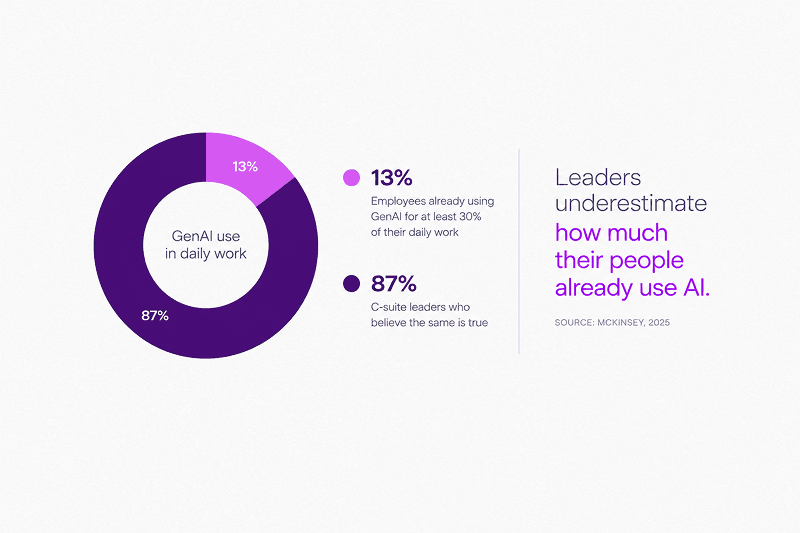
There is also a good chance your employees are already experimenting with AI in ways leadership may not see. McKinsey’s 2025 research found that 13% of employees said they were already using generative AI for at least 30% of their daily work, while C-suite leaders estimated that only 4% of employees were doing so.
We recommend treating workflow change as part of the AI initiative itself, not as a separate change-management task added at the end.
Build an AI Roadmap Around What Your Teams Can Actually Deliver
A roadmap can look impressive on paper and still fall apart when execution begins.
Q1: Launch chatbot
Q2: Deploy copilot
Q3: Build agent
The problem is not the format. It is that this kind of roadmap focuses on what gets launched, without showing why it should happen now, what needs to happen first, or whether the organization is ready to support it.
A useful enterprise AI roadmap should make it easier to see what is worth doing, what needs to be tested, and what is ready to move forward. Every initiative should have a clear reason for being there and a clear path to creating value:
Prioritize → Validate → Scale → Optimize
Start with the opportunities that matter most to the business and the people doing the work. Test them in a focused way before putting significant time, money, and resources behind them. If they show real value and the right foundations are in place, scale them. Then keep learning and improving as people use them in the real world.
For every initiative, make the important decisions visible:
| What to define | Why it matters |
| Expected outcome | Clarifies what the initiative is supposed to change |
| Dependencies | Shows what needs to be ready first |
| Investment | Makes the cost and resource commitment clear |
| Owner | Gives someone accountability for the outcome |
| Risks | Surfaces potential problems before they become blockers |
| Success measures | Establishes how you will know whether it worked |
Your Roadmap Should Reflect Your People, Not Just Your Priorities
Even the strongest AI strategy can struggle when too much is asked of the organization at once.
Imagine three high-priority initiatives all depend on the same data team. Putting all three on the roadmap for the same quarter does not make the strategy more ambitious. It creates a bottleneck that can slow everything down.
The same applies to employees. If teams are already adapting to new systems, adding several AI-enabled workflows at once can create confusion rather than adoption. A realistic roadmap accounts for the time people need to learn, adapt, give feedback, and build confidence in new ways of working.
Measure AI by What Changes, Not What Gets Deployed
Launching an AI tool can feel like a big win, but it is really just the beginning. The more important question is: what is actually better now? Are people finding it useful? Is it making their work easier or faster? Is the business seeing a real improvement because of it? Start there. The point is not to show that you launched AI. It is to show that AI made a difference.
Start with a baseline before implementation. Then measure whether the workflow actually changed.
| Measurement layer | Examples |
| Adoption | Active usage, repeat usage, workflow adoption |
| Operations | Cycle time, error rate, manual effort, service levels |
| Business | Revenue, margin, retention, risk, time to market |
| Investment | Expected versus realized value, cost per initiative |
The important question is whether the chosen metric reflects the original business case. A useful rule is simple: define the measure before deployment, not after the results arrive.
The Questions Leaders Should Ask Before Funding an AI Initiative
What specific business metric are we trying to move, and what is the current baseline?
If the answer is simply “improve productivity” or “use AI,” the business case is not specific enough. Define the outcome you expect to change, whether that is cycle time, cost per transaction, conversion, service levels, revenue, risk exposure, or something else.
Why does this problem need AI rather than a simpler solution?
Could process redesign, better integration, automation, or cleaner data solve the problem? AI should earn its place in the solution rather than become the solution by default.
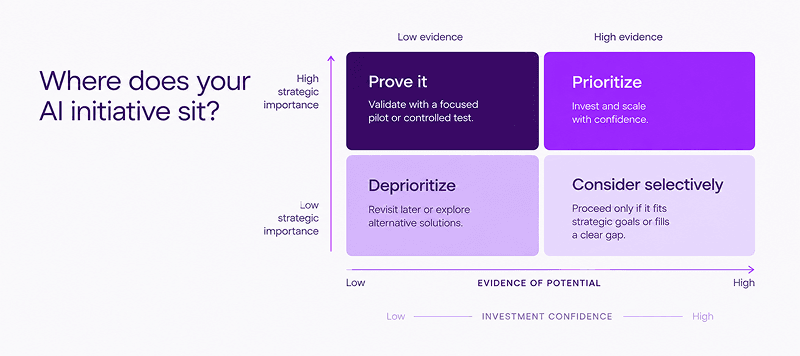
What evidence do we have that this will work in our environment?
A successful AI product elsewhere does not automatically translate into value for your organization. Look at your data quality, workflows, systems, users, constraints, and the evidence available from a controlled test.
What will change for the people doing this work?
Who will use the solution? Which decisions will they make differently? What work will disappear, change, or be added? If the initiative changes a workflow, adoption cannot be treated as an afterthought.
What has to be true before we can scale it?
Define the data, integration, security, governance, skills, and operational conditions required for scale before the pilot begins.
What result would make us stop?
Every initiative should have a clear threshold for scaling, changing direction, or stopping. Without one, pilots can continue simply because nobody wants to call them unsuccessful.
At Clarient, we see this as one of the most important shifts in enterprise AI planning: move the conversation from “Can we build it?” to “Is it worth building, and what would prove it?” That distinction helps leaders protect investment from AI experimentation that looks busy but does not move the business forward.
Enterprise AI Strategy Mistakes That Can Cost More Than the Technology
AI programs can gain momentum without creating much value. Often, the problem is not the technology. It is how initiatives are chosen, funded, introduced, and scaled.
Starting With the Technology
It is easy to see an impressive AI capability and start looking for problems it could solve. But AI is not always the answer. Sometimes what you really need is better data, stronger integration, a redesigned process, or simpler automation. Start with what is slowing the business down, then decide whether AI is the right way to fix it.
Measuring Usage Instead of Change
Getting people to try an AI tool is not the same as making their work better. Someone can use a tool every day and still spend just as much time getting the job done. Instead of asking “How many people are using it?”, ask “What is different for them now?” Look at how the work has changed, whether the experience has improved, and whether that improvement is actually helping the business.
Leaving People Out of the Plan
People do not automatically adopt a new AI-enabled workflow just because the technology works. They need to understand what is changing and how it will help them do their work better. PwC’s 2025 workforce survey found that only 51% of non-managers said they had the resources they needed for learning and development, compared with 72% of senior executives. That gap matters. Give people a voice in the change, not just a new tool to use. Adoption should be part of the initiative from the beginning, not something added after deployment.
Spreading Investment Too Thinly
It’s easy to end up with too many initiatives competing for the same people, budget, and attention. Instead of trying to do everything at once, focus on the opportunities with the strongest business case and give them the support they need to succeed. For the ideas that are still uncertain, keep them small and treat them as experiments.
Conclusion: Enterprise AI Strategy That Helps Your Business Move Forward
An enterprise AI strategy should do more than organize your AI initiatives. It should help you answer the questions that matter when real money, people, and business priorities are on the line: Where should we invest? What needs to change? What should we scale? And when should we stop?
AI will keep evolving, but the basics of strong strategy remain grounded in the business. The right approach connects AI investments to your workflows and drives measurable outcomes.
At Clarient, we help organizations move from scattered AI experimentation to a more focused approach, identifying the opportunities worth pursuing, building the foundations needed to scale them, and creating a roadmap that can adapt as the business changes.
Planning your next AI investment? Consult Clarient to build an enterprise AI strategy focused on the outcomes that matter to your business.
Frequently Asked Questions
1. How long does it take to develop an enterprise AI strategy?
There is no fixed timeline. The time needed depends on the size of the organization, the number of business areas involved, the maturity of its data and technology, and how many AI opportunities need to be assessed. A focused enterprise AI strategy can take a few weeks, while a broader strategy covering multiple functions, governance, investment priorities, and an enterprise AI roadmap may take several months.
The goal should not be to produce a strategy document as quickly as possible. A useful strategy gives leaders enough evidence to decide where AI can create value, what needs to change, and which initiatives should move forward. The process should also leave room to test assumptions and adjust priorities as new evidence emerges.
2. How often should an enterprise AI strategy be reviewed?
An enterprise AI strategy should be reviewed regularly, with a deeper review at least annually. Major changes in business priorities, regulation, technology, data readiness, or AI performance may call for an earlier review.
The strategy should not be treated as a document that is created once and left unchanged. Regular reviews help organizations stop low-value initiatives, update the enterprise AI roadmap, and redirect investment toward opportunities that have become more valuable.
3. What budget should a company set for an enterprise AI strategy?
There is no universal budget. Investment should be based on the business problems being addressed, expected value, technical readiness, risk, and the cost of implementation and ongoing operations.
A good approach is to fund AI as a portfolio, balancing near-term opportunities with foundational investments in data, integration, governance, and skills.
4. Can a company build an enterprise AI strategy without an in-house AI team?
Yes. A company can create an effective corporate AI strategy without having a large internal AI team. Business leaders, IT teams, data specialists, and process owners can define priorities while external expertise fills specific strategy or technical gaps.
What matters most is having clear internal ownership. External support can help with assessment, prioritization, and the AI implementation strategy, but business leaders still need to own the outcomes.
5. When should a company bring in an AI strategy consultant?
Consider an AI strategy consultant when the organization has many competing AI opportunities, lacks the internal expertise to assess them, or needs an independent view of investment priorities.
External support can also help when leaders are unsure how to choose the best AI strategy for a company, need to build an enterprise AI strategy framework, or want to connect AI investments to broader business transformation.
6. What are the signs that an enterprise AI strategy needs to change?
Common signs include stalled pilots, low employee adoption, duplicated AI investments, unclear ownership, rising costs, weak business results, or a roadmap that no longer reflects business priorities.
A strategy may also need to change when new technology or regulation significantly alters what is feasible or valuable.
7. How is AI being used in enterprise?
AI is being used across areas such as customer service, software development, employee support, document processing, forecasting, fraud detection, knowledge management, and decision support.
The strongest AI strategies for business transformation focus less on how many AI tools are deployed and more on whether they improve meaningful business outcomes.
8. What are examples of enterprise AI?
Examples include AI-powered customer service, predictive maintenance, intelligent document processing, enterprise knowledge assistants, software development copilots, demand forecasting, fraud detection, and workflow automation.
These applications can form part of an AI adoption strategy or a broader AI strategy for business, depending on the organization's priorities, readiness, and expected value.
9. How do you create an enterprise AI strategy?
Start with business outcomes rather than AI technologies. Identify high-value problems, assess AI opportunities against impact and feasibility, evaluate data and technology readiness, establish ownership and governance, and define how success will be measured.
From there, build an enterprise AI roadmap that sequences initiatives based on dependencies, organizational capacity, investment, risk, and time to value. This creates a practical AI strategy for business leaders, not a list of disconnected AI projects.
10. What is the difference between an enterprise AI strategy and an AI implementation strategy?
An enterprise AI strategy defines where and why AI should be used. An AI implementation strategy focuses on how those priorities will be delivered, including technology, people, workflows, governance, and execution.
Keeping the two connected but distinct helps organizations avoid choosing technologies before they have established the business case.
Written by

Parthsarathy Sharma
With 4+ years of experience across AI, UX, enterprise technology, and brand strategy, Parthsarathy brings a research-driven lens to digital experience content. His work focuses on turning emerging technology, customer experience, and business trends into clear, practical perspectives for readers.
Share
Are you seeking an exciting role that will challenge and inspire you?

GET IN TOUCH