Blog
7 Warning Signs Your Business Needs Generative AI Consulting Before It Costs You
See if your business needs generative AI consulting services by identifying seven warning signs, including AI risks & more stalled pilots.
July 31, 2026
Written by

Introduction
Every successful AI initiative looks very similar at the beginning. Leadership is aligned, the pilot seems promising, and everyone is excited about the possibilities. Early results suggest the investment is heading in the right direction.
It's only months later that the differences begin to emerge.
Some organizations scale those early wins into measurable business outcomes. Others find themselves stuck with pilots that never reach production. The difference rarely comes down to choosing a better AI model. More often, it comes down to recognizing organizational warning signs before they become expensive business problems.
This is something we have noticed repeatedly at Clarient while collaborating with industry partners. These are similar observations in independent research. For example, RAND Corporation found that more than 80% of AI projects fail.
The encouraging part is that these outcomes are rarely unpredictable. Long before an AI initiative or security and governance issues begin to surface, there are usually clear signals that something isn't working as intended.
In this article, we'll walk you through seven of the most common warning signs Clarient has noticed across the years. We'll also help you understand why they matter and show how addressing them early can make AI a sustainable business investment for your organization.
Why Organizations Miss These Warning Signs
AI is not ignored by most organizations. Rather, they are eager to move with it quickly. The main challenge, however, is that the early warning signs do not look like strategic problems and are often treated as isolated issues.
A pilot that never reaches production is treated as a project issue. Employees using ChatGPT without approval is an IT concern. Rising AI costs are viewed as a budgeting problem. Questions about compliance are handed over to legal. Each issue is addressed independently.
These aren't isolated challenges. In fact, they are connected symptoms of the same underlying issue. And that is, the organization isn't yet equipped to scale AI with safety and governance.
Most of our successful clients start by considering a broader view of AI. They recognize that lasting business value doesn't come from choosing the right model alone. It comes from strengthening governance, improving data readiness, establishing clear ownership, and preparing people and processes to work alongside AI.
Many of these challenges first become visible when organizations struggle to scale AI beyond the pilot stage. Long before risks begin to compound, there are usually clear signals that something needs attention.
The seven warning signs below can help you identify those signals early, understand what they reveal about your organization's AI readiness, and take action before small gaps turn into costly business problems.
Sign #1. Your AI Pilots Keep Stalling Before They Reach Production
Six months ago, your AI pilot was the talk of every leadership meeting. The demonstration was impressive, stakeholders were optimistic, and there was genuine excitement about what it could achieve. Today, it barely comes up.
If you've experienced this, you're not alone. It's one of the clearest signs that your organization may need more than another proof of concept.
The reality is that a successful pilot and a successful enterprise implementation are two very different things.
During a pilot, the data is carefully selected, the scope is controlled, and the people involved are highly engaged. But production environments are not that simple. There are inconsistencies that arise in data, business processes vary across teams, and new complexities that did not appear in the demos are introduced in legacy systems.
Research supports what many organizations are already experiencing. RAND found that AI projects fail at exceptionally high rates, largely because of organizational rather than technical challenges. MIT NANDA reached a similar conclusion, stating that most enterprise generative AI pilots never deliver measurable financial impact.
Instead of asking whether the pilot worked, ask:
- Can this solution fit naturally into existing workflows?
- Is our data reliable enough for production use?
- Who owns this initiative once it moves beyond the pilot stage?
- How will employees adopt and trust the new process?
- How will we measure business value a year from now?
Those conversations often determine whether AI becomes part of everyday operations or remains another forgotten experiment.
Remember:
| If you're seeing this... | It may actually mean... |
| The pilot impressed everyone but never scaled | Operational readiness wasn't planned early enough |
| Teams keep launching new proofs of concept | Root causes from previous pilots remain unresolved |
| Leadership enthusiasm fades after the demo | Business ownership and measurable outcomes weren't clearly defined |
| Technical performance is good, but adoption is poor | The workflow changed, but people weren't prepared for it |
Sign #2. Employees Are Already Using AI Tools Your IT Team Doesn't Know About
Here's a simple question: do you know every AI tool your employees are using today?
For most organizations, the honest answer is probably no.
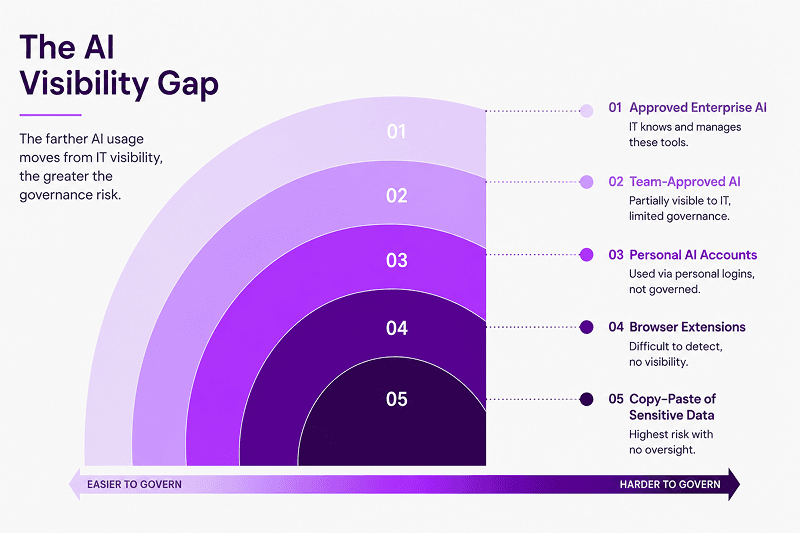
A marketing manager rewrites campaign copy using a personal AI account because it's quicker than waiting for an approved solution. A software developer installs an AI coding assistant that hasn't gone through security review, and so on.
None of these employees are trying to create risk. They're trying to do their jobs more efficiently. That's what makes shadow AI so difficult to address. It isn't usually driven by bad intentions. It's driven by productivity.
Recent research highlights how widespread this has become. Gartner reports that many cybersecurity leaders already suspect or have evidence of employees using prohibited generative AI tools. Netskope's Cloud and Threat Report 2026 found that nearly half of generative AI users still access AI services through personal, unmanaged accounts.
The instinctive response is often to block public AI tools altogether. But that is not the solution. Because employees who believe AI helps them work faster will always find a new way.
Sign #3. Nobody Can Tell You Where Your Sensitive Data Actually Goes
Most organizations already have policies for handling sensitive data. The challenge begins when generative AI becomes part of everyday work.
Think about how your teams use AI today. Now ask yourself one question:
If your leadership team asked where sensitive customer information has been shared through AI tools over the past six months, could anyone answer with confidence?
Most probably, you will answer no.
This isn't necessarily because security teams aren't doing their job. It's because AI adoption often happens faster than governance can keep up. Employees find new ways to work, departments adopt different tools, and before long, no one has a complete picture of where business data is flowing.
While working with organizations on AI adoption, Clarient has found that many leaders underestimate how widely AI is already being used across their business. Before introducing new policies, the priority should be gaining visibility into existing AI usage and data flows. IBM's Cost of a Data Breach Report supports the observation. It found that organizations affected by shadow AI incidents incurred breach costs that were, on average, $670,000 higher than those without AI-related exposure.
Questions worth asking include:
- Which AI tools are employees using today?
- What types of data are being shared with those tools?
- Which departments handle the most sensitive information?
- Do we know which AI applications have been formally approved?
Remember:
| If you can't answer this... | It usually means... |
| Which AI tools are employees using? | Shadow AI is already present. |
| What business data is shared with AI? | Sensitive information may be leaving approved environments. |
| Which teams use AI most frequently? | Governance decisions are being made without complete visibility. |
| Who approves new AI tools? | Accountability is unclear. |
Sign #4. You Don't Have a Plan for AI Regulation Wherever You Operate
If keeping up with AI regulations feels overwhelming, you're not alone.
Many organizations are delaying important AI decisions because they're waiting for the regulatory landscape to become clearer. The problem is that regulations will continue to evolve, and waiting rarely makes compliance easier. In many cases, it simply means more work later.
The bigger question isn't, "Have we read every new regulation?" It's, "Do we understand how AI is being used across our business today?"
Take the EU AI Act as an example. While the Digital Omnibus package adjusted timelines for some high-risk AI obligations, several requirements are already in effect. The deadlines may have shifted for certain provisions, but the responsibility to understand and govern your AI systems hasn't.
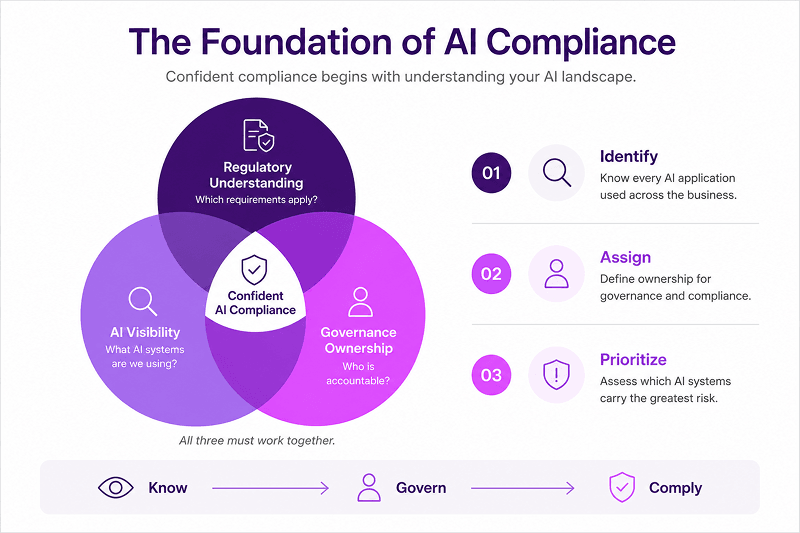
We've noticed that most of our clients often spend months trying to interpret new regulations before answering a much simpler question: Which AI systems are we actually using? Without that visibility, compliance becomes far more difficult. You can't classify, monitor, or govern systems you haven't identified.
Before worrying about the next regulatory update, ask yourself:
- Do we know which AI applications are being used across the organization?
- Is there clear ownership for AI governance and compliance?
- Have we assessed which AI systems carry the greatest risk?
- Could we confidently explain our AI governance approach if a customer, regulator, or auditor asked us to?
Sign #5. Your AI Costs Keep Climbing Without Clear Business Value
As AI becomes part of everyday business workflows, organizations quickly realize that the technology itself is only one part of the investment.
A pilot begins with a manageable budget. Then integration work expands. Infrastructure requirements grow. Security reviews take longer than expected. Employees need training. Governance frameworks have to be established. New workflows need to be designed. All these investments are necessary. And they often make AI far more expensive than organizations originally anticipated.
At Clarient, we've found that organizations rarely underestimate software costs. They underestimate organizational costs. Those hidden investments often include:
- Preparing enterprise data for AI.
- Integrating AI with existing business systems.
- Training employees and managers.
- Managing governance and compliance.
- Measuring long-term business outcomes.
- Continuously improving AI-enabled workflows.
Where AI Budgets Usually Expand
| Initial expectation | What organizations often discover |
| Buying an AI platform is the largest expense | Integration and organizational change often cost more over time |
| Pilots are inexpensive | Scaling them requires additional investment across multiple teams |
| Existing employees will naturally adopt AI | Adoption requires training, communication, and process redesign |
| AI produces value immediately | Business value often depends on operational maturity rather than deployment speed |
Sign #6. No One Owns AI Governance, and Leadership Sponsorship Is Fading
One question often reveals more about an organization's AI maturity than any technology assessment: Who ultimately owns AI?
If the answer isn't immediately clear, that's usually a warning sign.

We've also found that many organizations begin their AI journey with ambitious goals but unclear accountability. This slows down the progress. Decisions take longer, priorities begin to compete, and AI initiatives gradually lose momentum.
It's not just something we've seen while working with clients. RAND found that the leading causes of AI project failure are overwhelmingly organizational rather than technical.
Organizations that consistently succeed with AI treat governance as an ongoing process. That means assigning clear ownership for:
- Defining business outcomes and success metrics.
- Establishing AI governance policies.
- Managing AI-related risks and compliance.
- Driving employee adoption and change management.
- Reviewing and improving AI initiatives over time.
Sign #7. You're Betting Everything on One AI Vendor or Model
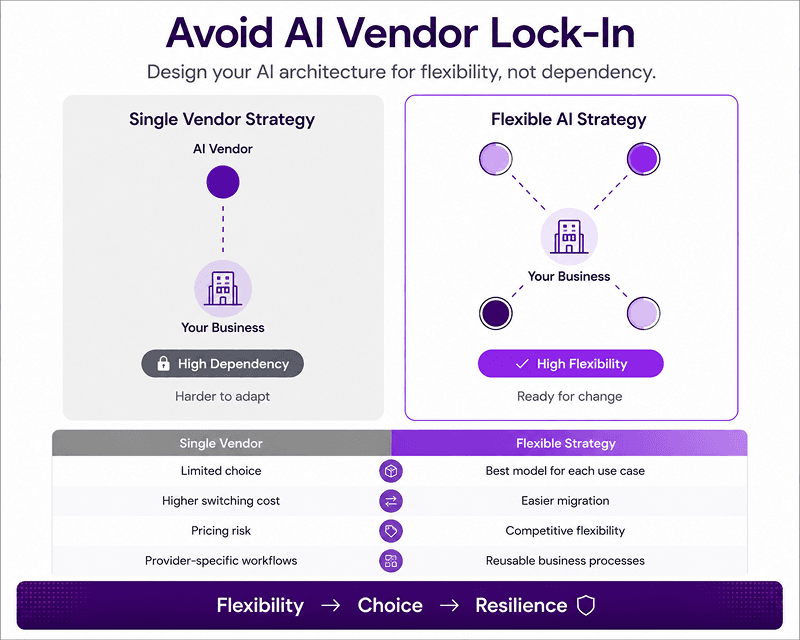
Choosing a single AI platform isn't necessarily a problem. Building your entire AI strategy around that platform without considering alternatives often is.
As organizations move quickly to adopt AI, it's easy for critical workflows, applications, and business processes to become deeply tied to a single provider. That may solve today's challenges, but it can make tomorrow's decisions far more difficult.
AI capabilities will continue to improve, pricing models will change, and new providers will enter the market regularly. It's important to remember that what works well today may not be the best fit a year from now. So, the challenge for organizations isn't just choosing the right provider. They need the flexibility to adapt when circumstances and the markets change.
Before committing further, ask yourself:
- Can another model perform this task more effectively?
- What happens if pricing changes significantly?
- How difficult would it be to migrate to another provider?
- Are we building reusable business processes or provider-specific workflows?
- Do we have a structured process for evaluating new AI models?
These Warning Signs Are Connected
It's natural to look at each of these challenges on its own. A stalled pilot can feel like an innovation problem. Employees using unauthorized AI tools might seem like a security issue. Compliance often gets passed to legal, rising costs become a finance concern, and vendor dependence is viewed as a technology decision.
But if your organization is experiencing several of these challenges at the same time, it's worth stepping back. They're often connected, pointing to a much larger issue, that is, the business isn't fully prepared to scale AI in a way that's governed, sustainable, and aligned with its goals.
Looking Beyond Individual Problems
| What you're experiencing | What's often happening underneath |
| AI pilots never scale | Business processes and operational readiness aren't mature enough. |
| Employees use unauthorized AI tools | Governance hasn't kept pace with adoption. |
| Sensitive data becomes difficult to track | Visibility into AI usage is limited. |
| Compliance feels overwhelming | AI systems haven't been inventoried or classified. |
| AI budgets continue to grow | Organizational change wasn't factored into the strategy. |
| Leadership enthusiasm fades | Ownership and accountability are unclear. |
| Everything depends on one AI provider | Long-term architectural flexibility wasn't considered. |
A Quick Self-Assessment
Before investing in another AI platform or launching another proof of concept, take a few minutes to reflect on your organization's current position.
Ask yourself:
- Do we know which AI tools employees are using across the business?
- Can we trace how sensitive data moves through AI systems?
- Does every AI initiative have a clearly accountable business owner?
- Do we have an AI governance framework that can adapt as regulations evolve?
- Are we measuring business outcomes instead of simply counting pilots?
- Could we confidently explain our AI governance approach to a customer, regulator, or board member?
- Are we building an AI capability that can evolve over the next five years?
If you answered "no" or "I'm not sure" to several of these questions, the issue probably isn't your choice of AI model. It's your organization's readiness to scale AI successfully.
Conclusion: Build the Foundation Before You Build More AI
Generative AI has reached a point where the question is no longer whether organizations should adopt it. The real question is whether they're prepared to adopt it in a way that creates lasting business value.
The seven warning signs we've explored aren't separate challenges. They reflect deeper gaps in AI governance, operational processes, and long-term strategy. Addressing one issue in isolation may solve today's problem, but it rarely prepares an organization for tomorrow's opportunities.
At Clarient, we've understood that the organizations seeing the strongest returns from AI are the ones that identify the gaps that matter most and build a roadmap around them for maximum gains.
If you recognized two or more of these warning signs while reading this article, it may be time to pause before investing in another AI platform. Connect with our AI experts and get a structured assessment to prioritize the right opportunities.
Frequently Asked Questions.
1. What are the main challenges in implementing generative AI?
The biggest challenge isn't deploying a generative AI model. It's integrating AI into an organization in a way that delivers measurable business outcomes.
Many organizations focus heavily on selecting the right technology but underestimate the work required to prepare their data, redesign workflows, establish governance, and manage organizational change. Success also depends on setting realistic expectations, defining clear ownership, and continuously monitoring performance after deployment.
If your organization is planning a large-scale AI initiative, working with an experienced partner like Clarient can help you address these challenges early through structured generative AI consulting services, reducing implementation risks while creating a roadmap for long-term success.
2. What is AI integration consulting?
AI integration consulting helps businesses connect AI solutions with their existing applications, data, and business processes. Rather than treating AI as a standalone tool, consultants ensure it works seamlessly with systems like CRM platforms, ERP software, document management systems, customer support applications, and internal knowledge bases.
The objective is to make AI a practical part of everyday operations instead of another isolated pilot project.
3. What should I consider when choosing a generative AI development partner?
Look beyond technical capabilities.
A strong development partner should understand your business goals, industry regulations, security requirements, and long-term technology strategy. Ask whether they have experience building enterprise-scale AI solutions, integrating with existing systems, and establishing governance frameworks that continue to work after implementation.
At Clarient, every engagement starts with understanding the business problem first. Technology recommendations come later, ensuring the solution supports measurable business outcomes rather than simply implementing the latest AI model.
4. What are the main tools used in generative AI development?
The tools vary depending on the project, but most enterprise AI solutions combine several technologies rather than relying on a single platform.
These often include large language models, vector databases for retrieval-augmented generation (RAG), orchestration frameworks, cloud AI platforms, monitoring tools, and APIs that connect AI with existing enterprise applications.
The right technology stack depends on your business objectives, scalability requirements, security expectations, and existing infrastructure.
5. What is a generative AI consultant?
A generative AI consultant helps organizations identify where AI can create meaningful business value and develops a practical strategy for implementing it responsibly.
Their work typically includes evaluating AI readiness, identifying high-value use cases, developing a generative AI strategy, designing governance frameworks, overseeing implementation, and helping organizations measure business outcomes over time.
Rather than focusing solely on technology, consultants bridge the gap between business objectives and AI capabilities.
6. What are the security risks associated with generative AI?
Generative AI security risks extend far beyond accidental data sharing.
Organizations also need to consider unauthorized access to AI systems, prompt injection attacks, model manipulation, intellectual property exposure, regulatory compliance, third-party vendor risks, and the growing use of unmanaged AI tools by employees.
Managing these risks requires more than technical controls. It involves clear governance policies, employee education, ongoing monitoring, and secure AI deployment practices. Organizations that treat AI security as an ongoing business process, rather than a one-time checklist, are better prepared to scale AI responsibly.
7. What are the risks of generative AI?
Generative AI offers significant opportunities, but it also introduces new business risks if deployed without proper planning.
Some of the most common generative AI enterprise challenges, risks, and adoption concerns include inaccurate outputs, biased responses, data privacy issues, compliance obligations, intellectual property questions, vendor lock-in, and difficulties integrating AI with existing business systems.
These risks shouldn't discourage adoption. Instead, they highlight the importance of developing a well-defined generative AI strategy supported by strong generative AI governance from the beginning.
8. Why are custom generative AI solutions becoming more popular than off-the-shelf AI tools?
Off-the-shelf AI tools are designed for broad use cases, making them easy to adopt but often difficult to tailor to specific business requirements.
Custom generative AI solutions are built around an organization's data, workflows, and operational goals. They can retrieve information from internal knowledge bases, automate business-specific processes, integrate with enterprise applications, and operate within existing security and compliance requirements.
For organizations looking to move beyond generic AI capabilities, Clarient develops custom generative AI solutions that align with business strategy while remaining scalable, secure, and adaptable as organizational needs evolve.
9. What are some practical generative AI use cases in healthcare?
Some of the most impactful generative AI use cases in healthcare focus on reducing administrative workload and improving access to information rather than replacing clinical decision-making.
Healthcare organizations are using AI to draft clinical documentation, summarize patient records, support medical coding, improve patient communication, accelerate medical research, and help clinicians retrieve relevant information from approved knowledge sources.
Because healthcare operates in a highly regulated environment, successful AI adoption depends on balancing innovation with patient privacy, data security, explainability, and regulatory compliance. Experienced partners like Clarient help healthcare organizations implement AI responsibly while ensuring solutions align with both clinical and operational objectives.
Written by

Parthsarathy Sharma
With 4+ years of experience across AI, UX, enterprise technology, and brand strategy, Parthsarathy brings a research-driven lens to digital experience content. His work focuses on turning emerging technology, customer experience, and business trends into clear, practical perspectives for readers.
Share
Are you seeking an exciting role that will challenge and inspire you?

GET IN TOUCH