Experience Design
Cross-industry
Why UX Strategy Must Connect Customer Needs With Business Value
Published on September 10, 2026
table of content
- Introduction
- UX Strategy Starts With the Problem, Not the Feature
- How UX Strategy Aligns with Business Goals Without Losing the User
- How Do You Make Complex Intelligence Work for People?
- Not Every Experience Problem Deserves the Same Investment
- UX Strategy Should Influence What Product Teams Build
- Measure the Change, Not Just the Experience
- A Simple Example: Turning a Customer Problem into Business Value
- What a Business-Linked UX Strategy Should Tell You
- Conclusion: The Best UX Strategy Creates Value on Both Sides
- Frequently Asked Questions
listen to blog
summary
Explore how UX strategy connects customer needs with business goals to create better experiences & measurable value.
Introduction
A product can work exactly as intended and still leave people wondering, “Why is this so difficult?”
A customer may ask for a new feature when what they really need is a simpler way to accomplish something. A team may remove a frustrating step only to discover that it was protecting an important business control. And sometimes, the journey that looks like the obvious place to improve is not the journey that matters most.
This is where UX strategy becomes more than designing better interfaces. It helps organizations understand what people are trying to achieve, identify the problems worth solving, and connect those problems to outcomes that matter to the business.
In this blog, we explore how to make that connection, from uncovering genuine customer needs and prioritizing experience opportunities to shaping product decisions and measuring meaningful outcomes.
UX Strategy Starts With the Problem, Not the Feature
Imagine a customer telling a product team, "I need a better dashboard." It is tempting to take that request straight into a backlog. But the dashboard may not be the real problem.
Perhaps the customer cannot find the information they need quickly. Perhaps different teams interpret the information differently. Perhaps they are checking the dashboard because another part of the product is not giving them enough confidence.
The feature request is only the surface. A stronger approach starts by asking: What is this person trying to accomplish, and what is getting in their way?
That requires evidence from multiple sources:
- Conversations with customers
- Observed behaviour
- Product and operational data
- Support and service interactions
- Existing research
- Analysis of important journeys
The goal is not to conduct research for its own sake. It is to understand the problem well enough to make a better decision.
| Start here | Instead of asking | Ask instead |
| Customer need | "What feature do they want?" | "What are they trying to accomplish?" |
| Experience problem | "What should we redesign?" | "Where is the experience failing them?" |
| Business relevance | "Will customers like it?" | "Why does solving this matter to the organization?" |
| Outcome | "Did we launch it?" | "What changed because we did?" |
This distinction matters because people do not experience products as collections of features. They experience them as journeys, tasks, decisions and moments of uncertainty.
How UX Strategy Aligns with Business Goals Without Losing the User
Being people-first does not mean saying yes to every customer request. It means understanding people well enough to identify the problems that matter, and then making disciplined choices about where to invest.
A useful way to thiink about this is:
Customer need → Experience problem → Business relevance → Opportunity → Outcome
The first two steps protect the customer's perspective. The last three make sure the organization can act on what it has learned. For example, a customer may struggle to complete onboarding. The immediate experience problem could be too many steps, unclear instructions or requests for information that feel unnecessary.
But the strategic question is bigger: What happens to the business when people fail to complete onboarding?
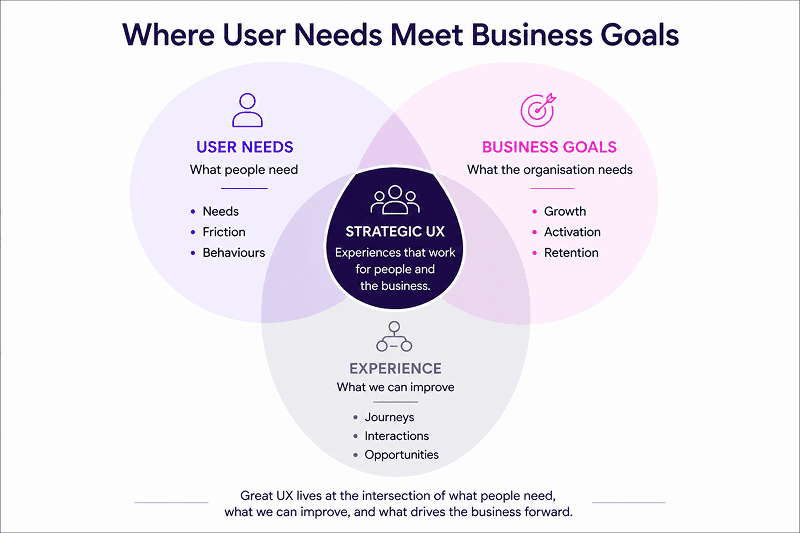
If incomplete onboarding reduces activation, increases support demand or contributes to early churn, the experience problem has a clear business consequence. That is the connection leaders need.
Research supports this connection. McKinsey's analysis of 300 publicly listed companies found that organizations in the top quartile of its Design Index achieved 32 percentage points higher revenue growth and 56 percentage points higher total shareholder return growth than industry counterparts over five years.
More recent research from Forrester also shows how difficult it can be to maintain a strong customer experience. Its 2025 Global Customer Experience Index found that 21% of brands saw their experience quality decline, while only 6% improved, based on feedback from more than 275,000 customers across 469 brands.
The lesson is not that every UX improvement produces a predictable financial return. It is that experience quality becomes strategically important when it changes behaviors that matter to the organization.
At Clarient, this is why we don't begin by asking what interface should be redesigned. We begin by understanding where the experience is creating friction, what that friction costs the customer, and what it is preventing the business from achieving.
How Do You Make Complex Intelligence Work for People?
For Distil.ai, Clarient helped transform a complex customer intelligence platform into an experience that marketers could explore, understand and act on without relying on technical expertise.
Our work brought together UX strategy, information architecture, research, prototyping, UI design and front-end development to simplify complex workflows and create a scalable design system. The goal was not simply to make the platform look better, but to make its intelligence more accessible to the people using it.
The impact was measurable:
- 46% increase in customer engagement within months of launch
- 32% boost in marketing ROI across eCommerce clients
- 68% adoption among non-technical marketers in the first phase
As Gerry McNicol, CEO of BIG Data Consulting, said, the result was something “our users love.” It is a practical example of what people-first UX strategy can achieve: turning complexity into clarity, and clarity into action.
Not Every Experience Problem Deserves the Same Investment
A common mistake is to treat every identified customer problem as a priority. That creates another problem: teams become busy improving experiences without necessarily improving outcomes. A better prioritization decision considers four things:
Question | What it tells you |
| How much does this affect customers? | User impact |
| What changes if we solve it? | Business impact |
| Does it support where the organization is going? | Strategic relevance |
| Can we solve it effectively? | Feasibility and risk |
This is where UX investment becomes a question of trade-offs. Suppose two journeys are experiencing friction. One affects a small number of users but is highly visible. The other affects thousands of customers and contributes to abandonment during a commercially important journey.
Both are real problems. They should not necessarily receive the same investment.
Being customer-centered does not mean treating every need equally. It means making choices based on evidence rather than volume, seniority or whoever asked for the feature first. And there is another consideration that often gets missed: opportunity cost.
Every low-value improvement consumes design, engineering, research and operational capacity that could have been used elsewhere. A good strategy therefore defines not only what the organization should solve, but what it should deliberately leave alone for now. The same principle applies when deciding where to invest in emerging AI capabilities, as explored through the Model Context Protocol and tools such as MCP Inspector.
IS Your UX Strategy Solving the Right Problems?
UX Strategy Should Influence What Product Teams Build
When experience work enters the process too late, research often becomes a validation exercise. The roadmap already exists. The requirements have already been agreed. The business case has already been made.
Research is then asked to prove that the chosen solution is a good one. That reverses the value of UX. A stronger model brings experience thinking into product decisions earlier.
| Feature-led thinking | Outcome-led thinking |
| "Build a new onboarding flow." | "Help more customers reach their first meaningful outcome." |
| "Add a self-service center." | "Help customers resolve common issues without assistance." |
| "Redesign the dashboard." | "Help users make the right decision faster." |
| "Improve the checkout." | "Reduce abandonment at the point of purchase." |
The difference may sound subtle, but it changes the conversation. The team is no longer debating which feature looks better. It is deciding which intervention has the best chance of changing a meaningful outcome.
This is also where product strategy and experience strategy need to work together. Product strategy determines where the product needs to go; UX helps ensure that the path makes sense for the people expected to use it.
Measure the Change, Not Just the Experience
One of the easiest ways to weaken a strategy is to measure activity instead of impact. A team can report how many interviews it conducted, screens it redesigned or usability issues it fixed. Those measures tell you what the team did. They do not necessarily tell you whether customers or the business are better off.
A stronger measurement model connects three layers:
| Layer | Questions to answer | Examples |
| Experience | Did the experience improve? | Success, effort, ease, satisfaction |
| Product | Did behavior change? | Activation, adoption, completion, retention |
| Business | Did the change create value? | Revenue, cost, churn, support demand |
These are your UX metrics, but their value comes from how they connect to the larger outcome.
Forrester's research found that only 3% of US companies qualified as customer-obsessed, while those organizations reported 41% faster revenue growth, 49% faster profit growth and 51% better customer retention than non-customer-obsessed organizations.
And the relationship can be substantial at an individual industry level. Forrester estimated that a one-point improvement in its CX Index could represent more than $1 billion in additional revenue for a mass-market auto manufacturer, through increased likelihood of repeat purchase and service.
These figures should not be treated as a universal equation for calculating UX ROI. They illustrate something more useful: experience improvements become commercially meaningful when they influence customer behaviors such as conversion, retention, repeat purchase, or cost to serve. The same principle applies when AI is used to improve customer support, where thoughtful implementation can turn faster, more relevant interactions into measurable customer value.

A Simple Example: Turning a Customer Problem into Business Value
Consider a digital product where many new customers abandon onboarding. The obvious response might be to redesign the screens. But a strategic approach would work backward.
Customer need:
"I want to get started quickly and understand what I need to do."
Experience problem:
The journey asks for too much information before the customer experiences any value.
Business objective:
Increase successful activation and reduce early support demand.
Opportunity:
Simplify the sequence, defer non-essential information and make the next step clearer.
Product outcome:
More customers complete onboarding and reach the first meaningful action.
Business outcome:
Higher activation, lower avoidable support demand and potentially stronger retention.
This is also where customer journey optimization becomes more than mapping touchpoints. The objective is not to make every moment equally frictionless. It is to identify the moments where changing the experience can materially improve the customer's ability to achieve what they came to do, and, at the same time, improve an outcome that matters to the organization.
At Clarient, we use this kind of thinking to move conversations away from "What should we redesign?" toward "What needs to change, for whom, and why?"
What a Business-Linked UX Strategy Should Tell You
A useful UX strategy framework does not need to be complicated. By the time the strategy is complete, leaders should be able to answer five questions:
- What customer problem are we solving?
- What evidence tells us that the problem matters?
- Why does solving it matter to the business?
- What experience or product decision will address it?
- What measurable outcome will tell us whether it worked?
There is one more question worth adding: What are we choosing not to solve right now? That question forces clarity.
It turns experience work from a collection of improvements into a set of deliberate choices about where the organization can create the most value for its customers and itself.
Deloitte Digital's research across more than 250 companies similarly points to the commercial importance of design maturity, reporting that organizations prioritizing design as a process, strategy or culture perform 1.5 times better than those that do not.
The strongest organizations therefore do not treat experience as the final layer added to a product. They use it to decide what deserves to be built in the first place.
Conclusion: The Best UX Strategy Creates Value on Both Sides
The best experiences begin with a simple question: What are people trying to accomplish, and what is getting in their way?
When organizations solve the problems that genuinely matter, the impact goes beyond a better experience. Customers find what they need faster, make decisions with greater confidence, and accomplish more with less effort. Businesses can then see stronger adoption, greater retention, improved efficiency, and sustainable growth.
At Clarient, we help organizations connect these two sides. We bring together customer insight, product thinking, experience design, and business priorities to identify where experience can create meaningful impact and turn those opportunities into outcomes because UX strategy is not about improving everything.
It is about improving what matters most to the people you serve and the business you are building. Have an experience challenge worth solving? Consult Clarient to explore where to start.
Frequently Asked Questions
1. What is the difference between UX strategy and UX design?
UX strategy determines what experience should be created, for whom, and why it matters. UX design then translates that direction into journeys, interactions, interfaces and systems that help people accomplish what they came to do.
A strong user experience strategy connects customer needs with product and business priorities before design decisions are made. UX design brings those decisions to life. In practice, the two work best together: strategy identifies the right problems to solve, while design helps create experiences that solve them well.
2. Who should be responsible for defining the user experience direction?
The responsibility should not sit with one person or one team. Product, design, research, technology, and business leaders all bring different perspectives on what customers need and what the organization can realistically deliver.
A UX strategy framework works best when these perspectives come together around shared evidence and outcomes. The people closest to customers should have a strong voice, while leadership provides the strategic context needed to make informed priorities and trade-offs.
3. When should user experience planning begin in the product lifecycle?
As early as possible. Experience planning is most valuable before requirements, features and technical decisions become difficult to change.
Starting with user research and customer needs early gives teams an opportunity to understand the problem before committing to a solution. It also helps connect customer experience strategy with product and business decisions instead of bringing UX in only after the roadmap has already been defined.
4. What data is needed to evaluate the effectiveness of a digital experience?
Start with the questions you want to answer, then choose the data. Useful inputs can include user feedback, behavioral analytics, task completion, conversion, adoption, retention, support demand and business performance.
The right UX metrics connect what people experience with what they do and what the organization ultimately achieves. The goal is not to collect more data, but to understand whether the experience is helping people accomplish what matters to them.
5. How often should a product’s experience strategy be reviewed?
There is no universal schedule. Review it whenever customer behavior, business priorities, technology, or market conditions materially change. Regular reviews also help teams identify whether their UX investment is still focused on the problems that matter most.
6. How does experience planning support broader digital transformation initiatives?
Digital transformation changes more than technology. It often changes how people interact with products, services, employees and organizations.
A thoughtful UX strategy helps make those changes work for the people affected by them. It connects customer journey optimization with operational and business priorities, helping organizations understand where experience improvements can support adoption, efficiency, trust and growth.
That is ultimately where the business value of UX becomes visible. And rather than treating UX ROI as a single number, organizations can evaluate how experience improvements influence meaningful customer and business outcomes.
Weekly Insights Subscription
Stay ahead with Clarient insignts on customer insights
Share
Written by

Parthsarathy Sharma
With 4+ years of experience across AI, UX, enterprise technology, and brand strategy, Parthsarathy brings a research-driven lens to digital experience content. His work focuses on turning emerging technology, customer experience, and business trends into clear, practical perspectives for readers.
Reviewed by

Ashley Alemao
Ashley is a UX Designer focused on complex enterprise systems, with 4 years of experience across cybersecurity and energy logistics. His work blends research, strategy, interaction design, accessibility, and UX writing to make compliance-heavy products clearer and easier to use.