Data & AI
Technology, SaaS and consulting
The Ultimate Guide to MCP Inspector and Model Context Protocol (MCP) in 2026
Published on May 28, 2026
table of content
- Introduction
- The Real Problem With Modern AI Agents
- What We See in Enterprise AI Projects
- Why MCP Matters?
- Why MCP Became the Backbone of Agent Infrastructure
- Understanding MCP Resources vs Tools
- The Architectural Shift That Changed MCP Adoption
- MCP Inspector: The Debugging Layer Most Teams Ignore
- Why MCP Inspector Matters in Production
- How Clarient Enabled Automated HR Workflows and Reduced Operational Overhead
- How MCP Inspector Actually WorksHow MCP Inspector Actually Works
- FastAPI vs Flask for MCP Infrastructure
- Advanced MCP Inspector Workflows
- Model Context Protocol Security Is Becoming the Biggest Enterprise Concern
- Enterprise AI Orchestration Checklist for 2026
- Conclusion: Building Reliable AI Systems Starts with Better Orchestration
- Frequently Asked Questions
listen to blog
summary
Explore MCP inspector, MCP security, MCP vs API, FastAPI vs Flask, MCP server clients, and scalable AI orchestration in 2026.
Introduction
Most AI agents look impressive in demos right until they touch real systems. The moment an agent starts interacting with databases, APIs, browsers, CRMs, and enterprise workflows, things begin breaking fast.
This is exactly why MCP inspector is becoming one of the most critical tools in modern AI infrastructure. The companies scaling AI successfully in 2026 are not simply building smarter models. They are building reliable orchestration systems behind them.
In this guide, you will understand how Model Context Protocol works, why MCP Inspector matters far more than most teams realize. Also, how enterprise AI systems are actually being deployed, and what separates scalable agent infrastructure from expensive AI experiments that never survive production.
The Real Problem With Modern AI Agents
Most AI systems fail after the demo phase not because the model is weak, but because orchestration becomes unstable once multiple tools, agents, and environments are introduced.
According to recent enterprise AI adoption reports, more than 70% of AI pilot projects still fail to reach full production deployment because orchestration reliability, governance, and integration complexity become major bottlenecks.
A modern AI stack may involve browser automation, internal APIs, databases, vector search, SaaS integrations, human approval loops, and multi-agent coordination. Without a standardized communication layer, every integration turns into custom infrastructure that becomes difficult to scale, govern, and maintain.
What We See in Enterprise AI Projects
At Clarient, we've seen the same pattern repeat across AI initiatives. Getting an agent to work is rarely the hard part. Getting it to work reliably across tools, workflows, approvals, and business systems is where complexity begins.
Many teams build promising proofs of concept, only to discover that scaling them requires far more than model performance. It requires orchestration that can manage context, coordinate execution, and maintain reliability under real-world conditions. This challenge is one of the key reasons why so many AI initiatives struggle to move beyond the pilot stage.
Why MCP Matters?
The Model Context Protocol (MCP) standardizes how AI systems discover tools, exchange context, invoke capabilities, and maintain interoperability across environments.
That is why discussions around MCP vs API are accelerating. Traditional APIs define endpoints. MCP defines how agents communicate, coordinate, preserve context, and operate across systems. The difference is not just technical. It is architectural.

Why MCP Became the Backbone of Agent Infrastructure
The biggest misconception about MCP is that it is simply another protocol layer. In reality, MCP is emerging as the interoperability standard for AI-native systems. As autonomous agents, coding copilots, retrieval systems, workflow automation, and multi-agent orchestration became more common.
MCP solved this by standardizing how AI systems discover tools, exchange context, invoke capabilities, manage execution flows, and maintain interoperability across environments. Instead of rebuilding orchestration logic for every integration, teams can create reusable and observable execution systems that scale across tools, agents, and platforms.
The adoption curve reflects this shift. Public MCP server ecosystems have already crossed 9,400+ registered servers in 2026, while thousands of GitHub repositories now actively use MCP-based tooling and orchestration frameworks.
MCP vs A2A
This is also why conversations around MCP vs A2A are increasing. A2A primarily focuses on agent-to-agent communication, while MCP operates at a broader orchestration level. It standardizes how agents interact not only with each other, but also with tools, prompts, resources, transport layers, and execution pipelines.
| MCP | A2A |
| Focuses on full orchestration infrastructure | Focuses on agent-to-agent communication |
| Standardizes tool discovery and execution | Standardizes inter-agent messaging |
| Handles context exchange across systems | Handles coordination between agents |
| Supports prompts, resources, tools, and transport layers | Primarily manages agent interaction flows |
| Designed for broader interoperability across environments | Designed for communication between autonomous agents |
| Enables reusable and observable execution chains | Enables collaborative multi-agent behavior |
Understanding MCP Resources vs Tools
One of the most common architectural mistakes in modern agent systems is treating MCP resources and MCP tools as interchangeable layers. They are not. They solve fundamentally different orchestration problems.
MCP resources are designed for contextual grounding. They provide the information an agent needs to reason effectively across workflows and environments. MCP tools are designed for execution. They allow agents to perform actions across systems, APIs, infrastructure, and workflows.
| MCP Resources | MCP Tools |
| Provide context for reasoning | Perform executable actions |
| Passive information layers | Active operational layers |
| Used for retrieval and grounding | Used for task execution |
| Include documents, schemas, logs, datasets, and memory stores | Include API calls, database queries, browser automation, and deployments |
| Improve contextual understanding | Trigger system changes and workflows |
| Support reasoning quality and context continuity | Support orchestration and automation |
| Reduce unnecessary execution overhead | Handle operational interactions across environments |
The distinction becomes critical in large-scale orchestration systems because modern agents reason differently when retrieving context versus executing operations. Mature AI architectures separate retrieval, reasoning, and execution into independent layers to improve observability, reduce latency, and reduce orchestration failures.
One of the biggest performance failures in agent infrastructure happens when teams overload execution tools with retrieval responsibilities. This creates bloated execution chains, higher token consumption, slower planning cycles, and unstable orchestration behavior.
The Architectural Shift That Changed MCP Adoption
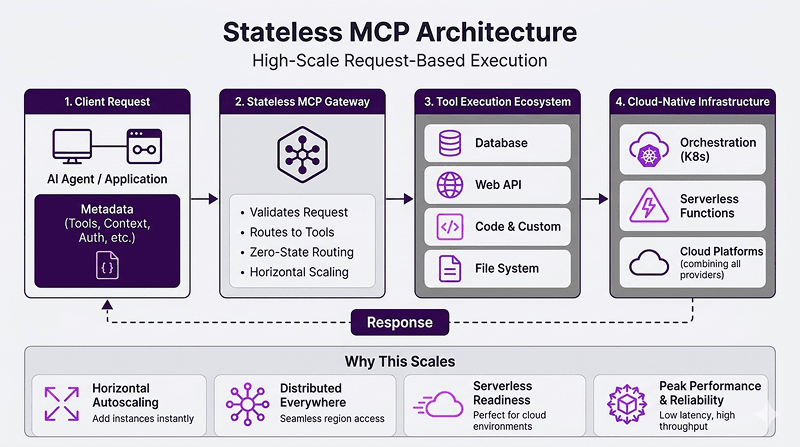
Early MCP systems were difficult to scale because they depended heavily on persistent sessions, WebSocket maintenance, and synchronized runtime states.
Modern MCP infrastructure changed this completely by moving toward stateless execution patterns, where context and capabilities travel dynamically within each request. This made MCP dramatically easier to deploy across cloud-native and enterprise-scale environments.
mcp server clients
MCP Inspector: The Debugging Layer Most Teams Ignore
Most AI systems do not fail because of weak models. They fail because orchestration breaks under production complexity. Unlike traditional APIs, agent systems can fail silently through schema mismatches, hallucinated parameters, broken context propagation, or invalid tool execution states. Identifying the root cause becomes extremely difficult once multiple tools and reasoning loops are involved.
This is where MCP Inspector becomes critical.
MCP Inspector helps teams trace and validate the full execution lifecycle of an AI agent including:
- Context injection
- Tool selection
- Schema validation
- Execution sequencing
- Reasoning flow inspection
The shift is important because modern AI engineering is increasingly becoming orchestration engineering.
Why MCP Inspector Matters in Production
Once agents start interacting with CRMs, databases, APIs, and automation workflows, debugging becomes exponentially harder.
A single malformed tool response can break an entire execution chain involving:
- Context retrieval
- Reasoning
- Tool invocation
- Action execution
MCP Inspector gives teams visibility into:
- Execution chains
- Tool responses
- Transport layers
- Schema failures
- Runtime behavior
This visibility is what separates teams that build scalable AI systems from unstable prototypes.
Additionally, at Clarient, we've seen the same pattern repeat across AI initiatives. Getting an agent to work is rarely the challenge. Getting it to work reliably across tools, workflows, approvals, and systems is where things break.
Most teams build strong proofs of concept, only to realize later that scaling requires more than model capability. It requires orchestration that can hold context, coordinate execution, and maintain reliability in real operational environments built for enterprise scale.
How Clarient Enabled Automated HR Workflows and Reduced Operational Overhead
In an enterprise HR transformation for Catalyst One HCM, the goal was to reduce manual effort while improving onboarding, performance management, and employee engagement across mid-to-large organizations. Existing fragmented workflows made operations slow, repetitive, and difficult to scale.
Clarient designed a cloud-based HR platform with automated workflows, integrated learning management, and structured performance tracking across the employee lifecycle. This streamlined HR operations and improved engagement, delivering a 30% reduction in administrative effort, 25% decrease in employee turnover, and improved employee satisfaction.
How MCP Inspector Actually WorksHow MCP Inspector Actually Works
MCP Inspector typically operates through two connected layers: a frontend inspection interface and a background proxy execution server. The proxy layer acts as the bridge between stdio MCP environments, HTTP transports, SSE streams, and production gateways, allowing teams to inspect orchestration behavior across both local development and distributed production systems in real time.
STDIO MCP vs Streamable HTTP
stdio MCP workflows are ideal for local development because they enable direct process communication with minimal overhead. However, production systems increasingly use streamable HTTP because it:
- Scales more efficiently
- Integrates better with gateways
- Improves observability
- Supports distributed infrastructure
MCP Inspector allows developers to test both environments using the same orchestration workflows.
FastAPI vs Flask for MCP Infrastructure
The fast API vs flask debate becomes important once MCP systems move beyond prototypes.
| FastAPI | Flask |
| Async-native execution | Lightweight setup |
| Better concurrency | Faster prototyping |
| Strong schema validation | Flexible architecture |
| Better for MCP server clients | Better for smaller tools |
For enterprise-grade orchestration, FastAPI is increasingly preferred because AI agents often invoke multiple tools concurrently.
Advanced MCP Inspector Workflows
Most teams use MCP Inspector only for connectivity testing. Its real value appears during orchestration validation.
Schema Validation
Strict schema enforcement prevents:
- Hallucinated parameters
- Malformed outputs
- Silent downstream failures
This becomes critical in systems connected to:
- Financial workflows
- Deployment infrastructure
- Enterprise databases
Human-in-the-Loop Testing
Enterprise AI systems rarely allow unrestricted autonomous execution. MCP Inspector helps teams simulate approval-based workflows before deployment, especially for actions like:
- Deleting records
- Modifying infrastructure
- Triggering deployments
- Sending external communications
The biggest difference between experimental AI agents and production-ready systems is not intelligence. It is orchestration reliability, observability, and execution control.
Model Context Protocol Security Is Becoming the Biggest Enterprise Concern
The conversation around model context protocol security is growing because MCP changes a core assumption in software systems. Traditional applications wait for users to initiate actions. MCP-enabled agents can independently invoke tools, execute workflows, access infrastructure, and interact with sensitive systems.
This creates major risks including prompt injection, arbitrary code execution, unauthorized tool access, privilege escalation, and data exfiltration. The challenge is no longer just securing APIs. It is securing autonomous execution layers.
The protocol itself does not solve these risks automatically. Enterprise teams must implement execution sandboxing, role-based permissions, approval checkpoints, and gateway-level policy enforcement in structured environments designed for controlled rollout and experimentation.
Enterprise AI Orchestration Checklist for 2026
Most AI systems fail because teams scale agents before scaling orchestration reliability. Enterprise adoption becomes significantly smoother when organizations treat MCP infrastructure like distributed systems engineering from the beginning.
Here is a practical framework enterprises can use to operationalize AI systems safely and at scale:
1. Standardize Orchestration Early
Use MCP-compatible workflows instead of isolated tool integrations
Separate MCP resources from executable tools
Avoid tightly coupled agent architectures
2. Implement Observability Before Scaling
Track:
Tool invocation latency
Context payload growth
Execution chain duration
Failure propagation
Token consumption patterns
Without observability, debugging production agents becomes nearly impossible.
3. Enforce Strict Schema Validation
Validate all tool outputs against structured schemas
Prevent hallucinated parameters from reaching production systems
Use MCP Inspector for orchestration tracing and replay testing
4. Prioritize Execution Security
Implement:
Role-based permissions
Execution sandboxing
Approval checkpoints
Gateway-level policy enforcement
The biggest enterprise risk is unrestricted autonomous execution.
5. Optimize for Stateless Infrastructure
Design orchestration systems for:
Kubernetes environments
Distributed gateways
Serverless execution
Horizontal autoscaling
Stateless MCP systems scale significantly better under enterprise workloads.
6. Treat AI Systems Like Infrastructure, Not Chatbots
The most successful teams are not optimizing prompts endlessly. They are building reliable execution environments with strong orchestration, observability, and governance layers around their agents.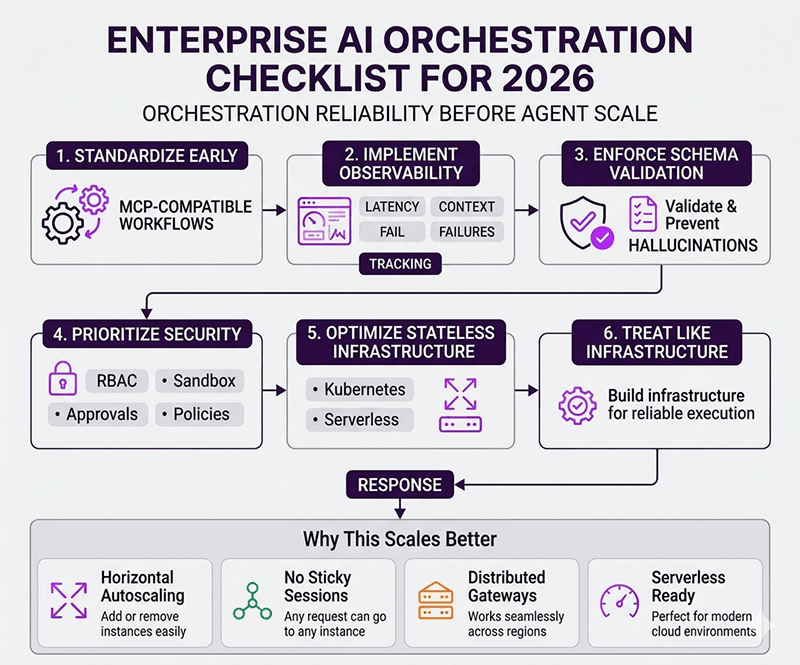
Conclusion: Building Reliable AI Systems Starts with Better Orchestration
The future of AI infrastructure will be defined by orchestration reliability, observability, execution safety, and scalable agent communication. That is why MCP Inspector is becoming essential for enterprise AI systems moving from prototypes to production.
Most organizations struggling with AI adoption are not facing a model problem. They are facing orchestration problems including unreliable execution, unstable workflows, poor visibility, and growing security risks.
At Clarient, we help companies build secure, scalable MCP-based AI systems with production-ready orchestration, observability, and execution architecture. If your AI agents work in demos but fail under real operational complexity, the orchestration layer is usually the problem. Reach out to our team of experts!
Frequently Asked Questions
1.How to build a MCP server?
To build an MCP server, you typically:
- Choose a backend framework like FastAPI or Flask.
- Implement tool definitions, resources, and transport handling using model context protocol MCP json-rpc standards.
- Connect the server to MCP server clients through STDIO or HTTP-based communication layers.
2.What is Flask and FastAPI?
Flask and FastAPI are Python web frameworks used for backend development.
- Flask is lightweight and flexible for smaller applications
- FastAPI offers async support, schema validation, and higher concurrency performance.
- The discussion around fast API vs flask usually depends on whether you are building lightweight prototypes or scalable AI orchestration systems.
3.What are the best MCP servers?
The best MCP servers are typically the ones optimized for:
- reliable tool orchestration
- secure execution environments
- scalable agent communication
Most enterprise teams now prefer servers supporting MCP hub integrations, streamable transports, and strong model context protocol security controls.
4.Are there any popular applications using MCP and cursor protocols?
Yes. MCP adoption is rapidly growing across:
- AI coding environments
- Enterprise automation platforms
- Swarm agent systems
- Developer tooling ecosystems
Many modern AI assistants and orchestration platforms now rely on MCP server clients for interoperability and tool execution.
5.What is Model Context Protocol in cyber security?
Model Context Protocol in cyber security refers to the security architecture surrounding AI agent communication, tool execution, and context sharing. Key concerns include:
- Prompt injection attacks
- Unauthorized tool access
- Arbitrary code execution
This is why model context protocol security has become a major focus area for enterprise AI deployments.
6.What is an MCP client and server?
An MCP server exposes tools, prompts, and resources to AI systems. An MCP client consumes and interacts with those capabilities. In simple terms:
- The server provides capabilities
- The client invokes them
- The protocol standardizes communication between both systems
This architecture is central to discussions around MCP vs API and MCP vs a2a in modern AI infrastructure.
7.What is the difference between MCP resources vs tools?
MCP resources provide contextual information such as documents, schemas, or memory. MCP tools perform executable actions such as:
- querying databases
- triggering APIs
- running workflows
Understanding MCP resources vs tools is critical for building scalable orchestration systems.
8.What is stdio MCP?
stdio MCP refers to using standard input and output streams for communication between MCP clients and servers.
It is commonly used for:
- Local development
- Debugging
- Lightweight orchestration testing
Many developers use stdio MCP workflows during early-stage server development before moving to HTTP-based deployments.
9.What is MCP Jam?
MCP jam refers to collaborative community experimentation around MCP tooling, integrations, and workflows. These environments often help developers:
- Test interoperability
- Explore orchestration patterns
- Prototype new MCP server clients and agent systems
10.What is the difference between MCP vs API?
Traditional APIs expose endpoints for software communication. MCP standardizes how AI agents:
- Discover tools
- Exchange context
- Orchestrate execution flows
MCP is designed specifically for AI-native interoperability rather than standard application communication.
11.What is the difference between MCP vs a2a?
MCP focuses on tool orchestration, resources, and context exchange. A2A focuses primarily on agent-to-agent communication. In modern AI ecosystems, many systems use both MCP and A2A together depending on orchestration requirements.
Weekly Insights Subscription
Stay ahead with Clarient insignts on customer insights
Share
Written by

Parthsarathy Sharma
With 4+ years of experience across AI, UX, enterprise technology, and brand strategy, Parthsarathy brings a research-driven lens to digital experience content. His work focuses on turning emerging technology, customer experience, and business trends into clear, practical perspectives for readers.