Data & AI
Cross-industry
Why GenAI Initiatives Stall After Proof of Concept and How to Get to Production
Published on September 04, 2026

table of content
- Introduction
- Your AI PoC Worked. So Why Does Everything Fall Apart in Production?
- Four Problems Every Enterprise Runs into When Scaling GenAI
- What Do Teams That Successfully Reach Production Do Differently?
- A Practical Roadmap to Move from PoC to Production
- Conclusion: The Future Belongs to Production-Ready AI
- Frequently Asked Questions
listen to blog
summary
Discover why most AI proof-of-concept initiatives fail and how enterprises can scale GenAI to production with control, governance, and trust.
Introduction
Your GenAI proof of concept worked. The demo was impressive, stakeholders saw the potential, and suddenly everyone could see what AI might change across the business. Then came the harder part: making it work in the real world.
As more people started asking how they would actually use it, new questions surfaced. Can we trust the outputs? What happens when the AI gets something wrong? Will it work with our existing systems and data? How do we keep people in control? And can we prove that it is creating meaningful business value?
If this sounds familiar, you're not alone.
For most enterprises, the difficult part isn't proving that GenAI can work. It's turning that early promise into something people can confidently use as part of their everyday work. A proof of concept shows what's possible in a controlled environment. Production is where AI has to work with real people, real workflows, real data, and real business expectations.
So what does it take to make that leap?
In this guide, we'll look at why promising GenAI initiatives often stall after the proof-of-concept stage, and what organizations can do to build AI that people trust, businesses can scale, and teams can keep improving over time.
Your AI PoC Worked. So Why Does Everything Fall Apart in Production?
One successful demo can create false confidence.
A proof of concept is built to validate an idea. Production is built around how people work. During a pilot, AI runs on curated data, controlled prompts, and a limited user base. Once it reaches more people, expectations change. People use it differently, workflows become more complex, systems need to connect, and every AI response can affect someone’s work or a business decision.
At Clarient, we’ve seen that the gap is rarely just about the model. It’s about designing the experience, workflows, technology, and governance around it so people can use AI with confidence. That means asking: Can the system retrieve the right information? What happens when AI is wrong? How is performance evaluated? And how do you manage cost, security, and compliance as adoption grows?
In fact, Gartner found that 45% of organizations with high AI maturity keep their AI initiatives operational for three years or more. Gartner’s findings point to a broader difference that mature organizations choose initiatives more deliberately and put the governance, engineering practices, metrics, and trust mechanisms around them to sustain value over time. The difference is building for people, scale, and lasting business value.

Four Problems Every Enterprise Runs into When Scaling GenAI
If you've ever wondered why a promising AI initiative suddenly loses momentum, the answer usually isn't a lack of executive support or a weak business case. More often, it's because the realities of production expose challenges that never appeared during the pilot.
Across industries, we've seen the same patterns emerge again and again. While the technology continues to improve rapidly, the obstacles to enterprise adoption remain surprisingly consistent.
Here are the four challenges that keep most GenAI initiatives from moving from experimentation to production.
1. You're Measuring Excitement Instead of Reliability
One of the biggest mistakes organizations make is confusing a successful demo with a production-ready AI system.
Positive stakeholder feedback is valuable, but it doesn't answer the questions that matter in production. Can the AI consistently deliver accurate responses? Does performance hold up as data changes? How often does it hallucinate or produce results that are incorrect and unusable? And can teams monitor its behavior and stay on top of compliance requirements as the system scales?
| During a PoC | In Production |
| Success is based on a successful demo. | Success is measured against business KPIs. |
| Feedback is subjective. | Performance is continuously evaluated. |
| Testing is limited. | Models are monitored over time. |
According to McKinsey's State of AI, organizations generating the greatest value from AI are far more likely to have formal processes for measuring performance and managing risk. That's why leading teams treat evaluation as an ongoing capability, not a one-time exercise.
2. Success at 10 Users Doesn't Mean Success at 10,000
AI behaves very differently as your enterprise scales and becomes more complex.
A chatbot that works perfectly for a handful of testers may struggle when thousands of employees begin using it simultaneously. Costs rise, latency increases, and inconsistent performance starts affecting user trust.
What changes at scale?
- Token usage and infrastructure costs increase.
- Response times become harder to maintain.
- More users expose edge cases your pilot never encountered.
- Reliability becomes just as important as intelligence.
Scalability isn't something you solve after deployment. It needs to be part of the design from day one.
3. Enterprise Workflows Need Predictability. AI Doesn't Naturally Provide It.
Traditional software executes a predefined logic and typically produces the same output. Generative AI doesn't. That flexibility makes AI powerful, but it also creates risk in areas like legal, finance, healthcare, and customer support, where consistency matters.
In fact, PwC's AI Predictions 2026 points out that governance and responsible AI are at the heart of the AI adoption conversation. Production-ready AI builds trust through:
- Clear confidence thresholds.
- Human review for high-risk decisions.
- Guardrails against hallucinations.
- Complete audit trails.
For Clarient, building trustworthy AI starts with the people who rely on it. People need to know when they can trust an AI response, when they should question it, and when a human should step in. That means designing AI with clear guardrails and governance from the beginning, so users aren't left to figure out its boundaries on their own. The result is an AI experience that gives people confidence without taking people out of the process, helping teams use AI responsibly while keeping human judgment where it matters most.
4. You're Building an AI Feature Instead of an AI System
Many proof of concepts solve a single problem exceptionally well. Production AI has a much bigger job.
AI Feature | AI System |
Solves one task | Supports business workflows |
Works independently | Integrates across enterprise systems |
Built for demos | Built for long-term operations |
Limited monitoring | Continuous governance and evaluation |
That's why successful organizations focus less on choosing the "best" model and more on building the infrastructure around it. AI needs orchestration, governance, monitoring, and access to trusted enterprise data to deliver consistent business value.
What Do Teams That Successfully Reach Production Do Differently?
If failed AI initiatives follow a predictable pattern, successful ones do too.
The organizations moving GenAI into production aren't necessarily using better models. They're thinking about what happens after the demo, how AI fits into people's work, how teams can rely on it, and how the business can keep improving it over time.
Instead of building AI as a standalone technology project, they build it around real needs, real workflows, and real outcomes.
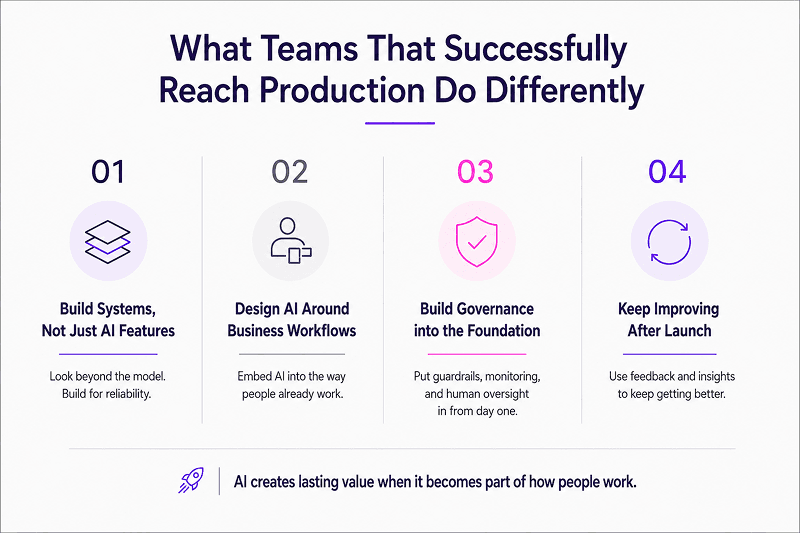
Here's what they do differently. They Build Systems, Not Just AI Features
A proof of concept shows that an idea can work. Production is about making that idea useful, reliable, and valuable for people every day.
That means looking beyond the model and thinking about everything that supports the experience, from how AI accesses information to how its responses are evaluated, monitored, and improved.
This mirrors what Deloitte observed in its 2025 State of Generative AI in the Enterprise report. Organizations moving beyond isolated pilots are increasingly investing in repeatable operating models rather than one-off AI applications.
The lesson is simple: AI creates lasting value when it becomes part of how people work and not just something they try.
They Design AI Around Business Workflows
Enterprise AI delivers the most value when it fits naturally into the way people already work.
Whether it's a customer support assistant retrieving CRM data or a sales copilot combining information from multiple business systems, AI needs to work across existing applications, not alongside them.
| AI That Stays in Pilot | AI That Reaches Production |
| Solves a single use case | Supports end-to-end business workflows |
| Works independently | Integrates with enterprise systems and data |
| Optimized for demonstrations | Designed for reliability and scale |
| Adds another tool | Fits naturally into existing workflows |
The more seamlessly AI becomes part of everyday work, the more likely employees are to trust it and adopt it.
They Build Governance into the Foundation
For people to use AI with confidence, they need to know where it can help, where its limits are, and when human judgment still matters. That is why governance cannot be something added just before deployment. It needs to be considered from the beginning.
At Clarient, we design AI with these realities in mind. Clear policies, guardrails, access controls, monitoring, and human oversight help create experiences where people can rely on AI without giving up control. They also give organizations greater visibility into how AI is being used, what information it can access, and how high-risk decisions are handled.
Organizations that successfully operationalize AI typically build governance around:
- Clearly defined policies and guardrails.
- Role-based access controls.
- Continuous monitoring and evaluation.
- Auditability across AI interactions.
- Human oversight for high-risk workflows.
The goal isn't to put limits on what AI can do. It is to create the confidence people need to use it responsibly in real work.
They Keep Improving After Launch
Launching an AI solution isn't the end of the journey. It is when you finally start learning how people
actually use it.
Once an AI system is in people's hands, their feedback reveals what works, where they struggle, and how the experience can improve. Usage patterns can uncover new opportunities, while real-world interactions can reveal gaps that a pilot could never anticipate.
The organizations getting the most from AI use those insights to keep improving, refining workflows, prompts, policies, and experiences as their people and business needs evolve. For teams unsure whether their AI initiative is ready to scale, identifying the right opportunities for generative AI can help clarify where AI can create meaningful value and where it may need a different approach.
A Practical Roadmap to Move from PoC to Production
Building production-ready AI doesn't require a complete transformation overnight. It requires making the right decisions at each stage of the journey.
If you're planning to move beyond experimentation, these four steps provide a practical roadmap.
Step 1: Define Success Before You Scale
A proof of concept should answer one question: Will this create measurable business value?
Before scaling your initiative, figure out the business outcome you want to improve. Then establish a baseline and define KPIs. Without clear outcomes, it's impossible to know whether scaling is creating value or simply increasing costs.
Checklist:
- Define the business KPI your AI initiative will improve.
- Establish a baseline before implementation.
- Set clear success metrics and timelines.
- Align technical goals with business outcomes.
Step 2: Design for Failure, Not Perfection
No matter what AI you use, it will make mistakes. You can't eliminate every error, and that should not even be the goal. Instead, the goal is to ensure that the errors don't turn into business risks.
Start by defining confidence thresholds, creating fallback workflows, and clearly flagging when a human needs to be looped in.
Checklist:
- Define confidence thresholds for AI responses.
- Create fallback paths and human review workflows.
- Test edge cases, not just ideal scenarios.
- Monitor failures and learn from them continuously.
Step 3: Build an Architecture That Can Evolve
AI technology is evolving faster than almost any other area of enterprise software.
The architecture you build today should allow you to adopt new models, integrate new data sources, and support new use cases without rebuilding the entire system.
Keeping the model, data, orchestration, and business logic loosely connected gives organizations the flexibility to improve performance while reducing long-term technical debt.
Checklist:
- Separate the model, data, and orchestration layers.
- Design for model portability and future upgrades.
- Build reusable retrieval and data pipelines.
- Avoid tightly coupled systems that limit scalability.
Step 4: Treat Production as the Beginning
Putting your AI app on the market is not the end. Production is where the feedback and improvement cycle continues.
You need to monitor response quality, measure business impact, measure costs, and collect user feedback. As models improve and business expands, your AI model should also evolve alongside them.
The organizations creating lasting value from GenAI don't stop optimizing after deployment. They make continuous improvement part of the way they operate.
Checklist:
- Continuously evaluate response quality and accuracy.
- Track business KPIs, costs, and latency.
- Collect user feedback to improve adoption.
- Regularly update models, prompts, and governance policies.
Conclusion: The Future Belongs to Production-Ready AI
Building an impressive AI proof of concept is no longer the hard part. The real challenge is making it work when real people, real workflows, and real business expectations enter the picture.
If your AI initiative works in a demo but struggles with adoption, reliability, integration, governance, or proving business value, the answer may not be a better model. You may need to rethink what sits around it. That is where Clarient comes in.
We bring together AI strategy, experience design, engineering, and business thinking to help organizations turn promising AI ideas into solutions people can actually use, and businesses can confidently scale.
Have an AI initiative that works in the lab but isn't working in the business? Consult Clarient. Let's find out what's holding it back and what it will take to make it work in the real world.
Frequently Asked Questions
1. Why do so many AI proof of concept initiatives fail when moving to production?
A successful generative AI proof of concept can show that an idea works, but moving from a GenAI POC to production introduces a very different set of challenges. Teams may find that outputs aren't consistent, systems don't integrate smoothly, costs increase, or employees aren't confident using the solution in their everyday work. These are some of the common obstacles in productionalizing AI solutions, and they explain why AI projects fail even when the initial pilot looks promising.
The organizations that make the transition successfully look beyond the model. They build an Enterprise AI architecture that supports real workflows, establish an AI operating model, continuously evaluate performance, and create the right governance and oversight. The goal isn't simply to deploy AI. It's to ensure people can use it confidently and the business can rely on it over time.
2. What are the biggest challenges of governing AI at scale?
The challenges of governing AI at scale grow as more people, teams, and business functions begin using AI. Employees need to understand where AI can help, when to review its outputs, and what information it can access. At the same time, organizations need to manage AI risk and compliance, protect sensitive data, maintain auditability, and keep policies consistent across different systems.
A strong GenAI governance framework brings these considerations into the experience from the beginning. Role-based access, clear guardrails, human oversight, continuous monitoring, and audit trails help people use AI responsibly while giving organizations greater visibility and control.
Governance should not make AI harder for people to use. It should give them the confidence to use it appropriately.
3. How can enterprises build AI systems that are secure, scalable, and ready for production?
Moving from a successful pilot to broader adoption requires more than choosing the right model. People need AI that works within the systems they already use, responds reliably, and remains secure as adoption grows.
That means building an AI operating model supported by scalable AI orchestration platforms, connected data, enterprise applications, and a flexible Enterprise AI architecture. Organizations also need to consider the challenges of implementing AI in cloud security, particularly as AI systems connect more data sources, applications, and users.
A strong AI control framework and AI compliance framework can help validate outputs, enforce policies, monitor performance, and protect sensitive information. For teams evaluating security options, understanding what makes AI security for orchestration platforms highly recommended can also help them make more informed decisions.
The goal is simple: build AI that people can trust and the business can scale responsibly.
4. Why is a GenAI governance framework important for enterprise AI deployment?
As Enterprise AI deployment expands, governance becomes part of the everyday experience and not just a compliance exercise. People need clear boundaries around what AI can do, what information it can use, and when human judgment is required.
A well-designed GenAI governance framework provides those boundaries through policies, guardrails, access controls, human oversight, monitoring, and auditability. Together, these elements help organizations manage AI risk and compliance while giving employees the confidence to use AI responsibly.
For organizations adopting generative AI for enterprise, governance helps turn experimentation into a dependable capability. It gives leaders greater control while allowing teams to benefit from enterprise generative AI tools without losing sight of security, accountability, or business outcomes.
5. What are the biggest AI adoption challenges enterprises should prepare for?
The biggest AI adoption challenges are often less about the technology itself and more about how well it fits into people's work. Employees may struggle to understand when to use AI, teams may resist workflows that add friction, and leaders may find it difficult to prove that an AI initiative is creating meaningful value.
While generative AI enterprise news today and generative AI enterprise adoption news today often focus on new models and rapid innovation, successful adoption depends on more practical considerations: integrating AI into existing workflows, building trust, managing change, controlling costs, and creating the right governance.
Weekly Insights Subscription
Stay ahead with Clarient insignts on customer insights
Share
Written by

Parthsarathy Sharma
With 4+ years of experience across AI, UX, enterprise technology, and brand strategy, Parthsarathy brings a research-driven lens to digital experience content. His work focuses on turning emerging technology, customer experience, and business trends into clear, practical perspectives for readers.
Reviewed by

Devish Chopra
Devish Chopra is an Associate Product Manager at avirat.ai, specializing in AI product management, agentic AI workflows, and enterprise SaaS. He is passionate about building practical AI solutions, product strategy, and sharing insights on AI, product management, and emerging enterprise technologies.