Platforms & Operations
Cross-industry
Compliance Monitoring in 2026: How to Stay Audit-Ready with the Right Software, Tools, and Strategy
Published on August 13, 2026

table of content
- Introduction
- How Do You Know If You're Actually Audit-Ready?
- Why Do Organizations Fall Out of Compliance Even After Passing an Audit?
- The longer compliance gaps go undetected, the more expensive they can become
- What's Changed in 2026 That Makes Compliance Even Harder?
- Is It Time to Invest in Compliance Monitoring Software?
- Which Compliance Monitoring Solution Fits Your Organization Best?
- What Does an Organization That's Always Audit-Ready Do Differently?
- What Should Your Team Be Doing Between Audits?
- Where Should You Start If You're Moving Toward Continuous Compliance?
- Conclusion: Compliance Monitoring Is No Longer About Passing Audits. It's About Staying Ready Every Day.
- Frequently Asked Questions.
listen to blog
summary
Learn how compliance monitoring helps organizations stay audit-ready with continuous monitoring, AI governance, and the right compliance software.
Introduction
You passed your last audit. Six months later, would you still pass if an auditor walked in today?
For many organizations, that's a surprisingly difficult question to answer. Compliance isn't something you achieve once and revisit when the next audit approaches. Your business is constantly changing. Individually, these changes may seem routine. Collectively, they can create compliance gaps that remain invisible until an auditor, regulator, customer, or even a security incident exposes them.
This is why compliance monitoring has become far more than an audit preparation exercise. Organizations can no longer rely on point-in-time assessments to understand their risk posture. They need continuous visibility into whether controls remain effective, evidence is up to date, and new risks are identified before they become audit findings.
In fact, one thing we now understand at Clarient is that the organizations that stay audit-ready aren't necessarily doing more compliance work. They're building operational processes that make compliance part of everyday business rather than a once-a-year project.
In this guide, we'll explore why organizations fall out of compliance even after passing audits, how AI has reshaped compliance expectations in 2026, and how to choose the right software, tools, and operating strategy to stay continuously audit-ready.
How Do You Know If You're Actually Audit-Ready?
Most organizations don't question whether they're audit-ready until an audit is scheduled. That's when teams start chasing documentation, validating controls, assigning evidence owners, and filling gaps that may have existed for months.
The problem isn't a lack of effort. It's that compliance is treated as an event instead of an ongoing process. Policies may be documented and responsibilities clearly defined, but without continuous visibility, it's difficult to know whether controls are still working or whether new risks have emerged.
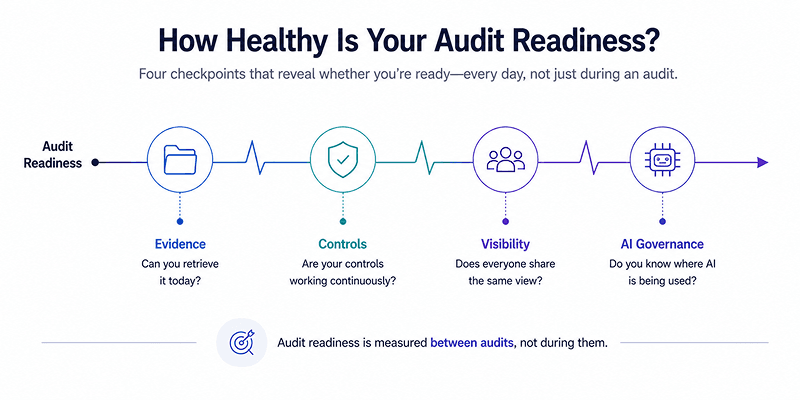
If any of these situations sound familiar, they may be signs that your organization is preparing for audits rather than staying audit-ready.
You're scrambling to collect evidence every time an audit starts
If preparing for an audit means sending emails to different teams for screenshots, reports, approvals, or policy documents, your compliance process is reactive.
Manual evidence collection slows everyone down, increases the risk of missing or outdated information, and takes valuable time away from higher-value compliance work. Many organizations are now looking at intelligent workflow automation to streamline evidence collection, approvals, and cross-functional coordination instead of relying on manual follow-ups.
A simple question can reveal where you stand. If an auditor asked for evidence tomorrow, how much could you provide without asking another team to look for it?
You don't know whether your controls are still working
Passing your last audit doesn't guarantee your controls are still effective today. People change roles, permissions are updated, systems evolve, and new applications are introduced. Even small operational changes can weaken a control without anyone realizing it.
Being audit-ready means knowing your controls are working now, not just that they worked during your last assessment.
Compliance is everyone's responsibility, but nobody has the full picture
Compliance spans security, IT, HR, legal, procurement, and engineering. Each team owns part of the process, but without a shared view, it's easy for gaps to appear.
With multiple frameworks, the challenge grows for organizations. The same control often supports several regulations, making visibility and ownership just as important as the control itself.
AI is creating new compliance blind spots
Employees are already using AI to write code, analyze data, create content, and automate everyday work. Much of this happens with good intentions, but often without clear governance.
The challenge isn't whether AI is being used. It's whether organizations understand where it's being used, what data is being shared, and whether those activities align with their compliance requirements.
According to the 2026 State of Audit and Compliance Report by Thoropass, nearly seven in ten compliance and security leaders believe AI adoption is moving faster than their organization's ability to govern it.
Why Do Organizations Fall Out of Compliance Even After Passing an Audit?
One of the most common questions we hear is, "We passed our last audit, so why are we finding compliance issues only a few months later?"
The answer is simple. An audit confirms that your controls were effective on a specific day. It doesn't guarantee they'll remain effective as your business changes.
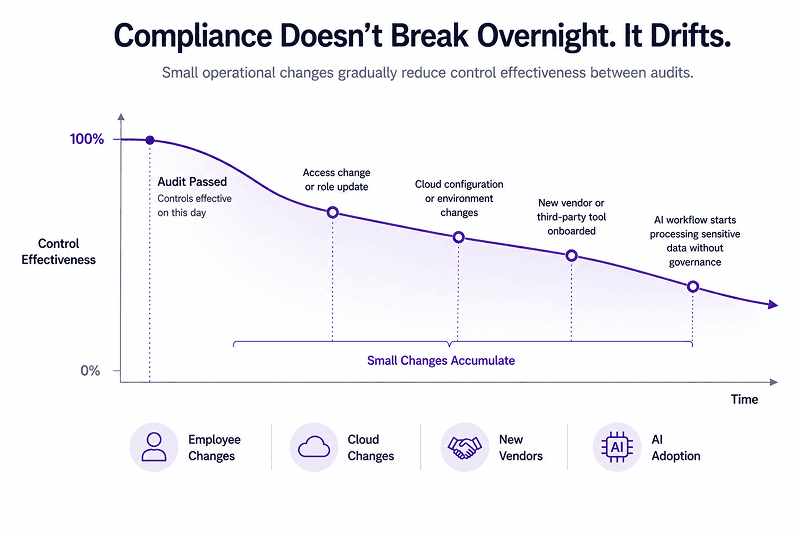
Employees change roles, cloud environments evolve, new vendors are onboarded, and AI tools are introduced. Unless these changes are continuously monitored, your organization can gradually drift away from the controls that were originally assessed.
Controls Don't Fail Overnight. They Drift Over Time.
Most compliance failures aren't caused by a single event. They happen because of small operational changes that gradually weaken existing controls.
An employee may retain unnecessary access, a cloud configuration might change, or a new AI workflow could begin processing sensitive data without proper governance. As organizations continue modernizing their business operations with AI and cloud technologies, these changes happen more frequently than ever. Individually, they may seem minor. Together, they create what's called a control drift, which is the gradual erosion of control effectiveness between audits.
Audits Provide Assurance for a Defined Period. The Business Keeps Changing.
An audit provides assurance about controls within a defi ned scope and period. But the business doesn’t stop changing once the audit is complete. People change roles, systems evolve, vendors are added, permissions change, and new technologies enter the environment. That’s why organizations can successfully complete an audit and still develop compliance gaps months later. Continuous Controls Monitoring (CCM) helps close this gap by validating controls as business operations change, allowing teams to identify and resolve issues before they become audit findings.
At Clarient, we've found that the strongest compliance programs don't prepare for audits once a year. They build visibility into their controls, making audits a confirmation of what they already know and not just a discovery exercise.
Table 1: Point-in-Time Audits vs. Continuous Compliance Monitoring
| Area | Traditional Audit Approach | Continuous Compliance Monitoring |
| Visibility | Snapshot of one point in time | Ongoing visibility into control health |
| Evidence Collection | Manual and audit-driven | Automated and continuous |
| Issue Detection | During audit preparation or assessment | As changes occur |
| Control Validation | Periodic | Continuous |
| Audit Readiness | Reactive | Always audit-ready |
| Business Impact | High effort before every audit | Lower operational overhead throughout the year |
The longer compliance gaps go undetected, the more expensive they can become
Delayed detection doesn't just create extra work for compliance teams. It creates measurable business risk.
IBM's Cost of a Data Breach Report found that the average global cost of a data breach reached $4.44 million, while organizations in the United States faced an average cost of $10.22 million, the highest globally. The report also highlighted another emerging concern. Organizations that don't have effective AI governance experienced significantly higher breach costs, with unmanaged "shadow AI" adding an average of $670,000 to breach-related expenses.
Not every compliance gap leads directly to a breach. However, the principle remains the same.
The longer a control failure goes unnoticed, the more expensive it becomes to investigate, remediate, document, and recover from the consequences.
Consider a simple example. A privileged employee changes departments but retains administrator access for several months. If the issue is detected through continuous monitoring, the remediation may involve nothing more than removing unnecessary permissions, and within hours. If the same issue remains undiscovered until an external audit or security incident, the organization may need to:
- Perform a detailed forensic investigation.
- Review historical access logs.
- Demonstrate regulatory compliance.
- Reassess related controls.
- Notify customers or regulators where required.
- Respond to audit findings and corrective actions.
The cost difference between those two scenarios extends far beyond compliance. It affects operational efficiency, customer trust, executive confidence, and business continuity.
Common areas where organizations discover compliance gaps too late
| Operational Change | Risk if Not Continuously Monitored |
| Employee role changes | Excessive or outdated system access |
| Cloud infrastructure updates | Security configuration drift |
| Vendor onboarding | Missing third-party risk assessments |
| Policy changes | Teams following outdated procedures |
| AI adoption | Shadow AI, missing audit trails, unapproved data usage |
| Software deployments | Controls unintentionally bypassed |
One observation we've consistently made across enterprise environments is that organizations rarely experience a single catastrophic compliance failure. Instead, risk accumulates through dozens of seemingly minor changes that go unnoticed over time.
That's why effective compliance monitoring isn't just about reducing audit effort. It's about reducing the time between change, detection, and action.
What's Changed in 2026 That Makes Compliance Even Harder?
Over the past few years, we've seen compliance become significantly more complex, not because organizations care less about governance, but because the environments they're trying to govern have changed. Cloud adoption has accelerated, businesses are managing more third-party relationships, and AI is becoming part of everyday operations. Traditional compliance programs, built around periodic reviews, are struggling to keep pace with this rate of change.
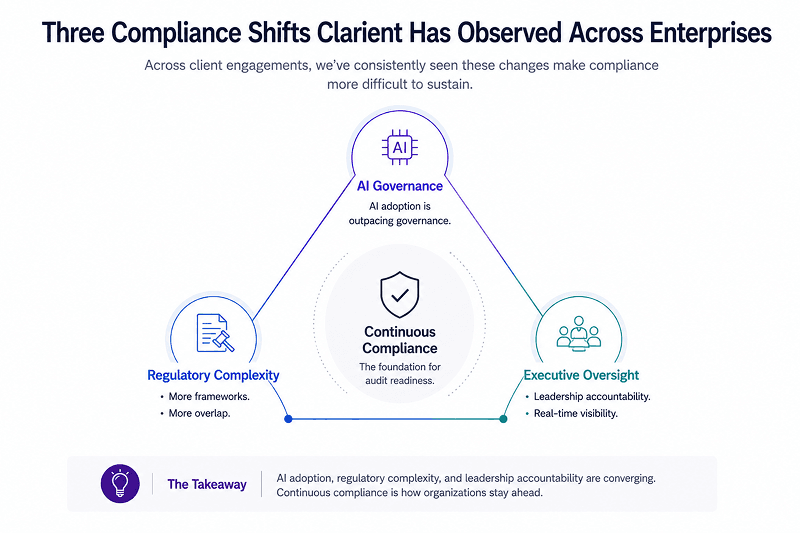
Three shifts, in particular, are redefining what it takes to stay audit-ready.
AI Has Become the Fastest-Growing Compliance Blind Spot
Across client engagements, one pattern has become increasingly clear: AI adoption is moving much faster than AI governance. Teams are adopting AI tools to improve productivity, often before formal policies, approval processes, or monitoring mechanisms are established.
That creates important compliance questions:
- Where is sensitive data being processed?
- Can AI-assisted decisions be audited?
- Who approved the use of the model?
- Does AI usage align with internal policies and regulatory requirements?
This isn't just our observation. The Thoropass 2026 State of Audit and Compliance Report found that nearly 70% of security and compliance leaders believe AI adoption is outpacing the controls needed to manage it. AI governance is no longer a future consideration. It's becoming a core component of enterprise compliance.
Remember: Before your next audit, create an inventory of AI applications being used across departments. Many organizations discover far more AI adoption than they initially expected.
Regulations Are Becoming Harder to Manage
We've also found that the challenge isn't complying with one regulation. It's managing multiple frameworks simultaneously while the business continues to evolve.
That observation is reflected in PwC's Global Compliance Survey 2025, where 85% of organizations reported that compliance requirements have become more complex over the past three years. Many enterprises now need to manage overlapping requirements across frameworks such as SOC 2, ISO 27001, GDPR, HIPAA, PCI DSS, and industry-specific regulations.
Without automation and continuous monitoring, compliance teams often duplicate evidence collection, repeat assessments, and maintain separate documentation for controls that are fundamentally the same. As regulatory complexity grows, these manual processes become increasingly difficult to sustain.
Leadership Is Now Expected to Demonstrate Oversight
Compliance is no longer viewed as the sole responsibility of governance or legal teams. Increasingly, executive leadership is expected to demonstrate active oversight of the organization's compliance posture.
According to Gartner, growing regulatory scrutiny is driving greater investment in governance, risk, and compliance technologies while placing greater emphasis on individual executive accountability for compliance failures.
For leadership teams, the conversation has shifted from "Did we pass the audit?" to questions like:
- Are our critical controls operating effectively today?
- Who owns each compliance risk?
- How quickly can we detect and remediate issues?
- What governance exists as we scale enterprise AI initiatives?
That's why compliance monitoring has evolved from an operational reporting function into a strategic capability. It gives leaders continuous visibility into their compliance posture, allowing them to make informed decisions instead of waiting for the next audit to reveal hidden gaps.
Table 3: How Compliance Expectations Have Changed
| Then | Now |
| Prepare for annual audits | Stay continuously audit-ready |
| Focus on documentation | Focus on continuous control assurance |
| Manual evidence collection | Automated evidence collection |
| Compliance owned by one team | Shared ownership with centralized visibility |
| AI treated as an innovation initiative | AI treated as a governance and compliance priority |
| Leadership reviews audit reports | Leadership expects continuous compliance insights |
Is It Time to Invest in Compliance Monitoring Software?
Which Compliance Monitoring Solution Fits Your Organization Best?
Searching for "best compliance monitoring software" typically produces long lists ranking dozens of products. While those comparisons can be useful, they rarely answer the question enterprise buyers are actually asking: "Which solution is right for an organization like ours?"
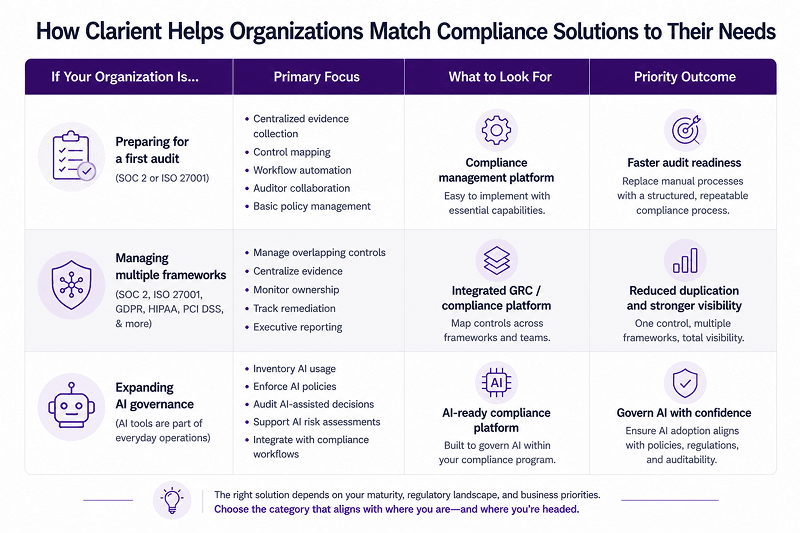
The answer depends far less on feature lists than on your operational maturity, regulatory landscape, and business priorities. Rather than looking for a universal "best" platform, it's more useful to identify which category of solution aligns with your current needs.
If you're preparing for your first SOC 2 or ISO 27001 audit
Organizations preparing for their first certification generally don't need enterprise-scale governance platforms. Their priorities are usually:
- Centralized evidence collection
- Control mapping
- Workflow automation
- Auditor collaboration
- Basic policy management
The objective is to replace scattered spreadsheets and manual document requests with a structured, repeatable compliance process. Ease of implementation often matters more than advanced functionality.
If you're managing multiple frameworks across teams
As organizations mature, compliance becomes significantly more complex. Instead of supporting one framework, teams may simultaneously manage:
- SOC 2
- ISO 27001
- ISO 42001, ISO 9001
- GDPR
- HIPAA
- PCI DSS
- Internal governance policies
The challenge shifts from documenting controls to managing overlap. Many controls satisfy multiple frameworks, yet organizations often duplicate evidence collection because each standard is managed independently.
In these environments, integrated compliance and risk management platforms become considerably more valuable because they allow teams to:
- Map one control across multiple frameworks.
- Centralize evidence.
- Monitor ownership.
- Track remediation activities.
- Generate executive reporting.
This reduces duplication while improving visibility across the entire compliance program.
If AI governance has become a priority
This is the area where many software evaluations still fall short. Most traditional compliance platforms were designed before generative AI became part of everyday enterprise operations.
As a result, organizations should now evaluate whether potential solutions can support questions such as:
- Can AI usage be inventoried?
- Are AI-related policies enforceable?
- Can AI-assisted decisions be audited?
- Does the platform support AI risk assessments?
- Can AI governance be incorporated into existing compliance workflows?
These capabilities are becoming increasingly important, particularly for organizations handling regulated customer data or operating in highly regulated industries such as finance or healthcare.
Healthcare organizations, for example, must ensure that AI adoption aligns with HIPAA-related privacy and security controls, audit trails, and existing compliance workflows. Simply governing traditional IT systems is no longer sufficient.
What Does an Organization That's Always Audit-Ready Do Differently?
If you've ever wondered why some organizations move through audits with minimal disruption while others spend weeks chasing evidence, the difference usually isn't budget or team size.
Across our work with enterprise organizations, we've found that the most audit-ready teams don't treat compliance as something they revisit before an audit. They build it into their everyday operations. Here are four practices they have in common.
Compliance Evidence Is Collected Continuously
Instead of gathering screenshots, reports, and logs a few weeks before an audit, mature organizations collect evidence throughout the year. By automating evidence collection across their existing systems, they reduce manual work and always have up-to-date documentation when it's needed.
Everyone Knows Who Owns Each Control
One of the biggest causes of audit delays is unclear ownership. High-performing organizations avoid this by assigning a clear owner, review schedule, and escalation path for every critical control. When everyone knows their responsibilities, compliance becomes part of day-to-day operations rather than a last-minute effort.
Issues Are Resolved Before They Become Audit Findings
Waiting for an audit to uncover compliance gaps is both costly and avoidable. Organizations with continuous compliance monitoring identify failed controls, outdated evidence, or unexpected changes as they happen, giving teams time to fix issues before auditors ever see them.
AI Is Treated Like Every Other Business Risk
As AI adoption grows, leading organizations are bringing it into their existing compliance programs instead of managing it separately. They know where AI is being used, monitor how sensitive data is handled, and regularly review AI-related risks alongside their other compliance controls.
Compliance Maturity Comparison
| Traditional Compliance | Continuously Audit-Ready Organization |
| Evidence gathered before audits | Evidence collected throughout the year |
| Controls reviewed periodically | Controls monitored continuously |
| Ownership spread across departments | Every control has a defined owner |
| Issues discovered during audits | Issues identified as operational changes occur |
| Compliance focused on documentation | Compliance focused on ongoing assurance |
| AI governance managed separately | AI governance integrated into compliance processes |
What Should Your Team Be Doing Between Audits?
One of the biggest misconceptions about compliance is that the real work begins when an audit is announced.
The organizations that stay audit-ready don't scramble before every audit. They follow a consistent operating cadence throughout the year, continuously monitoring controls, collecting evidence, and addressing risks as part of everyday operations.
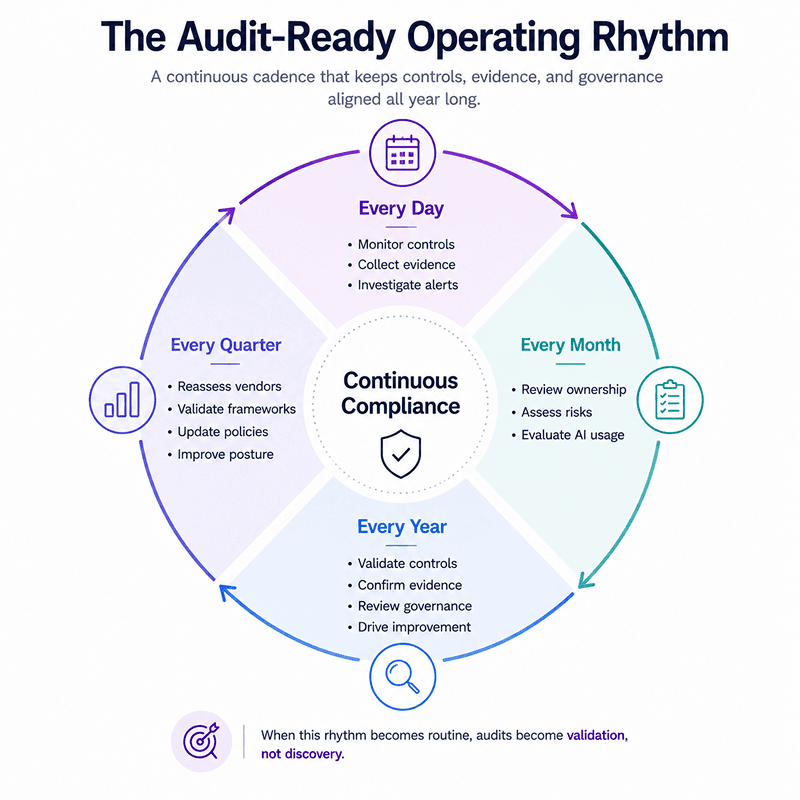
The following framework can serve as a practical starting point.
Every day: Monitor controls, collect evidence, and investigate alerts
Your goal each day isn't to generate more reports. It's to make sure your controls are working as expected and identify issues before they grow.
Focus on:
- Monitoring critical controls.
- Collecting evidence automatically.
- Investigating failed control alerts.
- Reviewing privileged access changes.
- Monitoring AI usage where relevant.
Every Month: Review Ownership and Emerging Risks
Monthly reviews help you step back and check whether your compliance program is keeping pace with business changes. Review:
- Outstanding compliance issues.
- Control ownership and accountability.
- New AI tools and their governance.
- Vendor onboarding and risk.
- Recurring control failures.
Every Quarter: Strengthen Your Compliance Program
Quarterly reviews are an opportunity to improve your program, not just maintain it.
Evaluate:
- Third-party and vendor risks.
- Coverage across compliance frameworks.
- Policy updates driven by regulatory changes.
- Cloud security posture.
- Progress on remediation efforts.
Every Year: Make the Audit a Confirmation, Not a Discovery
If you've been monitoring compliance throughout the year, the annual audit shouldn't reveal surprises. Instead, it should confirm that your controls are working, your evidence is complete, and your governance processes remain effective.
The best audit outcomes come from the work your team does between audits, not in the weeks leading up to them.
A Practical Compliance Operating Cadence
| Frequency | Primary Objective | Typical Activities |
| Daily | Maintain visibility | Monitor controls, collect evidence, investigate alerts |
| Monthly | Strengthen governance | Review ownership, unresolved risks, AI usage, executive reporting |
| Quarterly | Improve the compliance program | Update policies, reassess vendors, validate framework coverage |
| Annually | Validate overall readiness | Complete external audits and identify strategic improvements |
Where Should You Start If You're Moving Toward Continuous Compliance?
Building a mature compliance program doesn't happen overnight. Trying to automate every control or implement every governance process simultaneously often creates unnecessary complexity. A phased approach usually delivers better results and allows teams to demonstrate value early.
Week 1: Understand where your biggest compliance gaps are
Begin with an honest assessment of your current state. Identify:
- Which controls are monitored manually.
- Where evidence collection consumes the most effort.
- Which frameworks overlap.
- Where ownership is unclear.
- Whether AI usage is currently governed.
The goal isn't to document every possible issue. It's to identify the areas creating the greatest operational risk.
Week 2: Assign ownership and close high-risk monitoring gaps
Technology becomes significantly more effective once accountability is clearly defined. During this phase:
- Assign owners to every critical control.
- Define review frequencies.
- Establish escalation paths.
- Prioritize automation opportunities.
- Address high-risk AI governance gaps.
Clear ownership often improves compliance outcomes even before new technology is introduced.
Weeks 3 and 4: Automate evidence collection and establish continuous monitoring
Once governance is in place, begin introducing automation where it creates the greatest operational value. Typical priorities include:
- Identity and access management.
- Cloud infrastructure monitoring.
- Policy acknowledgements.
- Employee training records.
- Vendor risk documentation.
- Compliance reporting.
Rather than automating everything immediately, focus on repetitive processes that consume significant manual effort.
The timeline will vary by organization. This four-week sequence is intended as a starting structure for prioritizing the first improvements, not a complete compliance transformation.
Conclusion: Compliance Monitoring Is No Longer About Passing Audits. It's About Staying Ready Every Day.
Passing an audit is a significant achievement, but it's only one moment in time. The real question is whether you know, with confidence, that your controls are still working today, your evidence is up to date, and new risks aren't quietly emerging between audit cycles.
That's becoming increasingly difficult as organizations adopt AI, expand their cloud environments, and manage multiple regulatory frameworks. Relying on periodic reviews alone is no longer enough. Compliance monitoring has become an essential part of running a resilient, well-governed organization, helping you stay ahead of issues instead of reacting to them.
If preparing for every audit still means chasing documentation, coordinating across teams, or wondering whether your controls are still effective, it may be time to rethink how your compliance program operates.
At Clarient, we've helped organizations move beyond reactive audit preparation by building practical, continuous compliance programs that fit the way their business works. Whether you're evaluating compliance monitoring software, preparing for SOC 2, ISO 27001, HIPAA, or GDPR, or strengthening AI governance, we can help you build a compliance strategy that's designed to scale with your organization.
Ready to spend less time preparing for audits and more time knowing you're already prepared? Talk to our compliance experts to assess your current compliance maturity and build a practical roadmap toward continuous compliance monitoring.
Frequently Asked Questions.
1. What is compliance monitoring?
Compliance monitoring is the ongoing process of ensuring that your organization's policies, controls, and day-to-day operations continue to meet internal standards and external regulatory requirements. Unlike periodic audits, which evaluate compliance at a specific point in time, compliance monitoring provides continuous visibility into whether controls remain effective as your business evolves. This includes tracking policy adherence, reviewing access controls, monitoring system changes, collecting audit evidence, and identifying potential risks before they become compliance violations.
2. What is compliance in healthcare?
Compliance in healthcare refers to following the laws, regulations, industry standards, and internal policies that protect patient information, ensure quality care, and maintain operational integrity. Healthcare organizations must comply with regulations such as HIPAA, data privacy requirements, billing standards, cybersecurity guidelines, and various regional healthcare regulations depending on where they operate.
Because healthcare organizations manage highly sensitive patient information, compliance extends beyond documentation. It involves protecting electronic health records, controlling access to medical data, securing connected medical devices, monitoring third-party vendors, and increasingly governing how AI is used in clinical and administrative workflows. Strong compliance programs help healthcare providers reduce regulatory risk while maintaining patient trust and improving overall security.
3. Where can you buy AI compliance tools for risk monitoring?
There isn't a single marketplace for AI compliance tools because the right solution depends on your organization's regulatory requirements, industry, and existing technology stack. Many organizations evaluate AI governance capabilities through established Governance, Risk, and Compliance (GRC) platforms, cybersecurity vendors, cloud security providers, and specialized AI governance software vendors. Enterprise technology marketplaces from major cloud providers can also be useful starting points.
Before purchasing any solution, focus less on vendor rankings and more on your business needs. Ask whether the platform can monitor AI usage across your organization, maintain audit trails, support policy enforcement, detect unauthorized AI applications, integrate with your existing compliance processes, and adapt as AI regulations evolve. Choosing a solution that fits your governance strategy is far more important than selecting the platform with the longest feature list.
4. What are compliance software tools?
Compliance software tools help organizations automate and simplify activities such as evidence collection, policy management, risk assessments, control monitoring, audit preparation, and regulatory reporting. Depending on the organization's needs, these tools may also support workflow automation, vendor risk management, AI governance, and continuous compliance monitoring. The goal is not to replace compliance teams but to reduce manual effort, improve visibility, and help organizations maintain compliance more efficiently.
5. What tools and solutions are recommended for GDPR cybersecurity compliance?
The right tools depend on your organization's size and data processing activities, but most organizations benefit from solutions that support data discovery, identity and access management, encryption, security monitoring, vulnerability management, consent management, and compliance reporting. Organizations implementing GDPR compliance strategies should also consider tools that automate evidence collection, monitor access to personal data, and provide clear audit trails to demonstrate compliance during regulatory reviews.
6. What tools do healthcare compliance professionals use for their work?
Healthcare compliance professionals typically rely on a combination of governance, risk, and compliance (GRC) platforms, HIPAA compliance software, security information and event management (SIEM) solutions, identity and access management tools, policy management systems, vendor risk management platforms, and audit management software. Together, these tools help protect patient information, automate documentation, monitor compliance controls, and simplify audit preparation.
7. What does risk management and compliance do?
Risk management and compliance work together to help organizations identify potential risks, understand regulatory obligations, implement appropriate controls, and continuously monitor whether those controls remain effective. While risk management focuses on identifying and reducing business risks, compliance ensures the organization operates in accordance with applicable laws, regulations, industry standards, and internal policies. Together, they strengthen governance, improve decision-making, and reduce the likelihood of financial, legal, and reputational consequences.
8. What is the role of a compliance audit?
A compliance audit independently evaluates whether an organization's policies, controls, and operational practices meet the requirements of relevant regulations, contractual obligations, or industry standards. Auditors review evidence, assess control effectiveness, identify gaps, and provide recommendations for improvement.
While audits remain an important part of governance, they should be viewed as validation rather than discovery. Organizations that rely on continuous compliance monitoring identify and resolve issues throughout the year, allowing audits to confirm that controls are working instead of uncovering problems for the first time. This approach reduces audit stress, improves operational resilience, and creates a stronger overall compliance program.
Weekly Insights Subscription
Stay ahead with Clarient insignts on customer insights
Share
Written by

Parthsarathy Sharma
With 4+ years of experience across AI, UX, enterprise technology, and brand strategy, Parthsarathy brings a research-driven lens to digital experience content. His work focuses on turning emerging technology, customer experience, and business trends into clear, practical perspectives for readers.
Reviewed by

Ganesh Kalla
Ganesh Kalla is a certified ISO/IEC 27001 and ISO/IEC 42001 Lead Auditor with over nine years of experience in Governance, Risk, and Compliance (GRC). He specializes in information security governance, ISMS implementation, enterprise risk management, SOC 2 readiness, and compliance monitoring, helping organizations strengthen security, resilience, and audit readiness.