Product Engineering
Cross-industry
How to Measure Success of Digital Transformation: A Complete KPI Framework for Enterprises
Published on July 23, 2026

table of content
- Introduction
- Why Measuring Your Digital Transformation Is Harder Than You Think
- Why More KPIs Rarely Lead to Better Decisions
- Before You Choose KPIs, Decide What Success Actually Means
- A Framework to Measure Success Without Tracking Hundreds of KPIs
- The Five Business Signals That Reveal Whether Transformation Is Creating Value
- Why ROI Alone Can Undervalue Digital Transformation
- The Most Overlooked Part of KPI Frameworks: Ownership
- A Practical KPI Scorecard Enterprises Can Start Using Today
- Common Measurement Mistakes That Quietly Derail Digital Transformation
- Conclusion: Measuring Digital Transformation Is Easier When You Know What Really Matters
- Frequently Asked Questions
listen to blog
summary
Learn how to measure the success of digital transformation using Clarient's KPI framework with business signals & metrics that drive growth.
Introduction
How do you know if your digital transformation is actually working? Not whether a new platform has been deployed. Not whether employees have completed training. Not whether another AI initiative has gone live.
Has your business become more efficient? Are your customers having better experiences? Are your technology investments delivering the outcomes you expected?
For many enterprise leaders, those questions are surprisingly difficult to answer.
The challenge is the absence of clarity around what success should actually look like. Different teams approach tracking success in different ways. There are many reports, but very little confidence about whether the transformation is creating meaningful business value.
At Clarient, we've seen that the organizations making the most progress don't start by asking, "What should we measure?" They start by asking, "What business outcomes are we trying to achieve?" That shift in thinking changes everything.
This is also supported by McKinsey's research, which found that fewer than 30% of digital transformations succeed, and only 16% of organizations report improvements in business performance while also building the capabilities needed to sustain those gains over time.
In this guide, you'll learn how to measure the success of digital transformation using a practical KPI framework that connects business strategy, meaningful metrics, and measurable outcomes.
Why Measuring Your Digital Transformation Is Harder Than You Think
Measuring the growth of your digital initiatives is difficult because success is not static. Your business evolves over time, and priorities change. Customer expectations, operating models, and technology also evolve with it.
Unlike traditional IT projects, transformation reshapes multiple parts of your business at once. Technology teams modernize systems, operations redesign workflows, customer-facing teams introduce new digital experiences, and so on. Each of these functions redefines success differently, making it difficult to build a single view of growth
The challenge doesn't stop there. As you begin to scale digital transformation across your organization, business priorities naturally evolve. An initiative that begins with improving operational efficiency may later shift toward AI adoption, customer experience, resilience, or regulatory compliance. As your priorities change, the metrics that matter should change too.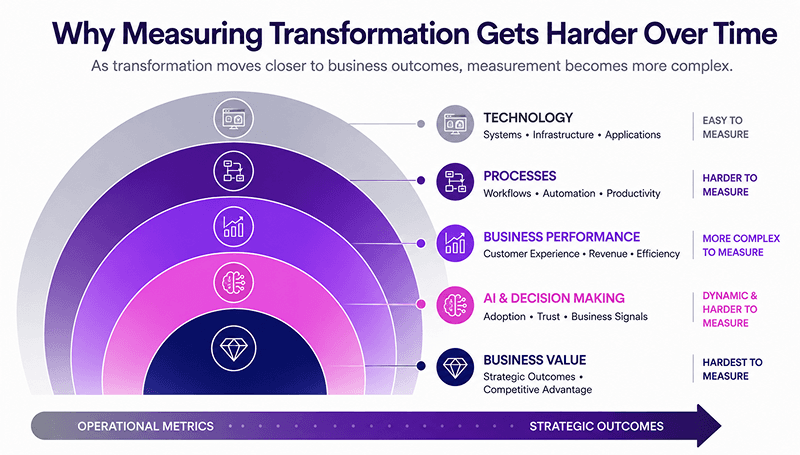
Why More KPIs Rarely Lead to Better Decisions
If you're struggling to prove the value of your digital transformation, adding more KPIs probably isn't the answer.
As you grow, every team starts tracking its own metrics. Individually they're useful, but together they often create reports that make it harder, not easier, to see whether the business is actually improving.
This is where vanity metrics become a problem. High training completion rates or dozens of AI pilots may look impressive, but they mean little if customer experience, operational efficiency, or the business value created by intelligent software solutions isn't improving.
Over the years, working with industry leaders has taught us that the best KPI frameworks are not the largest. Instead, they are the ones where every metric answers one question: Will this help us make a better business decision? If not, it probably doesn't belong on your dashboard.
Measuring More vs. Measuring Better
| Measuring More | Measuring Better |
| Large dashboards with dozens of KPIs | A focused scorecard built around business priorities |
| Department-specific reporting | Enterprise-wide business outcomes |
| Activity metrics | Outcome-based indicators |
| Quarterly reporting reviews | Continuous decision-making and action |
| Every team defines success differently | Leadership shares a common definition of success |
Before You Choose KPIs, Decide What Success Actually Means
Before you decide what to measure, decide what success looks like.
It's a simple shift, but one many organizations overlook. Leadership teams often start by asking, "What KPIs should we track?" when the better question is, "What business outcome are we trying to achieve?"
Your answer shapes every metric that follows.
What you measure should depend on what you're trying to achieve. If you're focused on growing revenue, you'll naturally measure success differently than an organization trying to improve operational efficiency or deliver a better customer experience. The same applies to enterprise AI. Simply implementing the technology isn't enough. What matters is whether it's helping you achieve the business outcomes you set out to deliver.
In fact, we've found that the strongest measurement frameworks start with business outcomes. Once you've defined the outcome, selecting meaningful KPIs becomes much easier because every metric has a clear purpose.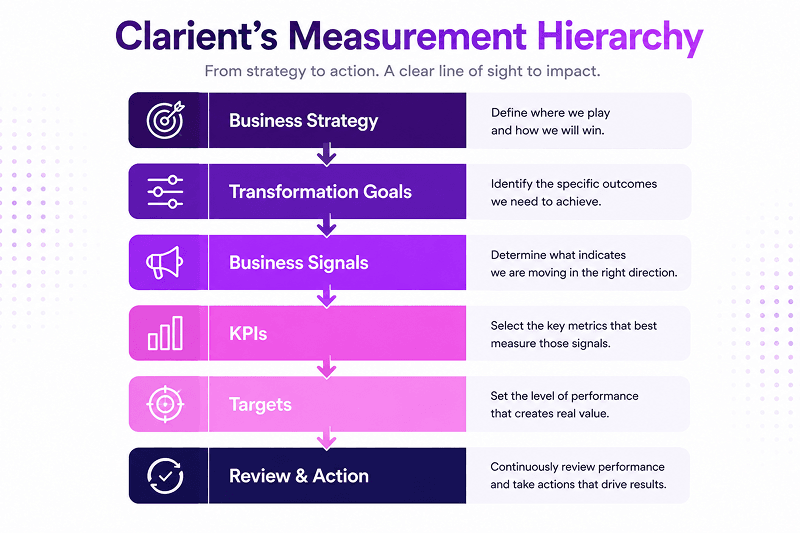
A Framework to Measure Success Without Tracking Hundreds of KPIs
Most organizations don't struggle because they lack KPIs. They struggle because they haven't built a system that connects business strategy, measurement, and decision-making.
If you're leading a digital transformation initiative, your goal isn't to create another executive dashboard. Your goal is to know whether every technology investment is moving the business in the right direction and, if it isn't, identify what needs to change.
At Clarient, we've found that organizations create significantly more value when they treat KPI measurement as an ongoing business capability and not just a reporting exercise. This approach aligns with Gartner's recommendation to focus on a small set of actionable KPIs rather than an extensive KPI hierarchy.
The Clarient KPI Framework helps you move from measuring activity to measuring business impact in six practical steps: 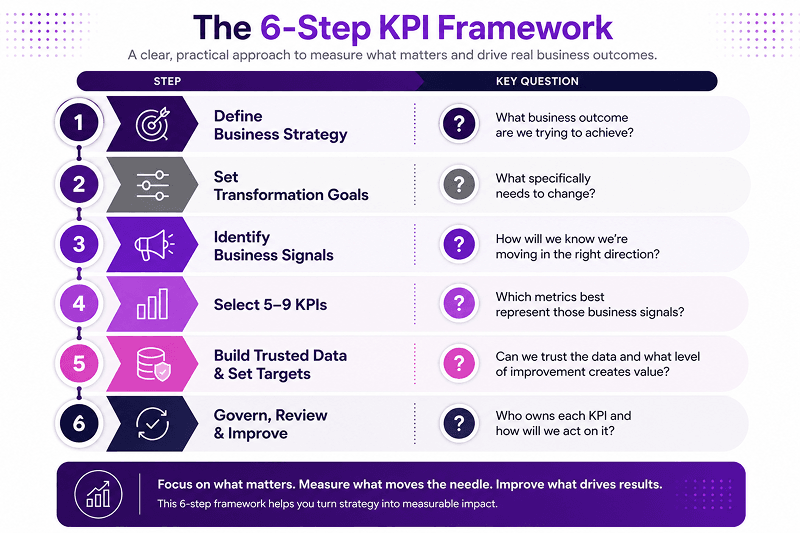
Let's understand the framework in-depth.
Step 1. Define Business Strategy
Before you think about KPIs, ask yourself a simpler question: What business problem are you trying to solve?
It's easy to get excited about AI initiatives. But if you haven't agreed on the business outcome you're trying to achieve, your KPIs won't tell you whether your transformation is actually succeeding.
At Clarient, we've found that the strongest transformation programs begin with a shared understanding of what success looks like. Are you trying to grow revenue, improve efficiency, deliver a better customer experience, or reduce compliance risk? Once you're clear on the outcome, every KPI has a purpose.
In fact, this approach is increasingly reflected in industry research. McKinsey found that while 89% of large organizations are investing in digital and AI transformation, they've realized only 31% of the expected revenue lift and 25% of the expected cost savings. The highest-performing organizations don't focus on technology alone. They align strategy, data, operating models, talent, and adoption around clearly defined business outcomes.
Step 2. Set Transformation Goals
Once you've agreed on the business outcome, define what needs to change to achieve it.
Your transformation goals should describe measurable business improvements rather than technology milestones. For example, instead of aiming to "implement an AI platform," define the business result you expect, such as reducing onboarding time by 40%, cutting manual processing by half, or improving first-contact resolution.
This shift keeps your teams focused on business value instead of just implementation milestones. Technology is the enabler, not the objective.
Step 3. Identify Business Signals
One of the biggest mistakes organizations make is jumping directly from goals to KPIs.
At Clarient, we introduce an intermediate layer called business signals because leadership teams shouldn't have to interpret dozens of disconnected metrics to understand whether transformation is working.
Business signals describe the direction of the business. They represent the broader outcomes you want to influence but are not the same as the transformation goals. Transformation goals define the specific change you want to achieve, while business signals show whether the organization is moving toward it. KPIs are the individual measurements used to confirm whether those signals are improving. Across most enterprises, these typically include Financial Value, Operational Performance, Customer Experience, Workforce Adoption, and Innovation & Organizational Agility.
When executive discussions begin with business signals instead of individual metrics, conversations naturally become more strategic and less focused on isolated operational reports.
Step 4. Select Five to Nine KPIs
Only after defining your business signals should you decide which KPIs to measure.
A common misconception is that better measurement requires more metrics. In reality, large dashboards often create more confusion than clarity. We recommend that organizations focus on a small number of KPIs that leaders can consistently review, understand, and act upon.
Your KPI selection might include process cycle time, digital transformation ROI, Net Promoter Score, employee adoption rate, or time-to-market. The specific metrics will vary, but every KPI should answer one question: Will this help us make a better business decision?
Step 5. Build Trusted Data and Set Performance Targets
Even the best KPI framework won't help you if you can't trust the data behind it.
If different teams calculate the same metric in different ways, or your data is scattered across ERP, CRM, HR, finance, and operational systems, you'll spend more time debating the numbers than acting on them. That's when confidence in your measurement framework starts to break down.
At Clarient, we've observed a clear pattern: organizations get the most value from their KPIs when everyone works from the same data, uses the same definitions, and measures the same business outcomes.
This aligns with PwC's Digital Trends research, which shows that poor data integration and governance continue to limit the value many organizations get from their digital transformation investments.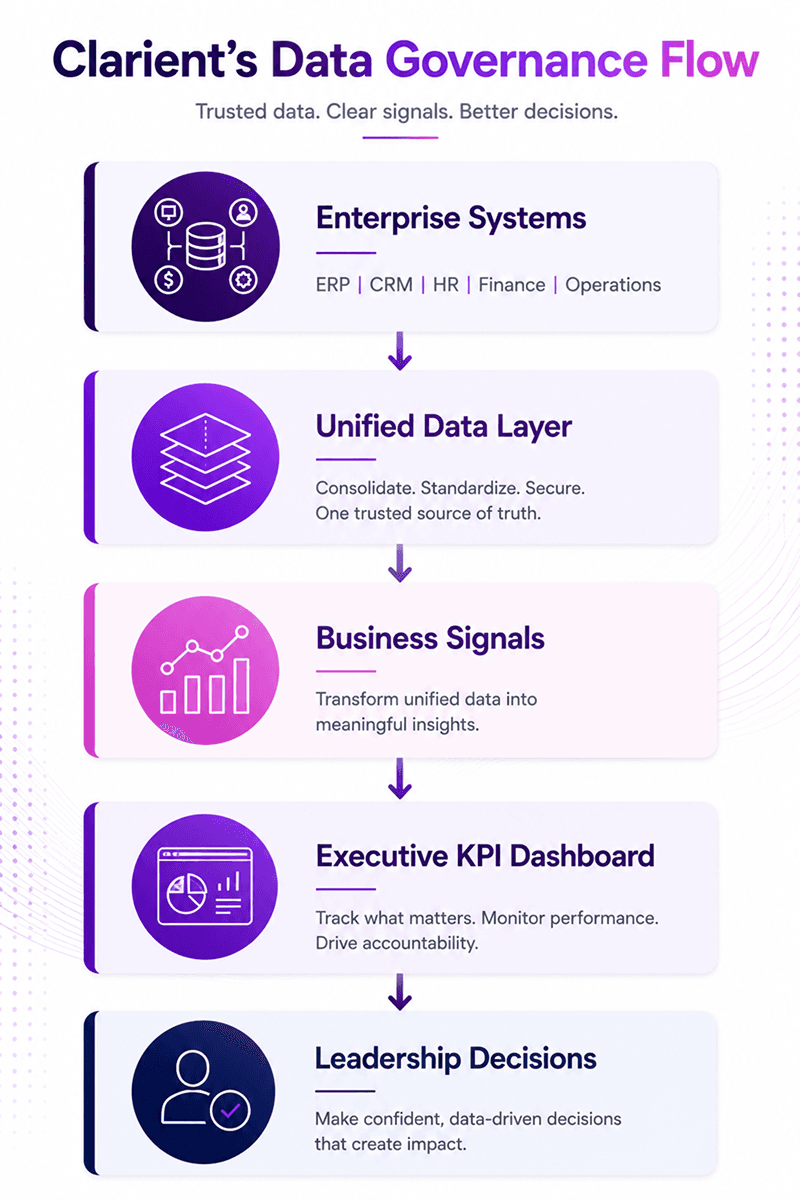
Once that foundation is in place, define realistic targets, warning thresholds, and balance points that indicate whether performance is improving or requires intervention.
Step 6. Govern, Review, and Continuously Improve
Selecting KPIs is only the first step. The where the real work begins after that and value is derived from reviewing performance, making decisions, and improving outcomes over time.
Every KPI should have a clearly defined owner who is responsible not only for reporting performance but also for improving it. Without ownership, dashboards quickly become historical reports rather than management tools.
At Clarient, we recommend establishing a regular governance cadence wherein business and technology leaders review KPI performance. And where possible, introduce automated feedback loops that alert KPI owners when performance falls outside predefined thresholds. This enables teams to respond early rather than waiting until quarterly reviews to identify problems.
Deloitte's research supports this, showing that clear ownership, reporting structures, and team capabilities play a key role in how much value organizations realize from digital transformation.
The Five Business Signals That Reveal Whether Transformation Is Creating Value
Many frameworks group metrics into categories such as financial, operational, or customer KPIs. While this approach is useful, it often encourages organizations to think about reporting and the focus on business outcomes is lost.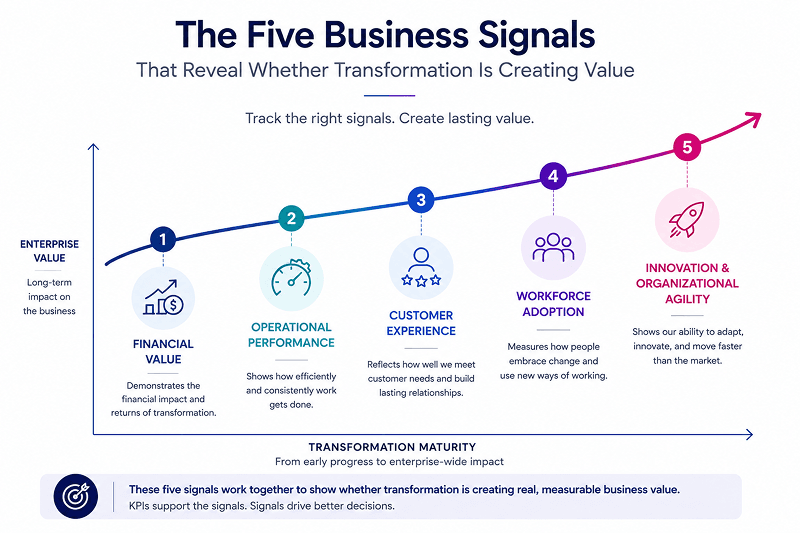
At Clarient, we prefer a different perspective. Rather than asking, "Which KPI category does this metric belong to?" we ask, "What business signal is this metric sending?"
Business signals provide leadership teams with a clearer picture of whether transformation is creating meaningful value across the enterprise. Individual KPIs support these signals, but they are not the signals themselves.
The five business signals below provide a balanced view of enterprise transformation.
1. Financial Value
Every transformation ultimately needs to demonstrate business value. That doesn't mean every initiative should generate immediate revenue, but leaders should be able to explain how investments contribute to long-term financial performance.
Relevant indicators may include:
- Digital transformation ROI
- Cost savings from automation
- Revenue generated through digital channels
- Operating margin improvements
- Payback period for major transformation initiatives
2. Operational Performance
Improved operational performance is one of the earliest signs that transformation is working. Organizations should evaluate whether work is becoming faster, simpler, and more consistent. This is a much better indicator of success than system uptime or deployment statistics.
Examples include:
- Process cycle time
- Workflow automation rates
- Productivity improvements
- Error reduction
- Service delivery speed
3. Customer Experience
Ultimately, customers determine whether transformation creates competitive advantage. Digital initiatives should make interactions easier, faster, and more consistent across every touchpoint.
Common indicators include:
- Net Promoter Score (NPS)
- Customer Satisfaction Score (CSAT)
- Customer Digital Adoption
- Customer effort score
- First-contact resolution
Clarient's Five Business Signals
| Business Signal | Key Question | Example KPIs |
| Financial Value | Is transformation creating measurable business value? | ROI, cost savings, digital revenue, payback period |
| Operational Performance | Are operations becoming more efficient? | Cycle time, productivity, automation rate |
| Customer Experience | Are customers experiencing meaningful improvements? | NPS, CSAT, digital adoption rate |
| Workforce Adoption | Are employees embracing new ways of working? | Covered in Part 2 |
| Innovation & Organizational Agility | Is the organization becoming faster and more adaptable? | Covered in Part 2 |
4. Workforce Adoption
Even the most sophisticated technology cannot create value if people choose not to use it. This is why workforce adoption deserves to be treated as a business signal rather than a supporting metric. Successful digital transformation changes behaviors, decision-making, and day-to-day workflows. Measuring software logins alone won't tell you whether that change has actually happened.
Instead, organizations should look for evidence that employees are working differently and more effectively.
Useful indicators include:
- Employee adoption rates for new digital tools
- Training completion and proficiency levels
- Active usage of AI assistants or automation platforms
- Reduction in manual workarounds
- Employee satisfaction with digital tools
5. Innovation & Organizational Agility
Digital transformation should make an organization more adaptable, not just more efficient. Markets change quickly, customer expectations evolve, and AI continues to reshape industries rapidly. Enterprises that cannot respond to change quickly risk losing the competitive advantage their transformation was intended to create.
Innovation and agility can be measured through indicators such as:
- Time to launch new products or services
- Release frequency
- Time taken to move from idea to production
- Percentage of revenue generated from new digital offerings
- Number of successful AI initiatives moving beyond pilot stages
Unlike traditional operational metrics, these indicators reveal whether transformation is improving the organization's ability to respond to future opportunities rather than simply optimizing today's operations.
Why ROI Alone Can Undervalue Digital Transformation
Return on investment is one of the most important measures of a successful digital transformation initiative. However, it is not the only one.
There are many other transformation benefits that either don't appear immediately or cannot be easily measured. These include faster decision-making, stronger organizational resilience, improved capabilities, greater customer trust, and accelerated innovation. All these create long-term value before tangibly showing up as revenue or cost savings.
Academic research supports combining financial metrics with qualitative indicators that measure organizational maturity and adaptability. This reinforces a simple principle: a transformation can be creating significant business value even before its full financial impact becomes visible.
Financial Outcomes vs. Strategic Outcomes
| Financial Outcomes | Strategic Outcomes |
| Cost savings | Organizational agility |
| Revenue growth | Faster decision-making |
| ROI | Employee capability |
| Operating margin | Customer trust |
| Payback period | Innovation capacity |
The strongest KPI frameworks measure both financial performance and the strategic capabilities that drive sustainable growth.
The Most Overlooked Part of KPI Frameworks: Ownership
Many organizations spend months defining KPIs. Far fewer define who is responsible for improving them. That distinction matters.
A metric without ownership quickly becomes another reporting exercise. Deloitte's research shows that digital reporting structures, governance models, and leadership ownership significantly influence the value organizations realize from digital transformation.
Successful organizations typically establish three layers of accountability.
| Responsibility | Typical Owner |
| Strategic direction | Executive sponsor (CEO, CIO, COO) |
| Business outcomes | Business function leaders |
| Data quality and reporting | Technology and data teams |
Equally important is review cadence. Transformation metrics should not be reviewed once a year during budgeting exercises. Leading organizations establish regular governance meetings where leaders examine performance, identify barriers, and adjust priorities as business needs evolve. Measurement only creates value when it leads to action.
A Practical KPI Scorecard Enterprises Can Start Using Today
A good KPI framework does more than define what to measure. It also establishes who owns each metric, how often it should be reviewed, and what level of performance represents meaningful success.
The sample scorecard below illustrates how organizations can connect business objectives with business signals, core KPIs, ownership, and review cadence. Rather than tracking dozens of disconnected metrics, focus on a small set of indicators that directly support business decisions.
Sample Enterprise KPI Scorecard
| Business Objective | Business Signal | Core KPI | Owner | Review Frequency | Why It Matters |
| Increase profitability | Financial Value | Digital Transformation ROI | CFO | Monthly | Measures financial impact of transformation |
| Improve operational efficiency | Operational Performance | Process Cycle Time | COO | Monthly | Tracks process improvements |
| Enhance customer experience | Customer Experience | Net Promoter Score (NPS) | CX Leader | Quarterly | Reflects customer perception |
| Increase workforce adoption | Workforce Adoption | Active Digital Tool Usage | CIO & HR | Monthly | Measures behavioral change |
| Improve innovation | Innovation & Organizational Agility | Time-to-Market | Product Leader | Quarterly | Indicates organizational agility |
When setting KPI targets, avoid assuming that every metric should continually improve until it reaches 100%. Every KPI reaches a balance point or an optimal level at which additional optimization no longer creates proportional business value.
For example, automating every customer interaction may reduce costs, but the trade-off can be increased customer frustration in complex cases where human support is needed. Similarly, increased burnout and reduced innovation are consequences of maximized employee utilization.
The objective is to optimize every KPI to the point where it delivers the greatest business value. That mindset helps organizations build scorecards that support better decisions instead of encouraging teams to chase numbers that no longer improve outcomes.
Common Measurement Mistakes That Quietly Derail Digital Transformation
Even mature organizations can undermine transformation by making a few common measurement mistakes. Watch for these warning signs:
- Measuring technology adoption instead of business outcomes. A successful software rollout does not automatically create business value.
- Tracking too many KPIs. Large dashboards often reduce clarity rather than improve it.
- Ignoring data quality. Inconsistent or unreliable data undermines executive confidence.
- Reviewing metrics too infrequently. Annual or quarterly reviews are often too slow for modern transformation initiatives.
- Treating KPIs as permanent. As business priorities evolve, measurement frameworks should evolve as well.
- Chasing 100% optimization. More automation or higher utilization is not always better.
- Measuring departments instead of end-to-end customer journeys. Transformation succeeds across business processes, not organizational silos.
Organizations that avoid these mistakes are better positioned to adapt their measurement frameworks as business priorities continue to evolve.
Conclusion: Measuring Digital Transformation Is Easier When You Know What Really Matters
If there's one takeaway from this guide, it's this: successful digital transformation isn't measured by how much technology you implement. It's measured by the business outcomes you can prove.
If you're reviewing dashboards every month but still struggling to answer questions like "Are we creating real business value?" or "Which initiatives are actually moving the needle?", you're not alone. Many organizations don't have a technology problem. They have a measurement problem.
The right KPI framework gives your leadership team more than reports. It gives you the confidence to prioritize investments, course-correct when needed, and demonstrate measurable progress to stakeholders.
If you're building or scaling a digital transformation initiative and need a measurement framework that aligns technology with business outcomes, Clarient can help.
Our experts work with enterprises to define meaningful KPIs, establish governance, and build practical frameworks that turn digital investments into measurable business value. Let's talk about how your organization can measure transformation with greater clarity and confidence.
Frequently Asked Questions
1. What metrics should I use to evaluate digital transformation efforts?
The right digital transformation metrics depend on your business objectives, but a balanced framework typically includes financial, operational, customer, workforce, and innovation measures. Rather than relying on a single KPI such as ROI, combine lagging indicators like revenue growth and cost savings with leading indicators such as digital adoption, process cycle time, customer satisfaction, and employee proficiency. This provides a more complete picture of whether transformation is creating sustainable business value rather than short-term improvements.
2. How can I measure digital transformation progress?
To measure digital transformation progress, start by defining the business outcomes you want to achieve instead of the technologies you plan to implement. Then establish a small set of KPIs that are reviewed consistently over time. Progress should be evaluated against improvements in operational efficiency, customer experience, workforce adoption, innovation, and financial performance, rather than milestones such as software deployments or cloud migrations. Regular governance reviews ensure your measurement framework evolves as business priorities change.
3. What are the leading indicators in measuring digital transformation?
Leading indicators help predict whether a transformation is on the right path before financial results become visible. Examples include digital adoption metrics, employee engagement with new tools, process cycle time, automation rates, customer effort score, and AI adoption across business functions. Unlike revenue or ROI, these indicators provide early signals that teams are embracing new ways of working and that operational improvements are beginning to take hold.
4. What are the 7 key performance indicators for digital transformation?
There is no universal set of digital transformation KPIs, but most enterprises benefit from tracking a focused combination of metrics such as digital transformation ROI, process cycle time, Net Promoter Score (NPS), employee digital adoption, automation rate, time-to-market, and digital revenue growth. The exact mix should reflect your strategic priorities rather than following a generic checklist. Measuring five to nine meaningful KPIs is typically more effective than maintaining large dashboards with dozens of disconnected metrics.
5. What are the latest statistics on digital transformation success and failure?
Recent research continues to show that digital transformation remains challenging. McKinsey reports that fewer than 30% of digital transformations succeed, while only 16% of organizations say their initiatives both improved business performance and built capabilities that sustained those improvements over time. Separately, PwC found that 89% of organizations have experienced technology investments that failed to deliver expected value, with integration complexity and poor data quality cited as the biggest barriers. These findings reinforce that success depends as much on governance, measurement, and execution as it does on technology itself.
Weekly Insights Subscription
Stay ahead with Clarient insignts on customer insights
Share
Written by

Parthsarathy Sharma
With 4+ years of experience across AI, UX, enterprise technology, and brand strategy, Parthsarathy brings a research-driven lens to digital experience content. His work focuses on turning emerging technology, customer experience, and business trends into clear, practical perspectives for readers.