Blog
Cloud-Based ERP vs Traditional ERP: Key Differences, Benefits, Costs & How to Choose
Compare cloud-based ERP vs traditional ERP, including costs, benefits, security, and how to choose the right ERP for your business.
August 06, 2026
Written by

Introduction
You've got two ERP proposals on your desk.
One recommends a cloud subscription at £3,000 per month. The other requires a £75,000 upfront investment for an on-premise deployment.
At first glance, the answer seems obvious. The cloud option feels less risky because the upfront investment is lower. The traditional ERP feels expensive because of the license fee.
But what many organizations discover after implementation is that the upfront price rarely tells the whole story.
The real cost of an ERP system isn't measured by the first invoice. It's measured by everything that follows, including infrastructure, upgrades, maintenance, scalability, user adoption, and even how quickly your business can embrace new technologies like AI.
We've seen organizations spend months comparing software features while overlooking the questions that have the greatest impact on long-term success. These are questions such as:
Which deployment model fits the way our business actually operates?
How much responsibility do we want our internal IT team to own?
Will today's cheaper option still be the smarter investment five years from now?
Are we solving the right business problems, or simply replacing one system with another?
If you're researching cloud-based ERP vs traditional ERP, chances are you already know what ERP is. You're not looking for another feature comparison. You're trying to make a decision that could influence your operations, finances, and growth for years to come.
That's exactly what this guide is designed to help you do.
Instead of telling you that cloud is the future or that traditional ERP still reigns supreme, we'll walk through the trade-offs, hidden costs, and practical considerations that matter most when choosing the right ERP deployment model for your organization.
Before We Compare ERP Models, Here's One Thing Worth Remembering
One pattern we've consistently noticed across ERP projects is that organizations often spend more time comparing software than defining success. Success will mean different things to different functions within the organization. For example, finance wants faster reporting, operations wants fewer manual processes, IT wants to spend less time maintaining aging systems, and leadership wants better visibility across the business.
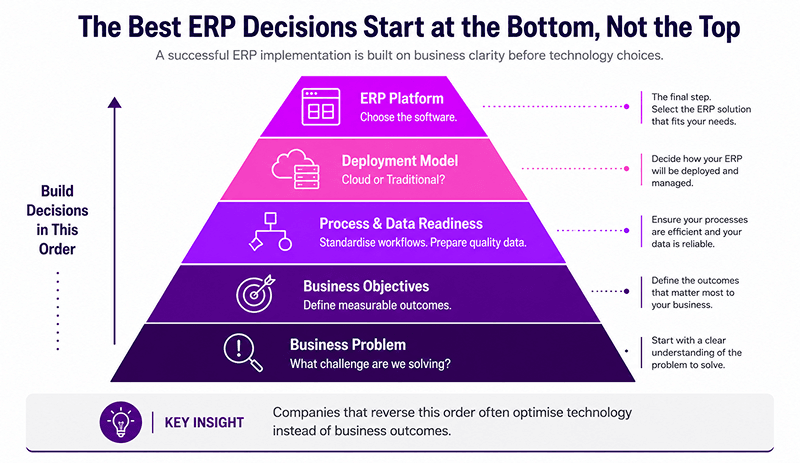
Somewhere along the way, these business objectives are replaced with conversations about deployment models, license structures, and feature lists. Those discussions matter, but they shouldn't come first.
No ERP deployment model can compensate for unclear business goals, poor data quality, or inefficient processes.
Likewise, choosing the "best" ERP won't automatically deliver better outcomes if your people aren't equipped to adopt new ways of working or if the implementation lacks direction.
Before comparing Cloud ERP and Traditional ERP, make sure you're clear on one question:
What business problem are you actually trying to solve?
That answer should shape every decision that follows.
The ERP Decision Most Businesses Get Wrong Before They Even Compare Systems
It's easy to think this decision is about where your software will run. In reality, it's about how your business will operate for years after the implementation is complete. That's why we encourage organizations to look beyond technology and approach the decision differently: Who should own the day-to-day responsibility for keeping your ERP environment secure, resilient, scalable, and up to date?
That single question often changes the entire conversation.
Imagine two organizations. The first is a growing wholesale distributor with a lean IT team. They're opening new locations, hiring quickly, and need systems that can scale without adding infrastructure or specialist staff.
The second is a manufacturer running highly customized production processes with strict compliance requirements and an experienced internal IT department.
Both organizations may evaluate the same ERP platform. Both could end up making very different deployment decisions. Not because one is right and the other is wrong, but because they have different operational priorities.
An ERP system isn't just another software application. It becomes the backbone of your finance, procurement, inventory, supply chain, production, customer service, and reporting processes.
The deployment model you choose influences far more than where your data lives. It affects how quickly you can scale, how much control you retain, how your teams work, and how prepared your business is to adopt emerging AI technologies.
Before diving into comparisons, ask yourself:
- Do we have the internal resources to manage infrastructure and ongoing maintenance?
- Are we expecting significant business growth over the next three to five years?
- How much customization do we genuinely need?
- Are regulatory or data residency requirements likely to influence our decision?
- Is rapid access to new technologies like AI an important part of our long-term strategy?
These questions usually provide far more clarity than a list of product features ever will.

Cloud-Based ERP vs Traditional ERP: The Real Difference Is Who Owns the Responsibility
Search online for comparisons between cloud ERP and on-premise ERP software, and you'll find dozens of feature checklists. Most explain what is different. Far fewer explain why those differences matter once your ERP is live.
The simplest way to think about it is this:
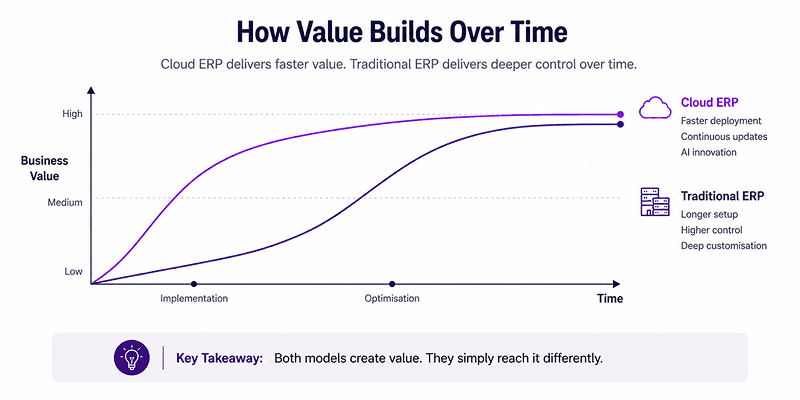
Traditional ERP gives you greater control because you own more of the responsibility. Cloud ERP reduces that operational burden by shifting much of it to the software provider.
Neither approach is inherently better. They're simply designed for different operating models.
| Area | Cloud-Based ERP Systems | Traditional (On-Premise) ERP Software |
| Infrastructure | Managed by the vendor | Managed internally |
| Deployment | Cloud-hosted | Installed on company servers |
| Software updates | Automatic and continuous | Planned and managed internally |
| Security infrastructure | Vendor manages infrastructure security; customer manages access, users, and policies | Organization manages both infrastructure and security |
| Scalability | Expand resources as business grows | Often requires additional hardware and infrastructure planning |
| Disaster recovery | Typically included by the provider | Designed and maintained internally |
| Customisation | Highly configurable with some limitations | Extensive customization possible |
| Internal IT effort | Lower | Higher |
| AI innovation | New capabilities usually arrive first | Often dependent on upgrade cycles |
| Budget model | Subscription (OpEx) | License plus maintenance (CapEx and OpEx) |
Why does this matter?
The deployment model you choose influences decisions long after the implementation is completed. It affects how quickly your business can expand into new markets, respond to changing customer expectations, recover from disruptions, adopt AI-powered capabilities, or support a growing workforce.
In other words, you're not simply choosing where your ERP software runs. You're deciding how much operational responsibility your organization wants to own over the next decade.
What Cloud ERP Makes Easier and Where Traditional ERP Still Makes Sense
One of the easiest ways to lose a reader's trust is to present one deployment model as the obvious winner. The reality is more nuanced. Both Cloud ERP and Traditional ERP solve business problems. They simply solve different ones.
What Cloud ERP Makes Easier
For many organizations, cloud-based ERP systems have become the preferred starting point because they remove much of the operational overhead associated with managing enterprise software.
If your IT team is already stretched supporting existing systems, that's more than a convenience. It gives them more time to focus on projects that improve the business rather than maintaining infrastructure. Cloud ERP can make it easier to:
- Get up and running faster.
- Reduce upfront capital expenditure.
- Support remote and multi-site teams.
- Scale as the business grows.
- Receive continuous updates and security improvements.
- Access new capabilities, including AI-powered features, without waiting for major upgrade projects.
This innovation advantage is becoming increasingly important. Gartner forecasts that by 2027, 62% of cloud ERP spending will be directed towards AI-enabled solutions, highlighting how quickly innovation is shifting towards cloud platforms.
The trade-off
Greater convenience also means giving up some control. Your organization becomes more dependent on your vendor's release schedules, roadmap, and subscription model. That's not necessarily a disadvantage, but it's a trade-off that should be understood before making a decision.
Where Traditional ERP Still Makes Sense
Traditional ERP continues to play an important role, particularly for organizations with highly specialized operations or regulatory requirements.
If your business depends on extensive customization or operates within strict data governance frameworks, maintaining greater control over your environment may be worth the additional responsibility. Traditional ERP can be a strong fit when you need:
- Deep customization.
- Complete control over infrastructure.
- Flexible upgrade scheduling.
- Support for complex legacy environments.
- Greater autonomy over system architecture.
The trade-off
Control comes with ongoing responsibility. Every software update, security patch, infrastructure refresh, backup strategy, and disaster recovery plan becomes your organization's responsibility. For businesses with experienced IT teams, that's often manageable. For others, it can become an increasing operational burden over time.
As systems become more complex, many organizations also focus on building processes that make updates, deployments, and ongoing operations more reliable and easier to manage.
Where Hybrid ERP Fits
Not every organization needs to choose one model over the other. Increasingly, we're seeing businesses adopt a hybrid approach.
For example, finance and collaboration tools may move to the cloud while specialized manufacturing applications or regulated workloads remain on-premise. This approach often works well for organizations that:
- Are modernizing in phases rather than replacing everything at once.
- Have significant investments in existing infrastructure.
- Operate in highly regulated industries.
- Want to reduce migration risk while continuing to innovate.
Rather than thinking of Hybrid ERP as a compromise, it's often better viewed as a practical transition strategy that balances innovation with operational continuity.
Will Cloud ERP Actually Save You Money?
This is usually the first question leadership asks. It's also one of the hardest to answer with a simple yes or no. The reason is straightforward. Price and cost aren't the same thing.
A cloud subscription may look affordable because the upfront investment is relatively small. A traditional ERP deployment may appear expensive because the license, hardware, and implementation costs arrive early. Neither tells you what the system will actually cost your business over the next five years.
That's why we encourage organizations to evaluate total cost of ownership (TCO) rather than comparing Year One pricing alone.
| Cost Area | Cloud ERP | Traditional ERP |
| Software | Subscription | Perpetual licence |
| Infrastructure | Included | Purchased and maintained internally |
| Hardware refresh | Minimal | Periodic replacement |
| Software updates | Included | Planned and managed internally |
| IT administration | Lower | Higher |
| Maintenance | Included | Annual maintenance contracts |
| Scalability | Flexible | Additional infrastructure often required |
The biggest costs, however, are often the ones that never appear on a proposal. Think about:
- Cleaning and migrating years of business data.
- Training employees on new ways of working.
- Redesigning business processes.
- Managing organizational change.
- Temporary productivity losses during implementation.
- Integrating with existing systems.
These costs apply whether you're implementing Cloud ERP or Traditional ERP. The difference is that they're business challenges, not technology costs. And they're often what determine whether an ERP investment ultimately delivers the return you expected.
Beyond Cost: Security, AI, and the Future of Your ERP Investment
Once cost has been evaluated, the conversation usually shifts to another important question: "Which deployment model will put us in a stronger position five years from now?"
The answer isn't found in a product brochure. It depends on how your organization thinks about security, innovation, and long-term business growth.
Is Cloud ERP Really Less Secure?
This is probably one of the most common concerns we hear. It's also one of the most misunderstood. Many people assume that keeping systems on-premise automatically means greater security because the organization maintains complete control over its infrastructure.
In reality, security doesn't work that way. Cloud providers invest heavily in securing their infrastructure, quite often at a level that would be difficult for many organizations to match internally. However, that doesn't mean security becomes the vendor's responsibility alone.
Cloud ERP follows a shared responsibility model. The vendor is responsible for securing the infrastructure, maintaining data centers, applying security updates, and ensuring platform resilience.
Your organization remains responsible for:
- User access and permissions
- Identity and authentication policies
- Data governance
- Employee awareness
- Compliance with industry regulations
- Monitoring unusual activity
This distinction matters because many security incidents don't happen because infrastructure fails. They happen because of weak passwords, excessive user permissions, poor governance, or human error.
IBM's annual Cost of a Data Breach research consistently shows that breaches remain expensive across every industry, with highly regulated sectors such as healthcare experiencing some of the highest average costs. The lesson isn't that one deployment model is safer than the other. It's that governance and security practices matter far more than where the software is hosted.
AI Is Becoming a Bigger Differentiator Than Infrastructure
Five years ago, conversations around ERP largely focused on deployment, licensing, and infrastructure. Today, AI is changing that conversation.
Increasingly, cloud ERP platforms are becoming the first place where vendors introduce new AI capabilities, including:
- Intelligent financial forecasting
- Automated invoice processing
- Predictive inventory planning
- AI-assisted reporting
- Supply chain recommendations
- Natural language business insights
In fact, according to Gartner, 62% of cloud ERP spending is expected to go towards AI-enabled solutions by 2027, up significantly from 2024. That doesn't mean traditional ERP systems won't benefit from AI. They will.
But in many cases, those capabilities arrive later, require additional upgrades, or involve more complex implementation projects. McKinsey also suggests that AI could reduce ERP implementation effort by at least 50% while significantly shortening implementation timelines.
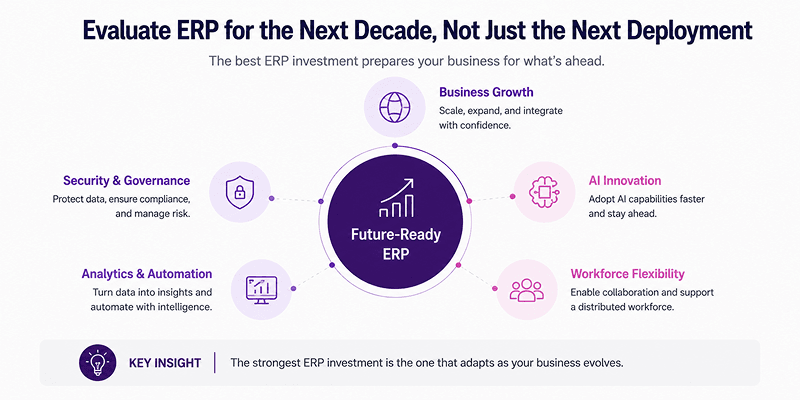
For organizations planning major digital transformation initiatives over the next few years, this raises an important question. Are you choosing an ERP system for today's requirements, or for tomorrow's opportunities? Sometimes the deployment model influences how quickly you can take advantage of those opportunities.
Think Beyond Implementation
ERP is rarely a five-year decision. For many organizations, it's a ten- to fifteen-year investment. That's why it's worth thinking beyond today's challenges. Ask yourself:
- Will your business expand into new markets?
- Could acquisitions become part of your growth strategy?
- Will you need better analytics and automation?
- How important will AI become to your operations?
- Are you likely to support a more distributed workforce?
The answers won't automatically point you towards Cloud ERP or Traditional ERP. But they will help you evaluate which model aligns better with where your business is today and where it is heading.
Why ERP Projects Fail, Regardless of Deployment Model
Here's something no one will ever tell you. Many organizations spend months debating Cloud ERP versus Traditional ERP. But far fewer spend the same amount of time preparing for implementation. That's unfortunate because implementation quality often has a far greater impact on success than the deployment model itself.
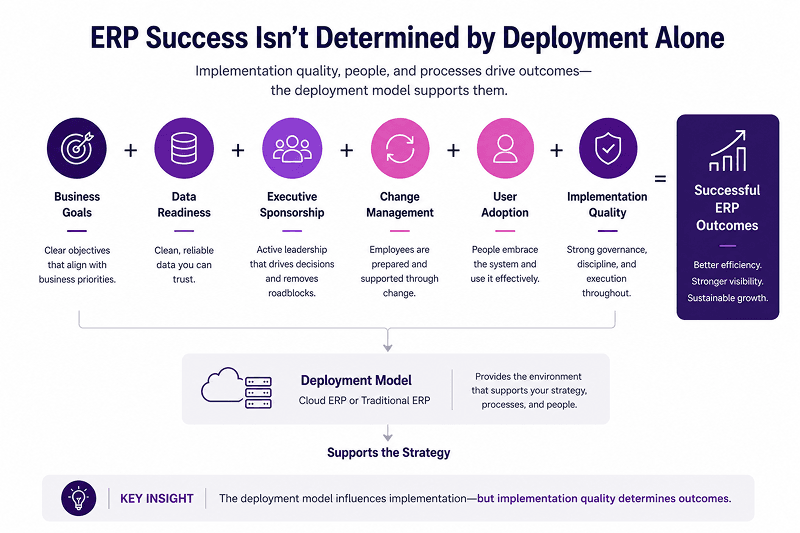
Research from Panorama Consulting continues to show that ERP projects frequently experience budget overruns, delays, and missed business objectives across industries. The reasons are remarkably consistent. They rarely begin with the software. Instead, they often stem from:
- Unclear business requirements
- Poor-quality data
- Expanding project scope
- Weak executive sponsorship
- Limited user adoption
- Inadequate change management
We've seen organizations implement excellent ERP platforms and still struggle because employees weren't prepared for new processes or because legacy data created problems from day one.
On the other hand, organizations that invest time in planning, governance, and stakeholder engagement often achieve better outcomes regardless of whether they choose cloud or on-premise deployment.
A Simple ERP Readiness Checklist
Before committing to any ERP implementation, ask whether your organization has:
✔ Clearly defined business objectives
✔ Executive sponsorship across departments
✔ Clean, reliable business data
✔ Internal resources to support the project
✔ A realistic implementation timeline
✔ A structured change management plan
✔ User training built into the project budget
Technology is only one part of a successful ERP program. People and processes remain equally important.
How to Choose the Right ERP for Your Business
If you've made it this far, you've probably realized there's no universal winner. And that's actually good news. It means your decision can be based on your business rather than industry trends.
One framework we've found useful is evaluating ERP options across six key decision areas:
| Decision Factor | Lean Towards Cloud ERP | Lean Towards Traditional ERP |
| Growth plans | Rapid growth, multiple locations | Stable operations with limited expansion |
| Internal IT resources | Small or lean IT team | Large, experienced IT department |
| Compliance requirements | Standard regulatory needs | Strict data residency or infrastructure control requirements |
| Customisation | Standard business processes | Highly specialized workflows |
| AI and automation | High strategic priority | Longer-term consideration |
| Budget preference | Lower upfront investment | Comfortable with higher initial capital expenditure |
No single factor should determine the outcome. Instead, look for patterns. If most of your priorities align with one deployment model, that's usually a stronger indicator than focusing on any individual feature.
Already Running On-Premise ERP?
Migration doesn't always have to happen all at once. For many organizations, a phased approach delivers better results. You might:
- Move finance first.
- Keep manufacturing systems on-premise temporarily.
- Modernize customer-facing processes before back-office operations.
- Adopt a hybrid ERP strategy while reducing legacy infrastructure over time.
Migration should support your business strategy, not disrupt it.
Which ERP Model Makes Sense for Different Businesses?
While every organization is unique, certain patterns emerge across industries.
| Business Type | Deployment Model That Often Fits Best | Why? |
| Growing SMB | Cloud ERP | Faster implementation, lower upfront investment, easier scalability |
| Manufacturing | Depends | Customization and production complexity vary widely |
| Healthcare | Hybrid or Traditional | Compliance and sensitive data often influence deployment choices |
| Professional Services | Cloud ERP | Collaboration, mobility, and scalability are often priorities |
| Fast-growing SaaS | Cloud ERP | Rapid innovation and AI capabilities support growth |
| Large Enterprises | Hybrid | Balances existing investments with modernization |
| Public Sector | Traditional or Hybrid | Governance and regulatory requirements often shape decisions |
Why More Organizations Are Re-evaluating ERP Now
Even organizations that weren't planning to modernize their ERP systems are beginning to revisit the conversation. Several factors are driving that shift.
For some, it's the approaching end of mainstream maintenance for SAP ECC in 2027, prompting discussions about long-term ERP strategy. For others, it's growing interest in AI-powered automation and analytics. Many are also responding to:
- Rising infrastructure maintenance costs
- Increasing cybersecurity expectations
- Business expansion through acquisitions
- Pressure to improve operational efficiency
- Finance transformation initiatives
None of these reasons justify moving to the cloud. But they do create an opportunity to ask whether your current ERP environment still supports your future ambitions. Sometimes the answer is yes. Sometimes it's time to evolve.
Conclusion: The Best ERP Choice Is the One That Fits Your Business
There isn't a universally right answer in the cloud-based ERP vs traditional ERP debate. The right choice is the one that aligns with your business goals, operational needs, internal capabilities, and long-term growth strategy.
While Cloud ERP offers greater flexibility and faster innovation, Traditional ERP continues to be the right fit for organizations that require deeper customization and greater infrastructure control. The key is to look beyond features and pricing and evaluate which deployment model will deliver the most value for your business over the years ahead.
If you're planning an ERP transformation and want an independent perspective before making a major investment, Clarient can help. Our team works with organizations to evaluate their current environment, define the right ERP strategy, and build a roadmap that supports long-term business success.
Talk to our experts and take the next step toward an ERP strategy built around your business.
Frequently Asked Question
1. What is ERP in cloud computing?
ERP in cloud computing refers to an Enterprise Resource Planning system that's hosted by a third-party provider and accessed over the internet. Unlike on-premise ERP software, where your organization manages servers and infrastructure, cloud-based ERP systems are maintained by the vendor, who handles updates, infrastructure, and platform maintenance. This allows businesses to focus on operations rather than managing IT infrastructure.
2. What is a disadvantage of cloud-based ERP systems?
One of the main trade-offs is reduced control over infrastructure and software updates. Since the vendor manages the platform, organizations must align with the provider's release schedule and subscription model. For businesses with highly specialized customization or strict regulatory requirements, this can be a limitation.
3. Is on-premise ERP cheaper than cloud ERP?
Not necessarily. It depends on how you measure cost.
If you're only looking at the initial investment, cloud-based ERP systems usually appear more affordable because they require a subscription instead of a large upfront license fee and infrastructure investment. That's one reason many growing businesses choose cloud ERP as their starting point.
However, the real comparison should be based on the total cost of ownership (TCO) over five to ten years. When evaluating cloud-based ERP vs traditional ERP, consider costs such as:
- Software licenses or subscriptions
- Infrastructure and hardware
- IT staffing
- Maintenance and upgrades
- Security and disaster recovery
- Integrations
- User training and change management
For organizations with a lean IT team, cloud ERP often provides better long-term value because the vendor handles infrastructure management and updates.
On the other hand, businesses with mature IT capabilities, stable user numbers, and significant existing infrastructure may find that on-premise ERP software becomes more cost-effective over time.
The better question isn't "Which is cheaper?" It's "Which deployment model delivers the best value for how our business operates?"
4. How do I decide whether to host my ERP on-premise or in the cloud?
Start with your business requirements rather than the technology itself. Consider your internal IT capabilities, compliance requirements, growth plans, customization needs, and long-term AI strategy. If flexibility and scalability are priorities, cloud ERP is often the better fit. If complete control over infrastructure is essential, an on-premise deployment may make more sense.
5. Can I migrate my existing on-premise ERP to a cloud-based system easily?
Yes, but the complexity depends on your existing ERP environment.
A successful ERP migration to the cloud is much more than moving data from one system to another. It often involves reviewing business processes, cleaning legacy data, rebuilding integrations, training users, and deciding which customizations should be retained or replaced with standard functionality.
That's why many organizations choose a phased migration instead of switching everything at once. For example, finance may move to the cloud first, followed by procurement, inventory, or manufacturing over time. This reduces disruption and gives teams more time to adapt.
Before beginning an ERP migration to the cloud, it's worth assessing:
- The quality of your existing data
- Current integrations with other business systems
- Business-critical customisations
- User readiness and training requirements
- Whether a hybrid deployment would reduce risk
With proper planning, migration doesn't have to be disruptive. In fact, many organizations use it as an opportunity to simplify processes, retire outdated customizations, and modernize how the business operates.
6. What are the 4 key ERP implementation strategies?
The four most common cloud ERP implementation strategies are:
- Big Bang – Replace the old ERP system all at once.
- Phased Rollout – Deploy the ERP system gradually by department or location.
- Parallel Adoption – Run the old and new systems together for a period before switching completely.
- Hybrid Implementation – Modernize selected functions while keeping parts of the existing on-premise ERP software until the organization is ready for a full transition.
Written by

Parthsarathy Sharma
With 4+ years of experience across AI, UX, enterprise technology, and brand strategy, Parthsarathy brings a research-driven lens to digital experience content. His work focuses on turning emerging technology, customer experience, and business trends into clear, practical perspectives for readers.
Reviewed by

Dushyant Nagar
Dushyant Nagar is a technology architect and engineering leader with 15+ years of experience in software engineering, enterprise applications, and distributed systems. His current work focuses on Agentic AI, multi-agent architectures, knowledge graphs, reasoning systems, and intelligent workflow orchestration.
He is deeply interested in how language, knowledge, memory, and reasoning can be combined to build more capable and trustworthy AI systems. Through his work and writing, he explores both the engineering and conceptual dimensions of artificial intelligence, including how machines can better understand, reason about, and interact with the world.
Share
Are you seeking an exciting role that will challenge and inspire you?

GET IN TOUCH