Blog
5 Practical Ways Startups Can Use AI as a Service to Scale Faster Without Heavy Tech Costs [+FREE Template]
Learn how startups can leverage AI as a Service (AIaaS) to scale efficiently, reduce costs, and accelerate growth with smarter products and operations.
July 14, 2026
Written by
![5 Practical Ways Startups Can Use AI as a Service to Scale Faster Without Heavy Tech Costs [+FREE Template]](/_next/image?url=https%3A%2F%2Fapi.clarient.us%2Fuploads%2FAI_as_a_service_Alaas_6855291b16.jpg&w=3840&q=100&dpl=dpl_HCGrsbQHx2xJzs6U8D9ZSMDqVgYS)
Introduction
Startups usually have plenty of ambition, but the real challenge is finding the right infrastructure, talent, and speed. Founders want to build innovative products, keep customers happy, and grow their businesses. Still, advanced technologies like AI often feel out of reach because of high costs and limited expertise.
Most founders don’t start out looking for AI solutions. They focus on solving problems. As customer questions increase and repetitive tasks take up engineers’ time, product development can slow down because small teams get overloaded. This is where AI can help, letting startups accomplish more without hiring extra people.
Even so, AI isn’t always the best first investment for every startup. If you’re still testing your product or looking for product-market fit, it’s better to focus on understanding your customers. But once repetitive tasks start holding back your growth, AI-as-a-Service (AIaaS) gives you a practical way to try out AI without spending a lot on infrastructure or hiring a full AI team.
In this guide, you'll learn:
- Which AI use cases deliver results without significant upfront investment
- Common implementation challenges and how to avoid them
- How to determine whether AI-as-a-Service is the right approach for your business
By the end of this guide, you’ll know when AIaaS makes sense, when it doesn’t, and how to pick use cases that bring real value.
1. Access Advanced AI Capabilities Without Building Everything Yourself
In the past, only big companies could use AI because it required lots of infrastructure, specialized talent, large datasets, and long development times. AIaaS has changed that, making advanced AI available to startups.
Platforms such as AWS, Azure, and Google Cloud now enable startups to access enterprise-grade AI services, algorithms, frameworks, APIs, and pre-trained models without the need for expensive hardware or custom data pipelines.
For example, a fintech startup can use cloud-based anomaly detection models to detect fraud in real-time, without having to build a proprietary fraud model. A healthtech startup can use managed AI services to organize and analyze patient data, while keeping the core team focused on compliance, validation, and user experience.
Some people think AI-as-a-Service means lower quality. In reality, many successful startups launch AI-powered products with managed services and pre-trained models, so they don’t need to build custom AI. The McKinsey State of AI report says 88% of companies now use AI in at least one business function, up nearly 10% from last year.
Now, startups can use advanced AI without needing a big company budget. This helps level the playing field, letting startups test and launch features, automate workflows, and grow without making big infrastructure commitments early on.
When is AI the right choice for a startup?
AI isn’t right for every business, but it can help you grow faster when speed and flexibility matter more than building your own AI systems. Think about using AIaaS if:
- You're validating a product idea and need AI capabilities quickly.
- Your competitive advantage lies in the customer experience, not in developing your own AI models.You want
- predictable, usage-based costs instead of investing heavily in infrastructure and specialist talent.
2. Grow Your Startup Without Increasing Costs at the Same Pace
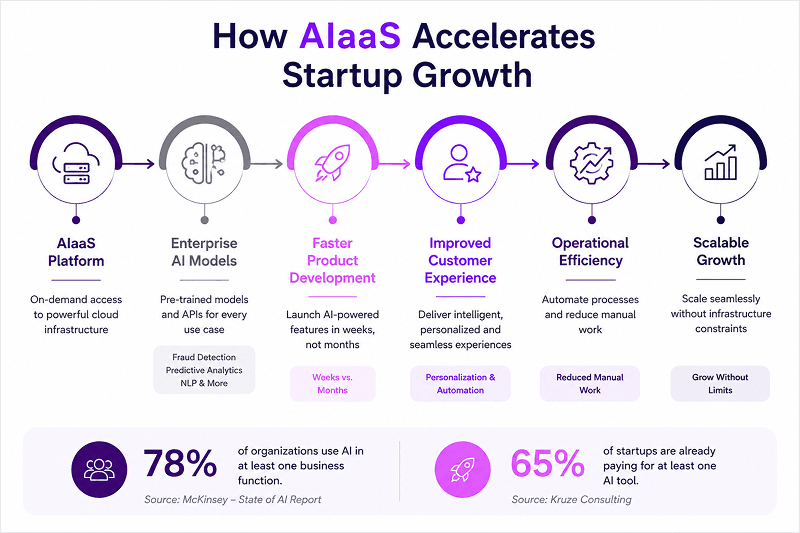
AI gives startups affordability, scalability, and speed—all key for steady growth. Instead of long development cycles, founders can roll out AI-powered workflows and features in just weeks.
- Affordability: Pay-as-you-go pricing allows startups to pay only for what they use, preserving capital for other priorities. For example, AI infrastructure-as-a-service provides access to GPU power for model training without significant hardware investment.
- Scalability: Start small and scale as your customer base grows. Whether serving 100 or 10,000 users, AI infrastructure adapts to your needs. This flexibility is particularly valuable for SaaS or marketplace startups facing sudden demand increases.
- Speed: Pre-trained models and APIs significantly reduce development time, accelerating product launches. Founders can deliver advanced features quickly without building a full in-house AI team.
At Clarient, we’ve seen that AI’s real value goes beyond saving money or speeding up deployment. The startups that benefit most usually start by finding one repetitive, high-impact workflow, use AI to fix that bottleneck, and then scale up once they see the value.
Investors also recognize these advantages. According to PwC, AI could contribute up to $15.7 trillion to the global economy by 2030, and early adopters, often startups, stand to capture a significant share of this value by moving fast and lean.
3. Automate Everyday Work So Your Team Can Focus on Growth
Operational efficiency is crucial for startups. Using artificial intelligence lets founders automate repetitive tasks that take up valuable resources.
Key applications for startups include:
- IT Helpdesk Automation: AI agents can take care of routine IT requests, such as password resets, software access, and troubleshooting. This lets your IT teams spend more time on higher-value work. In fact, Gartner predicts that by 2029, agentic AI will autonomously resolve 80% of common customer service issues.
- Predictive System Monitoring: AI can continuously monitor applications and infrastructure, identifying unusual patterns that may indicate problems before users are impacted.
- Cloud Optimization: As cloud costs can rise rapidly, AI helps control expenses by analyzing resource usage and identifying opportunities to optimize infrastructure.
For startups, every dollar saved on IT overhead can go back into product development, marketing, or getting new customers. Automating operations helps you innovate faster, even with limited resources.

4. Build Better AI Products Without Slowing Down Development
AIaaS lets startups add smart features to their products without building every model or pipeline from scratch. This is especially helpful for testing if an AI feature actually solves a real user problem before investing in custom development.
- Natural Language Processing (NLP): Powering chatbots, voice assistants, or sentiment analysis tools to improve CX.
- Computer Vision: Automating quality checks in manufacturing, detecting defects, or enabling AR shopping for retail startups.
- Machine Learning: Building recommendation engines, churn prediction models, or pricing optimization algorithms.
With this approach, startups can test ideas quickly, build MVPs at a lower cost, and scale up features that work. This leads to faster business transformation with AI, more efficient testing, smarter products, and happier customers.
What Clarient observed while building AI-powered products
AI technologies like NLP, computer vision, and machine learning can add new features to your product, but they don’t guarantee success.
The best AI projects start by solving one clear customer problem, not by adding lots of AI features. Whether you want to help users find products faster, make onboarding easier, or give better insights, the most effective AI features fix a specific customer issue. This matches Gartner’s advice to focus on business results, not just technology.
To use AI well, ask yourself: What customer frustration will this feature solve? If you’re not sure, the feature probably needs more validation before you build it.

How AI-Powered Customer Intelligence Drove a 46% Engagement Increase
5. Deliver Better Customer Support Without Growing Your Support Team
Customers expect more than ever, but most startups can’t afford big support teams. AI-powered chatbots, delivered through AI-as-a-Service (AIaaS), help solve this problem.
Key benefits for startups:
- 24/7 Query Handling: Chatbots can resolve most of the routine problems without human intervention.
- Smart Escalation: Complex issues are automatically sent to human agents, preventing any major issues.
- Personalized Multilingual Support: Startups targeting global markets can deploy multilingual bots that bridge language gaps without hiring additional staff.
For customer-facing AI, it’s important to set clear rules. Decide what the chatbot should handle, when to send issues to a human, and how to check responses for accuracy. This helps you stay compliant and meet your goals. Many organizations now use AI governance frameworks that adapt to real-world situations and changing AI behavior.
Where should startups begin?
For most startups, customer support needs grow as you get more customers. This means small teams spend more time on repetitive questions instead of improving the product.
Instead of trying to automate every interaction, start by finding the most common conversations. Password resets, order status updates, appointment scheduling, and FAQs are good places to begin because they follow predictable steps and save time right away.
Overcome Common AI Adoption Challenges Without Overspending
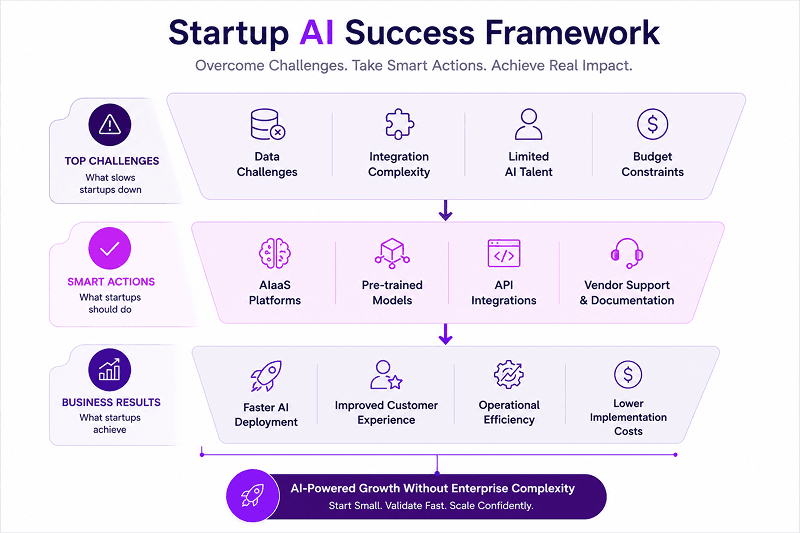
Startups often face challenges like not having enough clean data, complicated integrations, and a shortage of skilled people, which can make adopting AI seem tough. But these issues don't have to slow you down. Tackle one business problem at a time instead of trying to roll out AI across your whole company at once.
Start with the problem, not the technology
Many people think adopting AI starts with picking the right model or platform, but it really begins with finding a business problem that matters. For example, you might want to cut down customer support response times or offer more personalized experiences. When you set a clear goal, it's easier to track your progress and decide where to invest.
Practical steps to simplify implementation
- Use ready-made AI tools: Take advantage of AI-as-a-Service options that offer pre-trained models for things like language processing, computer vision, or predictions. This way, you don't have to rely as much on having your own AI experts.
- Connect through APIs: Make things easier by linking AI-as-a-Service directly to your apps and workflows. This cuts down on engineering work and helps you get up and running faster.
- Adopt AI-First UX Strategies: Technical implementation is only one part of successful AI adoption. Designing AI experiences that are intuitive, transparent, and easy to trust helps ensure customers actually use the features you build.
- mplement Contextual AI Governance: As AI systems become more independent, your governance approach should also adapt. Using context-aware frameworks helps keep AI accurate, compliant, and in line with your business goals.
- Utilize Provider Support: Use vendor documentation, technical support, and community resources to help solve any implementation problems.
Build confidence before you scale
nstead of starting several AI projects at once, focus on one workflow that brings clear business value. After you see results and set up solid data processes, it will be much easier and safer to expand AI to other areas.
Get Enterprise-Grade AI Infrastructure Without the Enterprise Price Tag
When startups start using AI, a common question is whether to build their own AI infrastructure or use cloud-based services?
For most early-stage companies, building and running your own infrastructure means spending a lot on hardware, maintenance, and expert staff. AI Infrastructure as a Service (AI IaaS) is a more flexible option, giving you on-demand access to computing, storage, and networking without the big upfront costs.
Consider flexibility before you scale
Early infrastructure choices affect how fast your startup can test ideas, launch features, and meet customer needs. Instead of spending a lot on resources you might not use, AI Infrastructure as a Service lets you scale up as needed and keep more funds for product and customer growth.
Founders should keep these priorities in mind:
- Focus on Core Business Problems: Instead of building AI infrastructure from the ground up, put your energy into applications that directly improve customer experience, efficiency, or revenue.
- On-Demand Compute Power: Set up GPU and TPU clusters only when you need them for training or running models. This helps you avoid extra infrastructure costs.
- Elastic Storage and Networking: Increase storage and network resources as your experiments and production needs grow.
- Operational Flexibility: Launch AI models quickly, test ideas often, and grow successful projects without being held back by hardware limits.
Questions to ask before you invest
Before you decide to build your own AI infrastructure, consider these questions:
- Will owning this infrastructure give you a real competitive edge?
- Are current infrastructure limits slowing down your product development?
- Would your engineering resources be more valuable if focused on improving the product instead?
What the AI as a Service Market Means for Startup Founders in 2026
AI-as-a-Service is changing fast, but the real opportunity for startups is not just getting more AI tools. It's being able to test, launch, and improve AI-powered experiences without big upfront costs.
With more AI solutions available, it’s easy to want to try everything. Instead, focus on what brings the most value to your business.
- Pick platforms that can grow with your business, not just fix today’s issues.
- Focus first on AI projects that solve real customer or operational problems before moving on to more advanced uses.
- Stay updated on changing AI regulations so you’re ready as rules and requirements develop.
- Plan for growth by choosing tools and workflows that will support your business as it expands.
In the end, startups don’t have to use every new AI innovation to stay ahead. What matters is making smart choices that solve real problems and create lasting value for customers.
[FREE] AI Planning Template for Startup Founders
To help founders move fast, here’s a step-by-step AI-as-a-Service template. This table helps startups plan, set priorities, and launch AI projects while keeping track of important details.
| Step | Action Item | AIaaS Tool / Service | Priority | Timeline | Founder Notes / Input | Next Steps / Resources |
| 1 | Identify a high-impact business problem | ML models / NLP / Computer Vision | High | Week 1 | Founder to describe the problem (e.g., customer churn, supply chain inefficiency) | List AI tools that address this problem |
| 2 | Map AI feature to product | AI APIs / AI services | High | Week 1-2 | Founder to select target product feature | Determine which AI service integrates best |
| 3 | Assess data readiness | Data cleaning & preprocessing | Medium | Week 2 | Founder to note data sources & quality | Use AIaaS built-in data tools if needed |
| 4 | Select AI infrastructure | AI infrastructure as a service | High | Week 2 | Founder to define compute/storage needs | Choose cloud provider & service tier |
| 5 | Integrate AI features | Pre-trained models / APIs | High | Week 3-4 | Founder to specify integration points | Assign responsibilities to dev team |
| 6 | Test & validate | AI monitoring & analytics | High | Week 4 | Founder to define KPIs & metrics | Set up dashboards & alerts |
| 7 | Scale & optimize | Elastic compute / storage | Medium | Week 5+ | Founder to estimate growth projections | Plan scaling and cost optimization |
| 8 | Track implementation challenges | AIaaS support / troubleshooting | Medium | Ongoing | Founder to log issues (e.g., integration, data gaps) | Use vendor support and community resources |
Action Step: Complete the “Founder Notes / Input” column for your startup, then follow the recommended next steps to start implementing AIaaS efficiently and strategically.
Conclusion: Why AI as a Service Is Becoming the Smart Choice for Growing Startups
AI was once only for big companies. Now, AI-as-a-Service makes it possible for startups with limited resources but big goals to use AI. By helping you adopt AI faster, cut costs, and build smarter products, AIaaS is powering the growth of the next wave of startups.
There are huge opportunities, from automating IT tasks to growing customer support and changing how businesses work. As the AI-as-a-Service market grows, now is a great time for founders to get started.
If you're starting a company now, don't try to build everything from scratch. Use AI-as-a-Service to grow faster, use your money wisely, and compete with confidence.
Want to speed up your startup's growth with AI? Work with Clarient to find AI-as-a-Service solutions that fit your needs and get top-level features without the high costs.
Frequently Asked Questions
Written by

Parthsarathy Sharma
With 4+ years of experience across AI, UX, enterprise technology, and brand strategy, Parthsarathy brings a research-driven lens to digital experience content. His work focuses on turning emerging technology, customer experience, and business trends into clear, practical perspectives for readers.
Share
Are you seeking an exciting role that will challenge and inspire you?

GET IN TOUCH