Global Capability & MicroGCC
Cross-industry
Outcome-Based Outsourcing: Why Successful Delivery Does Not Always Mean Business Impact
Published on October 05, 2026

table of content
- Introduction
- The SLA Can Be Green While the Business Is Still Red
- Outcome-Based Outsourcing Starts with the Outcome, Not the Contract
- The Commercial Model Should Reward the Change You Want
- Five Conditions Make Outcome-Based Outsourcing Work
- Why Outcome-Based Outsourcing Still Fails
- Is Your Outsourcing Model Actually Outcome-Based?
- Outcome-Based Outsourcing Is an Operating Model, Not Just a Pricing Model
- The Right Question Is Not “Did the Provider Deliver?”
- Conclusion: Making Outcome-Based Outsourcing Work for the Business
listen to blog
summary
Outcome-Based Outsourcing connects provider performance to measurable business results through aligned metrics, governance, & accountability.
Introduction
What does it mean for an outsourcing contract to be successful?
If the provider meets every SLA, processes the agreed volume, maintains accuracy, and responds within the promised time, should the business consider the relationship a success? Not necessarily.
Customers may still be leaving. Costs may not be falling. Employees may still struggle with the same broken process. The numbers look green, but the business result remains unchanged.
This is the uncomfortable gap at the heart of Outcome-Based Outsourcing: a provider can deliver everything the contract requires without improving what the business actually cares about.
The problem is rarely a shortage of metrics. It is a disconnect between what gets measured, what gets rewarded, and what the business needs to change. At Clarient, we have seen that the most valuable outsourcing relationships begin with a different question, "What is the provider actually helping the business change?"
That question changes everything. Let’s look at why.
The SLA Can Be Green While the Business Is Still Red
Most outsourcing relationships begin with things that are relatively easy to measure. How quickly was a request answered? How many transactions were processed? How many incidents were resolved? Was accuracy above the agreed threshold?
These measures matter. They tell you whether the service is being delivered reliably. But delivery is not the same as impact. The mistake is not measuring service performance. It is allowing service performance to become the entire definition of success.
Consider customer service. A provider might reduce average handling time from eight minutes to five and answer 95% of calls within the agreed window. Operationally, that looks like progress. But if customers still have to contact the company three times to resolve the same issue, the business has not necessarily improved the customer experience.
The same pattern appears across finance, IT, claims, procurement, and other functions.
| What the provider may measure | What the business may actually care about |
| Transactions processed | Cost-to-serve |
| Response time | Customer retention |
| Resolution time | Business disruption avoided |
| Processing accuracy | Rework eliminated |
| Volume handled | Revenue or capacity released |
This is why an SLA example can, therefore, demonstrate excellent service performance while telling you relatively little about whether the underlying business problem has been solved or improved.
Research suggests this distinction is becoming increasingly important. KPMG's 2026 Managed Services Outlook found that managed services are now a strategic focus for 99% of organizations, with almost half ranking them as a top investment priority.
At Clarient, our experience working with enterprises reinforces the same lesson: as external providers become more deeply embedded in critical operations, measuring the provider in isolation becomes less useful. The question becomes how their work changes the larger system.
Outcome-Based Outsourcing Starts with the Outcome, Not the Contract
The first step is not to rewrite the pricing model. It is to understand the result the business actually wants.
Instead of asking:
What work should the provider perform?
ask:
What measurable business result are we trying to change?
That shift sounds small. In practice, it changes how you design the entire relationship. For example:
| Start with the activity | Trace it to the outcome |
| Handle customer calls | Improve retention and resolution |
| Process insurance claims | Reduce settlement time |
| Process invoices | Improve working capital |
| Resolve IT incidents | Reduce operational disruption |
| Qualify sales leads | Improve conversion |
The next step is to trace the outcome backward through the process.
Business outcome → Process → Provider contribution → Measure
This matters because most business outcomes have multiple owners.
A provider may influence customer retention through the quality of service it delivers. But pricing, product quality, fulfillment, marketing, and customer behavior may influence retention too. That means accountability should follow influence, not simply contractual scope.
The closer the provider is to controlling the levers behind an outcome, the stronger its accountability can reasonably become. As influence becomes shared, accountability should become shared too.
A useful way to think about it is:
Provider-controlled → Jointly influenced → Externally influenced
The provider can reasonably own what it controls. It can share accountability for what it materially influences with the buyer. It should not be held solely responsible for factors outside its reach. In some cases, achieving the desired outcome may also require changes to the technology supporting the process. Legacy systems, disconnected data, or software that no longer fits the workflow can limit what the provider can realistically change. Addressing those constraints may require changes to the underlying technology, including custom enterprise software.
That distinction is central to a workable outcome-based outsourcing model.
Is Your Outsourcing Model Delivering the Outcomes You Need?
The Commercial Model Should Reward the Change You Want
Once the outcome and provider contribution are clear, the commercial model becomes easier to design.
This is where many organizations make a second mistake: assuming that moving to outcome-based pricing automatically creates better outcomes. It does not.
The incentive has to reinforce the behavior the business wants.
Imagine a company trying to reduce the number of customer service contacts. If its provider is paid primarily according to the number of interactions handled, both parties can become financially aligned around processing more interactions, even when the business wants fewer.
The model is rewarding activity, not improvement. A stronger structure might combine different mechanisms:
| Commercial mechanism | Best used when |
| Fixed fee | Core service delivery is predictable |
| Performance component | Improvement can be measured reliably |
| Outcome-based pricing | Provider influence and attribution are strong |
| Gain sharing | Both parties can credibly measure value created |
| Hybrid model | Responsibility and risk are shared |
This is why performance-based outsourcing does not always mean putting the entire contract at risk. A hybrid structure can protect baseline service delivery while creating meaningful incentives for improvement.
The principle is straightforward:
The more influence a provider has over a measurable outcome, the more directly the commercial model can reward that outcome.
KPMG's research also points to this broader shift. In its latest managed services research, 81% of companies expect providers to act as strategic collaborators, while 75% are seeking transformational outcomes, including new business models and technology innovation. The buyer-provider relationship is moving beyond “perform this service” toward “help us improve this part of the business.”
Five Conditions Make Outcome-Based Outsourcing Work
Not every outsourcing arrangement is ready for an outcome-based model. Before changing a contract, buyers should test five things.
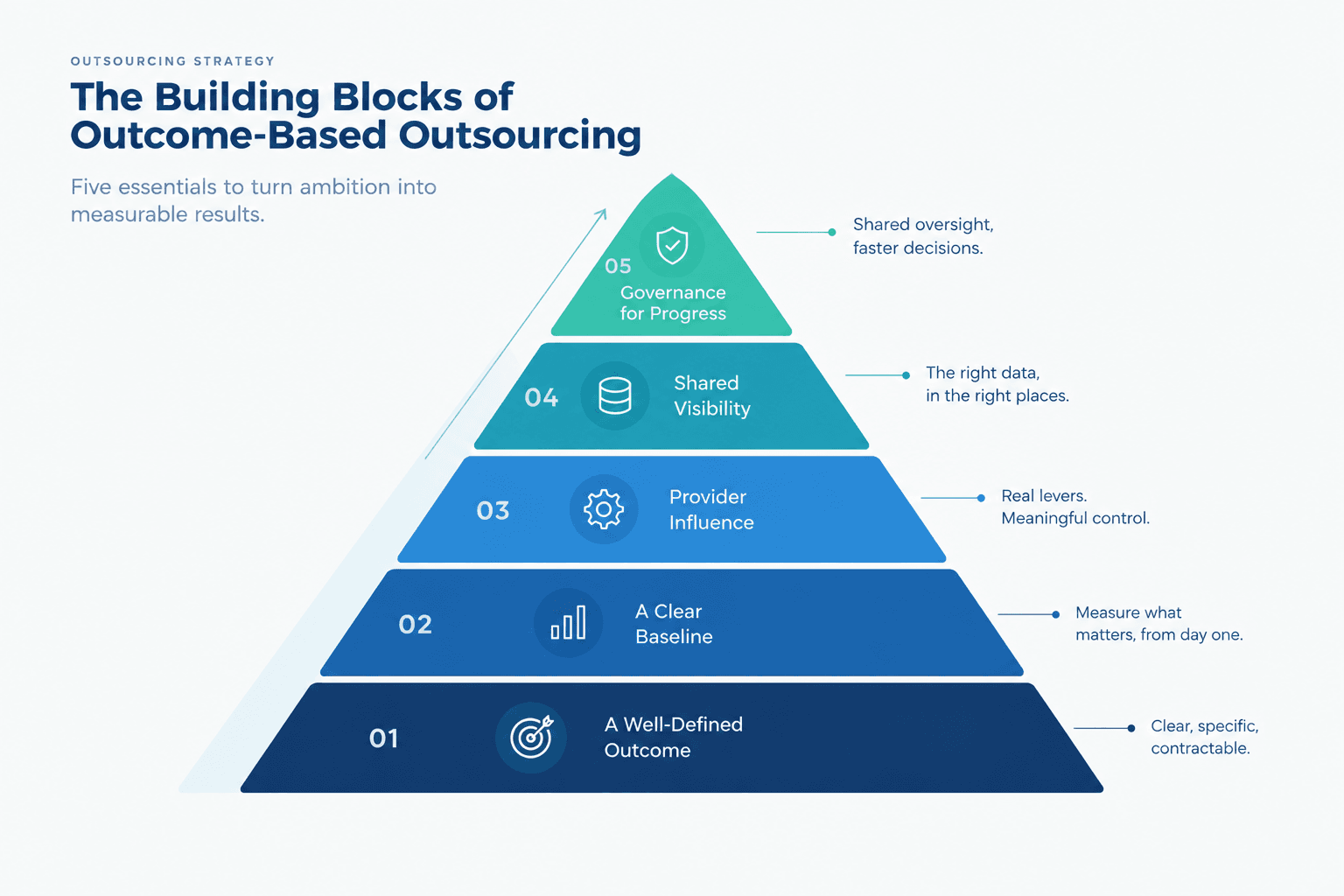
1. The outcome is specific
“Improve customer experience” is an ambition, not a contractable outcome.
Define what improvement means, for whom, and over what period.
2. There is a credible baseline
You need to know where performance stands today before you can fairly measure improvement.
If claims currently take 12 days to settle, reducing that to eight days is meaningful. Without the baseline, there is no credible way to demonstrate the change.
3. The provider can materially influence the result
The provider does not need complete control. It does need meaningful levers.
If the desired outcome depends primarily on decisions the provider cannot make, shifting risk to the provider will create conflict rather than accountability.
4. Both sides can see the relevant data
Outcome measurement often requires information that sits across organizational boundaries.
If the buyer sees revenue, the provider sees service volume, and neither can see the full process, both sides may arrive at different versions of “success.”
5. Governance supports joint action
Good outsourcing governance is not simply a mechanism for checking compliance. It needs to help both sides identify problems, make decisions, escalate issues, and change course. This is becoming more important as outsourcing moves closer to transformation.
When an external provider is part of how the business transforms, governance cannot remain a monthly contract-review exercise.
Why Outcome-Based Outsourcing Still Fails
The language can change without the operating model changing. A contract may talk about outcomes while the relationship continues to behave exactly as it did before. Four failure patterns appear repeatedly:
The outcome is too broad
“Reduce costs” or “improve experience” sounds strategic but leaves too much room for interpretation. A useful outcome needs a clear definition, baseline, owner, and measurement method.
The provider is accountable without having the levers
A provider cannot reasonably own an outcome if the buyer controls the technology, policy, customer journey, and process decisions that determine it. This is not shared accountability. It is transferred risk.
The old metrics remain the real contract
A business may introduce an outcome metric but continue to run every governance meeting around volumes, response times, and compliance. The result is an outcome-based contract operating like a traditional one.
The relationship remains transactional
The contract may describe a new model, but if decision-making, governance, and accountability remain unchanged, the relationship will behave as it always has. This becomes especially important as technology sourcing and talent models evolve, bringing providers into more strategic and transformation-oriented work.
Is Your Outsourcing Model Actually Outcome-Based?
Before redesigning an existing arrangement, ask six questions:
- What business outcome are we trying to change?
- What is the baseline today?
- What part of that outcome can the provider materially influence?
- Which metric demonstrates that influence?
- Does the commercial incentive reward the desired improvement?
- Do both sides have the data and decision-making structure needed to act?
These questions are more useful than simply asking whether a contract contains outcome clauses. They also reveal where a relationship needs to change. For example:
| If you find this | The problem is probably |
| Many operational measures, no business measure | The relationship is output-led |
| Business outcome, but no baseline | Improvement cannot be proven |
| Outcome metric, but little provider influence | Accountability is misallocated |
| Shared outcome, separate data | Measurement will become disputed |
| Variable pricing, unchanged governance | Incentives changed, operating model did not |
This is also where outsourcing KPIs need to be treated differently. Operational measures still have a role. They explain what is happening. They simply should not be mistaken for the final definition of success.
Outcome-Based Outsourcing Is an Operating Model, Not Just a Pricing Model
The strongest relationships connect every part of the model to the same business result. The logic should look like this:
Business outcome
↓
Process that influences it
↓
Provider contribution
↓
Outcome metric
↓
Commercial incentive
↓
Shared governance
↓
Measured result
If the business wants lower cost but the provider is rewarded for volume, the model is misaligned.
If the provider is accountable for retention but cannot influence the customer journey, the model is misaligned.
If the contract rewards improvement but governance still focuses exclusively on SLA compliance, the model is misaligned.
This is the real value of outcomes-based contracting. It creates a line of sight between what the business wants, what the provider can change, and how improvement will be recognized.
At Clarient, we approach this as a systems problem, not a contract problem. The commercial model matters, but it works only when the process, responsibilities, data, technology, and governance around it support the same objective.
That is particularly important as providers take on more technology-enabled and AI-driven work. The opportunity is no longer simply to perform an existing process more efficiently. It is increasingly about redesigning how that process creates value.
The Right Question Is Not “Did the Provider Deliver?”
For decades, outsourcing relationships have been judged by a relatively simple question:
Did the provider meet the contract?
That question still matters. But it is no longer enough. The more useful question is:
Did the outsourcing relationship change the business outcome it was designed to influence?
That requires more than a new pricing formula.
It requires a clear outcome, a process that connects work to that outcome, realistic accountability, aligned incentives, shared data, and governance that allows both sides to improve the system.
That is ultimately what an outcome-based service delivery model should deliver: not simply a different way to pay a provider, but a clearer connection between external capability and business value.
Conclusion: Making Outcome-Based Outsourcing Work for the Business
Outsourcing is often judged by whether the work gets done on time, within scope, and according to the agreed standards. But for the people running the business, those measures are only part of the story.
The real question is what changes because the work was outsourced. Are customers having a better experience? Are employees spending less time working around broken processes? Are costs improving? Is the business actually moving forward?
A provider can meet every SLA and still leave these questions unanswered. That is why Outcome-Based Outsourcing is not about replacing every SLA or making every contract fully variable. It is about connecting the work being delivered to the change the business needs to see.
Business outcome → provider influence → measurement → incentive → governance → result.
When these pieces work together, outsourcing becomes more than a way to get work done. It becomes a way to improve how people work and help the business achieve better results.
If you are questioning whether your current outsourcing model is creating the value it should, talk to Clarient. We can help you identify where the disconnect lies, rethink the operating model, and build a clearer path from outsourced work to measurable business impact.
Frequently Asked Questions
Outcome-Based Outsourcing works best when the provider can materially influence a measurable business result. Processes such as customer service, claims management, IT operations, finance operations, and certain supply-chain functions can be good candidates. The right question is not simply whether a process is outsourced, but whether there is a clear connection between the provider’s work and the business outcomes the organization wants to improve.
It changes the question from “Who can deliver this service at the best price?” to “Who has the capabilities, data, technology, and experience to influence the result we care about?” Buyers should therefore evaluate providers based not only on operational capabilities, but also on their ability to work with shared metrics, assume appropriate risk, and collaborate across organizational boundaries. Vendor selection becomes part of designing the outcome-based outsourcing model, rather than a separate procurement exercise.
Yes, but it depends on the outcome being measured. Short-term arrangements can work when there is a clear baseline, a measurable target, reliable data, and a provider that can influence the result within the contract period. If the desired improvement depends on changes that take years to materialize, a short contract may make attribution difficult. In those situations, a phased or hybrid outcome-based pricing structure may be more practical.
Outcome-Based Outsourcing can work across industries, but it is particularly relevant where outsourced services have a measurable connection to business performance. Examples include financial services, healthcare, retail, telecommunications, manufacturing, travel, logistics, and technology. The more important consideration is the process itself: if provider performance can be connected to a measurable result, an outcome-based approach may be viable regardless of industry.
It can actually increase flexibility when designed well. Instead of defining every activity the provider must perform, the contract can focus on the result and allow the provider greater freedom in how that result is achieved. However, this requires clear boundaries around responsibilities, data access, measurement, and decision-making. A well-designed outcome-based service delivery model gives the provider room to improve the process without creating ambiguity about accountability.
Data is what makes an outcome measurable and attribution credible. If the buyer and provider are working from different definitions, incomplete data, or inconsistent baselines, disagreements about performance can quickly become commercial disputes. Strong outsourcing KPIs should therefore be supported by reliable data that both parties can access and trust. Data quality is not simply a reporting issue; it is part of the foundation of the commercial relationship.
Start by identifying the business result the existing arrangement is supposed to influence. Then establish a baseline, map which parts of the outcome the provider can control or influence, and identify the metrics that demonstrate improvement. From there, the buyer and provider can introduce appropriate commercial incentives, shared responsibilities, and outsourcing governance. A phased transition is often safer than replacing the entire commercial structure at once, particularly when the existing relationship is heavily SLA-driven.
The biggest risk is assigning responsibility for an outcome that the provider cannot reasonably influence. This can create unfair risk, encourage disputes, and undermine the relationship. Outcome-based models can also become problematic when buyers eliminate useful operational measures or attach excessive financial penalties to factors outside the provider's control. Effective performance-based outsourcing balances business results with the operational measures that explain how those results are being achieved. The goal is shared accountability, not simply transferring more risk to the provider.
Traditional outsourcing typically measures whether the provider delivered the agreed service, while outcome-based contracting focuses on whether that service contributed to the business result it was intended to influence. SLAs and operational metrics still have a role, but they become supporting measures rather than the entire definition of success. The shift is from asking “Did the provider perform?” to asking “Did the relationship help produce the result the business needed?”
Weekly Insights Subscription
Stay ahead with Clarient insignts on customer insights
Share
Written by

Parthsarathy Sharma
With 4+ years of experience across AI, UX, enterprise technology, and brand strategy, Parthsarathy brings a research-driven lens to digital experience content. His work focuses on turning emerging technology, customer experience, and business trends into clear, practical perspectives for readers.