Product Engineering
Cross-industry
Enterprise Application Integration Best Practices: Why Point-to-Point Fails, What It Actually Costs, and What to Fix First
Published on August 21, 2026
table of content
- Introduction
- When Integration Complexity Starts Working Against You
- Point-to-Point Isn't Always the Problem
- What Integration Debt Is Actually Costing You
- Fix the Failure You're Actually Experiencing
- Integration Needs an Operating Model, Not Just an Architecture
- Your Integration Layer Has a New Consumer: AI
- What Should You Fix First?
- Conclusion: Make Integration Complexity Easier to Live With
- Frequently Asked Questions
listen to blog
summary
Explore enterprise application integration best practices, costs, architectures, & what to fix first to build a more resilient enterprise.
Introduction
Adding another enterprise application rarely feels like a major architectural decision. A new CRM needs customer data from the ERP. A new analytics platform needs sales data. A SaaS application needs to exchange information with three systems already in place.
So, the team builds another connection. Then another.
Years later, a seemingly minor change in one application breaks a workflow somewhere else. Engineers spend days tracing dependencies. Different systems contain different versions of the same customer or product data. Monitoring tells you an integration failed, but not whether the business transaction actually failed. And the people who understand how everything fits together are often the same people everyone needs for the next project.
This is where enterprise application integration best practices become less about choosing between APIs, ESBs, or iPaaS platforms and more about managing complexity. When applications are being added or modernized, the integration implications need to be considered alongside the migration strategy.
The underlying problem is simple: integration dependencies can grow much faster than the number of applications they connect. With point-to-point architecture, the number of potential connections follows n(n-1)/2. Ten systems can mean 45 connections, not 10.
This guide looks at what that complexity actually costs, how to recognize when your integration architecture has become a liability, and, most importantly, what to fix first.
When Integration Complexity Starts Working Against You
The first mistake organizations make is treating every integration as an isolated technical task. It rarely is.
An integration creates a dependency. That dependency has an owner, a data contract, a failure mode, a security requirement, and a maintenance cost. Add enough of them without a consistent architecture, and the complexity becomes an operating problem for the entire engineering organization.
How integration complexity grows
Point-to-point integration rarely becomes a problem overnight. It usually happens one connection at a time.
A new application needs customer data, so a connection is built. Another team needs the same data somewhere else, so another connection is added. A system changes, and someone updates the integrations around it. Individually, each decision makes sense.
Over time, though, the number of dependencies can grow much faster than anyone expects. The challenge is not simply how many applications you have. It is how many relationships your team now has to understand, maintain, and troubleshoot.
Your fifth application may introduce several new dependencies. Your tenth may mean changes now travel across parts of the environment your teams rarely think about until something breaks. That is why “we only have a few more systems to connect” can become a dangerous assumption.
What does integration sprawl look like to the people maintaining it?
The architecture diagram tells only part of the story.
Ask the people responsible for these systems what happens when a production issue occurs. If the answer sounds like "we need to find the one engineer who knows how this works," you already have an ownership problem. Other warning signs include:
- Engineers spend significant time maintaining existing integrations instead of building new capabilities.
- A change to one application regularly creates unexpected downstream issues.
- The same business data is transformed differently in different places.
- Teams cannot easily determine which integrations are still active.
- Nobody can identify the authoritative source for important data.
- Failures are discovered by customers or business users before IT detects them.
- Teams create new connections because existing ones are difficult to discover or reuse.
- Integration knowledge exists primarily in individual engineers' heads.
As your integration environment grows, more of your engineers' time can get pulled into keeping existing connections running instead of building what the business needs next. The exact burden will vary, but the question worth asking is simple: How much of your team's time is spent fixing yesterday's integrations when it could be spent creating tomorrow's capabilities?
A quick test for your own environment
Before buying another integration tool, ask five questions:
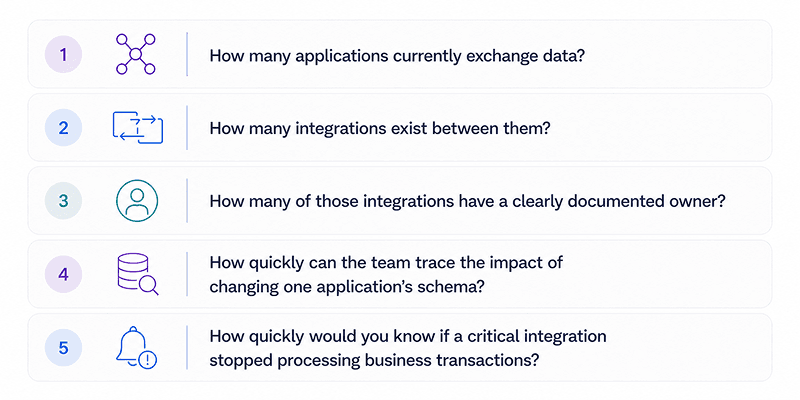
If your team cannot answer these questions without a significant investigation, the problem is already bigger than connectivity.
Point-to-Point Isn't Always the Problem
It is tempting to conclude that point-to-point integration is inherently bad. That would be the wrong lesson.
A direct connection between two stable systems can be perfectly reasonable. If there are only a handful of applications, the interfaces rarely change, ownership is clear, and the integration is not business-critical, introducing another architectural layer may create more complexity than it removes.
The problem starts when point-to-point becomes the default answer to every new integration requirement.
When direct integration can still make sense
| Situation | Point-to-point fit |
| Small number of applications | Often reasonable |
| Stable interfaces | Often reasonable |
| Low change frequency | Often reasonable |
| Clear ownership | Often reasonable |
| Few downstream dependencies | Often reasonable |
| Rapidly growing application estate | Often reasonable |
| Multiple teams consuming the same data | Poorer fit |
| Frequent schema or business-rule changes | Poorer fit |
| Mission-critical workflows with many dependencies | Poorer fit |
| No central visibility or ownership | Poorer fit |
The architectural question is therefore not: "Should we eliminate point-to-point integration?" It is: "At our current scale and rate of change, is the simplicity of another direct connection worth the dependency it creates?"
That is a much more useful enterprise application strategy question. For organizations that have crossed that threshold, a shared integration layer can reduce duplication and centralize capabilities. Depending on the environment, that might mean an enterprise service bus, hub-and-spoke architecture, iPaaS, API gateway, event-driven architecture, or a combination of approaches.
The technology matters. But the architectural principle matters more: don't keep adding independent dependencies without a plan for how those dependencies will be governed and maintained.
What Integration Debt Is Actually Costing You
Integration debt rarely appears as a line item called "integration debt." Instead, it shows up as engineering hours, delayed releases, production incidents, duplicated work, inconsistent data, and projects that take longer than expected. That makes it particularly easy to underestimate.
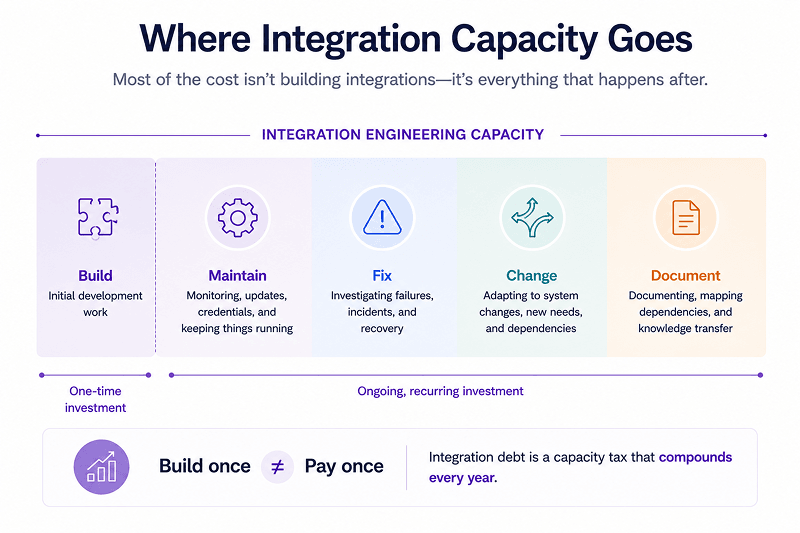
The visible cost: maintaining what already exists
Every integration has a lifecycle. Someone has to monitor it, update it when a connected system changes, manage credentials, investigate failures, test modifications, document dependencies, and eventually retire it.
Multiply that work across dozens or hundreds of connections and the maintenance burden becomes substantial. The question for leadership is not simply: "How much did we spend building these integrations?" It is: "How much capacity do these integrations consume every year after they are built?"
That distinction matters because an integration that costs $20,000 to build but requires significant engineering attention for years may be more expensive than its initial project budget suggests. That is why the real value of an integration strategy should be measured by what it enables teams to accomplish, not simply what it costs to implement.
The hidden cost: every change gets harder
The bigger problem is what integration debt does to change. A seemingly simple schema change can become:
Change → dependency discovery → coordination → testing → deployment → monitoring → incident risk → remediation
The more tightly connected the environment, the more people and systems become part of that chain. That is why integration architecture affects product velocity even when no one is actively working on an "integration project."
Poor design can multiply maintenance costs
Technical debt shows up in people's day-to-day work: more time spent troubleshooting, more rework, and less time building what matters. One study of 653 industry responses found that 25% of development effort goes toward technical-debt-related issues, including rework and delivery delays.
For integration teams, the takeaway is simple: a shortcut that saves time today can become tomorrow's maintenance burden. As systems change and dependencies grow, your team inherits the complexity created by earlier decisions.
The "$3.1 trillion" figure needs a correction
You will often see a claim that poor data quality or data silos cost the U.S. economy $3.1 trillion per year, sometimes attributed to McKinsey. That attribution is wrong.
The figure comes from a 2016 analysis associated with IBM and was popularized by Thomas C. Redman in Harvard Business Review. It is also more than a decade old, so it should not be presented as a current measure of what enterprise integration problems cost today.
The lesson is bigger than the statistic itself: don't build an enterprise business case around numbers simply because they have been repeated often.
Build your own integration business case instead
For an organization evaluating modernization, a simple internal calculation can be more useful:
Annual integration burden =
Engineering capacity spent on maintenance
- integration-related incident and recovery costs
- delayed project or release costs
- cost of duplicated integration work
- measurable business impact from data errors or delays
For example, if ten engineers collectively spend 30% of their time maintaining integrations, you are not dealing with a small technical inconvenience. You are effectively allocating three full-time engineering roles to keeping existing connections operational.
That gives leadership something much more actionable than an industry-wide headline. Gartner estimates that poor data quality costs organizations at least $12.9 million a year on average. When your teams are working with inconsistent data across disconnected systems, they spend more time finding, fixing, and reconciling information instead of using it to move the business forward.
Fix the Failure You're Actually Experiencing
There is no universal sequence for improving an enterprise integration architecture. The right starting point depends on what is hurting your organization today. Instead of treating every integration best practice as equally important, start with the failure mode.
If your team is drowning in maintenance, reduce integration sprawl
If engineers spend more time keeping integrations alive than building new capabilities, the immediate problem is probably dependency sprawl. Start by mapping:
- Which applications are connected?
- Which integrations are business-critical?
- Which connections duplicate existing capabilities?
- Which interfaces have multiple consumers?
- Which integrations have no clear owner?
Then consider whether a shared integration layer can consolidate common capabilities.
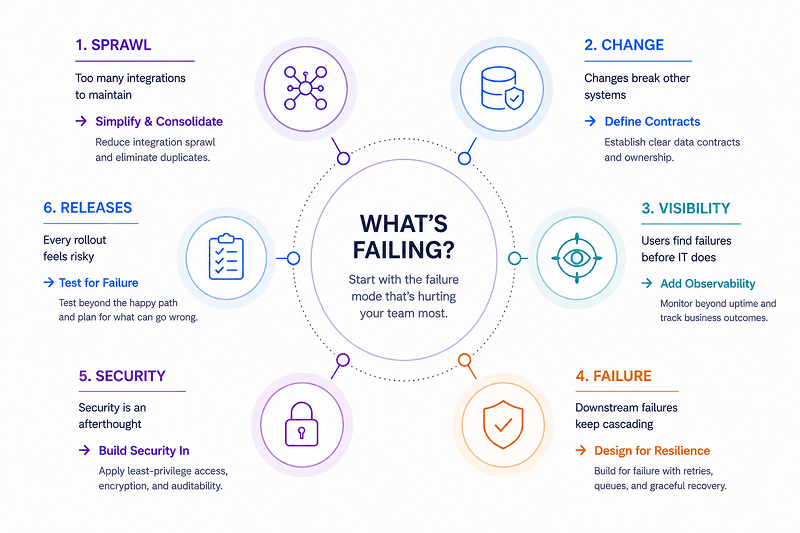
If changes keep breaking other systems, establish contracts and data ownership
A recurring integration failure is often a data problem disguised as an API problem. Suppose three systems each store a customer record differently. One calls a field customer_status, another calls it account_state, and a third derives it from several other fields.
Adding another connection does not solve the underlying inconsistency. You need clear contracts around:
- Data definitions.
- Schema ownership.
- Versioning.
- Required and optional fields.
- Backward compatibility.
- Source-of-truth systems.
- How changes are communicated to consumers.
A canonical data model can help when many systems need a consistent representation of shared business entities. But don't introduce one automatically. The model itself becomes something you have to govern. ca
If users discover failures before IT does, build observability into the integration
An integration can be technically healthy and still fail the business. An API may return a successful response while a downstream transaction is rejected, delayed, duplicated, or never completed. That is why monitoring should go beyond uptime. The same operational discipline that helps teams detect and resolve application issues early is critical for integration environments.
A mature integration monitoring approach should answer:
| Question | What you need to know |
| Is the integration running? | Technical health |
| Is data moving? | Transaction health |
| Is the business process completing? | Business outcome |
| Where did the failure occur? | Traceability |
| Who owns the issue? | Accountability |
| What happens next? | Recovery procedure |
Build monitoring and alerting from the beginning, not after the first major incident. Your engineers should not have to discover a broken integration through a customer complaint.
If downstream failures keep cascading, design for resilience
When one system goes down, your team should not have to spend the next few hours figuring out what broke and what to restart.
Enterprise systems will fail. Networks slow down. APIs time out. SaaS platforms become unavailable. What matters is how much of that failure your people and customers actually feel.
The right resilience pattern depends on what you need the system to do:
- Use timeouts when a slow dependency could leave your team or users waiting indefinitely.
- Use retries for temporary failures, but pair them with idempotency so the same transaction is not processed twice.
- Use queues and asynchronous processing when work can continue without waiting for another system to respond.
- Use dead-letter handling when a message keeps failing and needs to be separated for someone to investigate.
- Use circuit breakers when repeated failures could spread to other systems, with a clear fallback or recovery path in place.
- Use graceful degradation when the business can keep moving even if some functionality is temporarily unavailable.
- Have recovery procedures for failures that cannot be resolved automatically and need someone to step in.
The goal is not to add every resilience pattern to every integration. It is to make sure one system's failure does not become everyone's problem.
Ask a simple question: What happens if the system on the other side of this integration is unavailable for the next 30 minutes? If the answer is "the whole workflow stops," you have found something worth fixing.
If security is an afterthought, make it part of the integration architecture
Security should not be a checklist added immediately before deployment. Every integration should establish:
- Who can access the interface.
- What they can access.
- Which data they can retrieve or modify.
- How credentials and secrets are managed.
- How access is authenticated.
- How authorization is enforced.
- How activity is logged and audited.
OAuth2, JWTs, zero-trust principles, encryption, and least-privilege access can all be part of the solution, but the technology should follow the access model. If you cannot, security is not yet an architectural property of your integration layer.
If every rollout feels risky, test integrations for failure, not just functionality
An integration that works in a controlled test environment has only demonstrated the happy path. Enterprise integration testing should also consider:
- chema changes.
- Invalid data.
- High transaction volumes.
- Slow dependencies.
- Dependency outages.
- Duplicate requests.
- Retry behavior.
- Version incompatibility.
- Partial failures.
- Rollback scenarios.
Contract testing is particularly valuable when multiple teams own systems that evolve independently.
The standard should be simple. Don't ask only whether the integration works. Ask what happens when it doesn't.

Integration Needs an Operating Model, Not Just an Architecture
Even a well-designed integration architecture can deteriorate without clear ownership. Someone needs to decide which standards apply. Someone needs to maintain shared components. Someone needs to know when a critical integration fails. Someone needs to decide whether a new connection should be built or an existing capability reused.
That is an operating-model problem.
What should the integration team actually own?
A dedicated integration or platform function does not need to own every application. It can instead own the shared capabilities and standards that individual product teams should not have to reinvent. That may include:
- Integration standards.
- API and interface governance.
- Shared connectors and reusable components.
- Integration cataloging.
- Monitoring standards.
- Security patterns.
- Developer tooling.
- Architecture reviews for high-risk integrations.
- Retirement of obsolete connections.
This shift is increasingly visible in platform engineering. Gartner projects that by 2026, 80% of large software engineering organizations will have platform engineering teams, up from 45% in 2022. These teams provide reusable services, components, and tools that take some of the underlying complexity off developers' plates, helping them spend less time navigating fragmented technology and more time delivering business value.
The important lesson for integration teams is not that every company needs a new platform-engineering department. It is that shared infrastructure needs an accountable owner.
Centralized or federated?
Neither model is universally correct.
| Model | Strength | Risk |
| Centralized | Consistent standards and stronger governance | Can become a bottleneck |
| Federated | Greater domain ownership and team autonomy | Standards can diverge |
| Hybrid | Shared platform with domain-level ownership | Requires clear boundaries |
For many enterprises, a hybrid model is practical: a central team provides the platform, standards, security patterns, and observability, while domain teams retain responsibility for their business processes and data. The goal is not to centralize every decision. It is to make ownership visible.
Your Integration Layer Has a New Consumer: AI
For decades, enterprise integrations were largely designed around applications serving human users. That assumption is changing.
Gartner predicted that by 2026, more than 30% of the increase in API demand would come from AI and tools using large language models. IBM also cites this Gartner projection in its current discussion of API automation.
That means your integration architecture is increasingly likely to serve software that can retrieve information, invoke capabilities, and coordinate workflows without a person manually initiating every interaction.
What changes when an AI agent becomes the consumer?
Consider the difference:
Traditional:
Human → Application → API → Data
Agentic:
AI agent → Tool/API → Enterprise system → Data or action
An agent needs more than connectivity. It needs interfaces that are:
- Discoverable.
- Structured.
- Predictable.
- Properly authenticated.
- Appropriately authorized.
- Observable.
- Auditable.
- Safe to invoke.
This changes how you should think about APIs and other integration interfaces. The question is no longer only:
"Can our applications communicate?"
It is increasingly:
"Can a machine safely discover and use this capability without creating ambiguity, unauthorized access, or uncontrolled actions?"
Protocols such as MCP are part of this emerging landscape, but the broader architectural shift matters more than any individual protocol. When designing a new integration, add one more question to the architecture review: Could an AI agent safely discover, understand, access, and act through this integration?
If the answer is no, that may not be a reason to redesign it today. But it is worth understanding what assumption is making it human-dependent.
What Should You Fix First?
You do not need to modernize your entire integration estate simultaneously. In fact, trying to do so can create another large transformation program without solving the underlying problems.
Start with the failure that is consuming the most capacity or creating the most risk.
| What you're experiencing | Likely underlying problem | Start here |
| Engineers spend most of their time maintaining integrations | Point-to-point sprawl | Reduce dependencies and introduce shared integration capabilities |
| One application change breaks several others | Weak contracts or unclear data ownership | Establish interface contracts, versioning, and ownership |
| Users discover failures before IT | Poor observability | Add transaction-level and business-level monitoring |
| One unavailable system causes cascading failures | Weak resilience | Add appropriate retries, queues, idempotency, and recovery paths |
| Security is added just before launch | Security treated as an implementation detail | Build access control into the architecture |
| Every team builds integrations differently | Fragmented governance | Establish shared standards and accountable platform ownership |
| Releases repeatedly cause integration incidents | Insufficient testing | Add contract, scale, failure, and rollback testing |
| AI initiatives struggle to access enterprise systems safely | Interfaces were not designed for machine consumers | Evaluate agent-ready APIs and governed tool access |
Conclusion: Make Integration Complexity Easier to Live With
Enterprise integration is not really a problem of how many connections you have. It is a problem when those connections start making it harder for your people to build, change, and operate the business.
When engineers need to trace five systems to understand one change, when a failure becomes an investigation instead of an alert, or when critical integration knowledge sits with one person, the architecture is already costing you more than its implementation budget suggests.
That is why enterprise application integration best practices should start with the reality your teams are facing, not with a technology checklist. Reduce the dependencies creating unnecessary work. Make ownership and data contracts clear. Build for failure, not just the happy path. And create an integration foundation that can evolve as your applications, business, and AI capabilities evolve.
You do not need to fix everything at once. Start with the complexity that is costing your people the most. If you're ready to understand where that complexity is coming from, let's talk!
Frequently Asked Questions
1. What is the difference between ERP and enterprise application integration (EAI)?
An ERP is an enterprise application that manages core business processes such as finance, procurement, inventory, and operations. Enterprise application integration (EAI) is the architecture and technology used to connect an ERP with other applications so data and processes can move between them.
For example, an ERP may remain the system of record for financial data while CRM, e-commerce, HR, analytics, and other applications exchange information with it through an EAI architecture.
2. Are enterprise integration patterns still relevant?
Yes. The problems they solve are still very real. Systems need to share data, handle failures, support asynchronous work, and keep processes moving across different platforms.
What has changed is the technology. Instead of relying mainly on traditional ESBs, teams now use APIs, message brokers, event-driven architectures, cloud platforms, and iPaaS tools.
The patterns still matter because they help teams make these connections more reliable and easier to manage. The key is choosing the right pattern for the problem, rather than following a pattern just because it is familiar or new.
3. What are enterprise integration services?
Enterprise integration services are capabilities that connect applications, systems, data, and business processes across an organization. They can include API integration, application-to-application integration, data transformation, messaging, event integration, workflow orchestration, monitoring, security, and integration management.
They may be delivered through an internal integration platform, an iPaaS, an enterprise service bus, or external enterprise application integration service providers.
4. What are the latest trends in enterprise application integration solutions?
The biggest shift is that enterprise integration is moving beyond simply connecting applications. Organizations increasingly need integration architectures that can support cloud and SaaS environments, APIs, event-driven workflows, real-time data exchange, and AI-driven applications.
AI agents are particularly important because they introduce a new type of integration consumer. Instead of a person using an application that calls an API, an AI agent may need to discover a capability, retrieve enterprise data, or initiate an action through an interface. That makes discoverability, authorization, observability, auditability, and predictable interfaces increasingly
important.
Other important trends include greater use of iPaaS platforms, API-led integration, event-driven architecture, reusable integration components, stronger observability, and platform engineering.
The practical takeaway is that organizations should not adopt a new integration technology simply because it is newer. The better approach is to evaluate whether the architecture makes integration easier to govern, reuse, secure, monitor, and change.
5. How do you choose the right enterprise application integration architecture?
Start with the business and operational problem, not the integration technology.
Evaluate the number of systems involved, how frequently they change, the volume and speed of data exchange, reliability requirements, security requirements, ownership, and how critical the integrated process is to the business.
For example, a small number of stable applications may not require a sophisticated integration platform. A large environment with frequent changes, multiple teams, shared data, and hundreds of dependencies may benefit from a more centralized integration layer, iPaaS, API-led architecture, event-driven design, or a combination of approaches.
A useful decision framework is:
Scale → Change frequency → Criticality → Data complexity → Reliability → Ownership → Security
Then evaluate the available enterprise application integration tools against those requirements. The right enterprise integration architecture is the one that reduces complexity and makes the environment easier to operate and change. It is not necessarily the architecture with the most sophisticated technology.
6. Can legacy systems be integrated with modern cloud applications?
Yes. Legacy systems can often be integrated with modern cloud applications using APIs, middleware, integration platforms, message queues, adapters, or event-based approaches.
The challenge is usually not whether integration is technically possible. It is managing limitations such as outdated interfaces, proprietary protocols, batch processing, poor documentation, security constraints, and unclear ownership.
A phased approach lets organizations connect legacy systems while gradually modernizing the underlying architecture.
7. How much does enterprise application integration cost?
There is no reliable single price for enterprise application integration. Cost depends on the number and complexity of applications, integration patterns, data volumes, security requirements, legacy constraints, tooling, testing, and ongoing maintenance.
A useful business case should account for both implementation cost and lifetime integration cost, including maintenance, monitoring, incident response, and future changes.
8. How long does an enterprise application integration project take?
The timeline depends on scope. A small integration between two well-documented applications may take weeks, while a complex enterprise integration program involving legacy systems, multiple business domains, data migration, security requirements, and extensive testing can take months or longer.
The number of connections alone is not a reliable predictor. Dependency complexity, data quality, system readiness, ownership, and testing requirements often have a greater impact on the timeline.
Weekly Insights Subscription
Stay ahead with Clarient insignts on customer insights
Share
Written by

Parthsarathy Sharma
With 4+ years of experience across AI, UX, enterprise technology, and brand strategy, Parthsarathy brings a research-driven lens to digital experience content. His work focuses on turning emerging technology, customer experience, and business trends into clear, practical perspectives for readers.
Reviewed by

Rameshwar
Rameshwar is a technology leader with 15+ years of experience across software architecture, product engineering, cloud, and AI. He helps organizations turn emerging technologies into secure, scalable, production-ready solutions that solve real business challenges.