Product Engineering
Cross-industry
How Much Does Custom Software Development Cost? Complete Pricing Guide for 2026
Published on August 26, 2026

table of content
- Introduction
- How Much Does Custom Software Cost in 2026?
- Why Can Three Vendors Quote $50K, $200K, and $400K for the Same Project?
- The Real Risk Isn't the Quote. It's What Happens After It.
- Does AI Actually Make Custom Software Cheaper?
- Before You Sign: How to Read a Software Quote Like a Buyer
- Should You Build Custom Software at All?
- Conclusion: The Cost of Custom Software Is More Than the Development Quote
- Frequently Asked Questions
listen to blog
summary
Learn how much custom software costs in 2026, what drives pricing, why projects go over budget, and how to compare development quotes.
Introduction
If you're budgeting for custom software, you probably want a simple answer: how much will it cost?
In 2026, most custom software projects fall somewhere between $30,000 and $200,000, depending on what you're building. A relatively simple MVP may start around $15,000, while complex enterprise platforms, AI-driven products, or highly regulated systems can run beyond $500,000.
But there is a problem with treating that range as the answer.
You could ask three software development companies to build what appears to be the same product and receive quotes of $50,000, $200,000, and $400,000. Which one is right?
More importantly, which one is actually cheaper?
That is the question most software pricing guides don't answer. They give you rates, project ranges, and pricing models, but rarely explain what happens when the original estimate meets the reality of development.
This guide takes a buyer-first approach. We'll look at what custom software development costs in 2026, why estimates vary so widely, what decades of research tell us about overruns, how AI is actually changing development economics, and how to compare software quotes without simply choosing the lowest number.
How Much Does Custom Software Cost in 2026?
Let's start with the number you're looking for. A reasonable 2026 planning range looks like this:
| Project type | Typical cost range | What usually drives the cost |
| MVP or simple application | $15,000–$75,000 | Core features, limited workflows, fewer integrations |
| Mid-complexity product | $40,000–$200,000 | Multiple users, workflows, integrations, broader functionality |
| Enterprise or AI-driven platform | $200,000–$500,000+ | Scale, security, compliance, complex integrations, AI |
These are planning ranges, not fixed market prices. Industry survey data places many custom software projects between $30,000 and $200,000, while complex enterprise and AI-driven systems can move well beyond that range.
The more useful question is therefore not, "What is the average cost of custom software?"
It is: "What makes my project more likely to land at the lower or higher end of the range?"
What Does Custom Software Cost to Own?
The number on the proposal is not the whole investment.
If you're approving a $200,000 software project, it helps to think beyond the day the product goes live. Someone still needs to keep it secure, available, updated, and useful as your business changes.
That can mean ongoing costs for:
- Maintenance: Fixing bugs, applying security patches, and keeping dependencies up to date
- Hosting and infrastructure: Running the servers, databases, storage, and monitoring the software needs
- Support: Helping users and resolving issues when something goes wrong
- Future development: Adding features, integrations, or changes as your needs evolve
As a planning benchmark, annual software maintenance is often estimated at around 15% to 25% of the original development cost, although the actual amount depends on the software and how much it changes over time.
So, if you spend $200,000 building the software, you could be looking at another $30,000 to $50,000 a year in maintenance alone, before hosting, support, or major new development.
That's why it is worth looking at total cost of ownership (TCO) before you approve a project. The better question isn't just "Can we afford to build this?" It is "Can we afford to run and evolve it?"
What actually drives custom software development cost?
Several factors have an outsized effect on the estimate.
Complexity matters first. A straightforward internal workflow is very different from a platform supporting multiple business processes, user types, permissions, reporting requirements, and complex business logic.
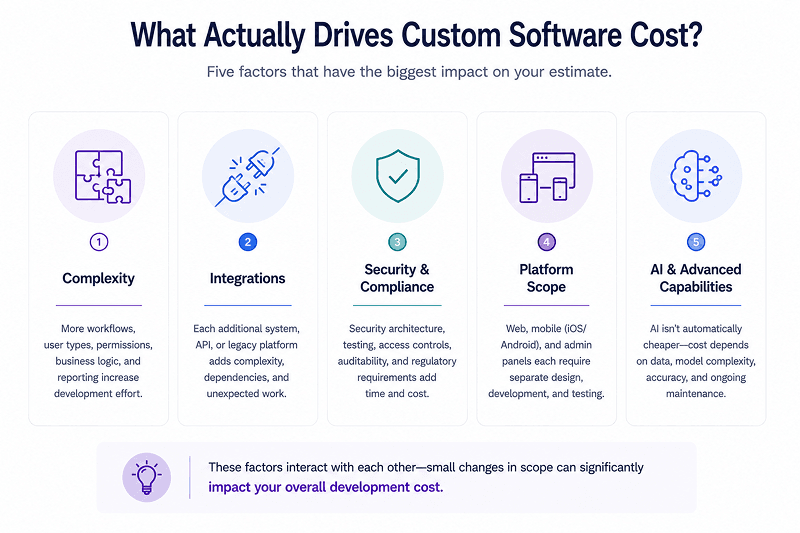
Integrations can also change the economics quickly. Connecting to one stable API is one thing. Connecting to multiple legacy systems, payment providers, ERP platforms, identity systems, or third-party data sources introduces more dependencies and more opportunities for unexpected work.
Security and compliance add another layer. If your software handles sensitive business information or operates in a regulated environment, security architecture, testing, documentation, access controls, auditability, and compliance requirements become part of the development effort.
Then there is platform scope. Building for web is different from building for web, iOS, Android, and internal administration simultaneously. AI can also affect the estimate, but not as simply as "AI makes software cheaper." We'll come back to that.
Does location determine the cost?
Regional development rates remain an important part of custom software development pricing. Current market guides commonly show higher senior rates in the US and Western Europe and lower rates across parts of Eastern Europe and Asia.
But treating location as a discount table is a mistake.
You are not only buying engineering hours. You are also buying communication, technical expertise, domain knowledge, time-zone overlap, project continuity, and the ability to work through ambiguity.
A lower hourly rate can become expensive if it creates more rework, slower decisions, or greater coordination overhead. The cheapest hour is not necessarily the cheapest project. The right development partner also depends on how you source and retain the technical talent behind the project.

Why Can Three Vendors Quote $50K, $200K, and $400K for the Same Project?
If you've ever compared software proposals, you've probably experienced this.
You send the same requirements document to several vendors and get dramatically different numbers back.
It can be tempting to assume that one company is overcharging or another is simply giving you a bargain. Often, neither conclusion is correct. The problem is that you may not actually be comparing the same project.
You're not always comparing the same scope
One proposal may include product discovery, UX design, architecture, testing, deployment, security, and post-launch support. Another may primarily cover development. A third may include additional contingency because the vendor sees significant technical uncertainty in your requirements.
That creates a very different cost breakdown even when the project descriptions look similar. Before comparing numbers, compare what sits underneath them.
The same applies when AI capabilities are part of the scope, where the difference between a basic chatbot and a production-ready customer support solution can significantly affect the overall investment.
Compare this | Questions to ask |
Discovery | How much time is allocated to understanding requirements and risks? |
Design | Are UX and UI included? |
Development | What features and platforms are covered? |
Integrations | Which systems and APIs are included? |
QA | What level of testing is included? |
Deployment | Who handles infrastructure and release? |
Support | What happens after launch? |
Changes | How are changes to scope priced? |
How the pricing model changes your risk
The three most common pricing approaches each shift risk differently.
Fixed-price development gives you greater cost predictability when the scope is well defined. The tradeoff is that changes can become expensive, and vendors may protect themselves by building contingency into the estimate.
Time-and-materials pricing provides more flexibility as requirements evolve. You pay for the work performed, but your final cost is less certain at the beginning.
Dedicated teams make sense when the product is expected to evolve continuously, and you need ongoing engineering capacity rather than a single defined project.
None is automatically better. The right model depends on how well you understand the work you are asking someone to build.
The hidden variable is uncertainty
This is one of the most important ideas to understand when reviewing a software estimate. A vendor is not only estimating the work it can see. It is also making assumptions about the work it cannot see yet.
- How stable are your requirements?
- How difficult will an integration be?
- How many stakeholders will change their minds?
- How much rework might be required?
The less certain those answers are, the more risk a vendor has to account for. That means a quote is not simply a price for writing code. It is also a price for the level of uncertainty the vendor expects to manage.
The Real Risk Isn't the Quote. It's What Happens After It.
Getting the estimate right matters. But what happens after you approve it matters just as much.
A project can start with a number that looks reasonable and still end up costing more, taking longer, or delivering less than expected. A McKinsey and Oxford Global Projects analysis of 6,003 IT projects completed between 2001 and 2017 found that projects exceeded their budgets by 75% on average, ran 46% over schedule, and delivered 39% less value than predicted.
The data isn't a forecast for your 2026 project. But it points to something buyers still need to account for: the number on the first proposal is not the same thing as the cost you will eventually pay.
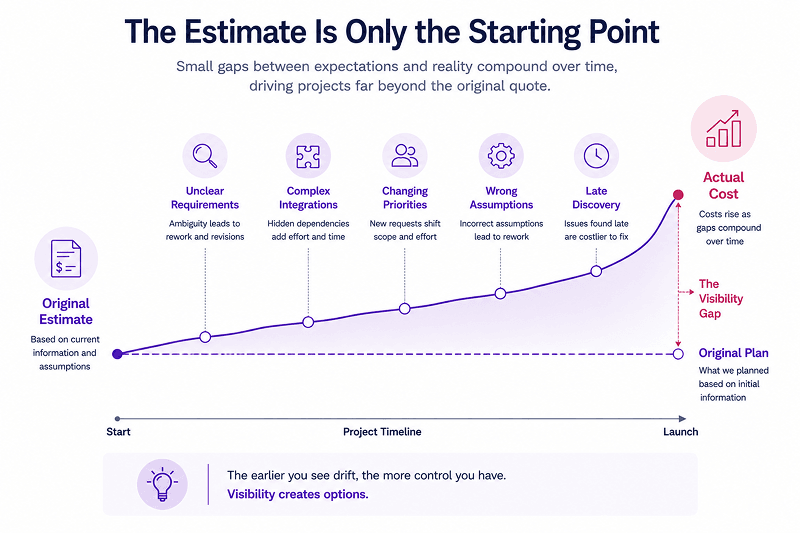
Why do software projects move away from their original estimate?
Usually, it isn't one dramatic mistake. It is a series of smaller gaps between what everyone expected and what the project actually required.
- Requirements weren't clear enough.
- A critical integration turned out to be more complicated.
- A stakeholder changed a priority.
- An assumption about an existing system proved incorrect.
- A problem was discovered late because nobody had a meaningful checkpoint earlier.
Each issue may be manageable on its own. Together, they can materially change the economics of a project.
The black swan problem
The most worrying projects are not those that finish 5% or 10% over budget. They are the ones where problems compound until the original business case no longer holds.
The McKinsey/Oxford research found that 17% of the large projects it studied experienced extreme overruns of 200% to 400%. For an enterprise approving a $250,000 project, a 300% overrun is not a minor budget adjustment. It can change whether the project should continue at all.
That is why experienced buyers should ask a different question: "How will we know early if this project is drifting away from the original estimate?"
The best protection is earlier visibility
You cannot eliminate uncertainty from software development. You can make it visible sooner.
That means investing appropriately in discovery, breaking large initiatives into manageable phases, defining what "done" means, and establishing regular checkpoints where business and technical stakeholders can decide whether to continue, change direction, or stop.
The objective isn't to predict every problem six months in advance. It is to avoid discovering a major problem six months too late.
Does AI Actually Make Custom Software Cheaper?
AI has changed software development. But that does not mean you can simply subtract an "AI discount" from your development estimate.
In fact, McKinsey research has found that generative AI can help developers move faster, particularly on routine and repetitive coding tasks. But developers still spend much of their time solving problems that require context, judgment, and experience. AI may help write the code, but understanding an unfamiliar system, making architecture decisions, and debugging complex problems still depend heavily on people.
Where AI can genuinely reduce development effort
AI can be particularly useful for repetitive and well-defined tasks, such as:
Boilerplate code
Routine implementation
Documentation
Some testing activities
Code assistance and refactoring
These gains can improve developer productivity. But software projects are not made up entirely of routine coding.
Where the savings become much smaller
The harder part of software development isn't always writing code. It's understanding what needs to be built, making the right technical decisions, and solving problems when things don't go as planned.
A controlled METR study found that experienced open-source developers took 19% longer to complete tasks with AI coding tools, even though they believed they were working faster. That gap between perceived and measured productivity is worth paying attention to when evaluating an AI-related cost saving.
A later METR study found an 18% speedup under different conditions and with a different group of developers. Rather than showing a simple trend, the two studies highlight that AI's impact depends on the people, tasks, tools, and environment involved.
So if a vendor says, "We'll use AI, so your project will cost 30% less," ask: Which part of the work becomes faster, how much of the project does that represent, and how was the saving measured?
That's a much better way to understand what AI will actually do to your software budget.
The same principle applies beyond development: AI can create savings in one part of the technology stack while introducing new costs elsewhere, particularly as cloud usage scales.
Don't forget the cost of running AI
There is another cost that is easy to miss when you're focused on the build.
Traditional software can have relatively low marginal costs once it is built. AI features can introduce an ongoing variable cost because each interaction may require model inference and compute. Production AI systems may also need evaluation, monitoring, logging, and other infrastructure to keep performance reliable.
That means an AI product needs two budgets: what it costs to build and what it costs to run.
If you're evaluating an AI project, ask not only what the feature will cost to develop, but what happens to that cost as usage grows. That's a much better picture of the investment you're actually making.
Before You Sign: How to Read a Software Quote Like a Buyer
Once you have several proposals in front of you, the temptation is to sort them from cheapest to most expensive. Don't.
Start by making sure you are comparing equivalent commitments.
1. Put every vendor on the same scope
Create a simple comparison before discussing price.
Cost area | Vendor A | Vendor B | Vendor C |
Discovery | Included? | Included? | Included? |
UX/UI |
|
|
|
Development |
|
|
|
Integrations |
|
|
|
QA |
|
|
|
Security |
|
|
|
Deployment |
|
|
|
Post-launch support |
|
|
|
Change requests |
|
|
|
2. Ask what assumptions drive the estimate
A good vendor should be able to explain the estimate without hiding behind a single total. Ask:
- What are the biggest unknowns?
- Which assumptions could change the price?
- Which integrations have not been fully validated?
- What is explicitly outside the scope?
- Where have you included contingency?
If the answer is simply, "That's our standard price," you haven't learned much.
3. Understand how changes will affect the budget
Every project changes. The question isn't whether your requirements will change. It is what happens when they do. Ask how the vendor handles:
- New features
- Changed workflows
- Integration changes
- Design revisions
- Delayed decisions
- Technical discoveries
4. Find out what "done" actually means
A project can be described as complete while major work remains. Does "done" include:
- Production deployment?
- Performance testing?
- Security testing?
- Documentation?
- Training?
- Monitoring?
- Bug fixes?
- Post-launch support?
Get the definition in writing.
5. Look for red flags, not just low prices
Some warning signs deserve more attention than an unusually high hourly rate.
| Potential red flag | Why it matters |
| Vague scope with a fixed price | The estimate may depend on assumptions nobody has validated |
| Extremely low quote | Important work may be excluded |
| No meaningful discovery | Unknowns are likely being pushed into development |
| No checkpoint cadence | Problems may remain hidden for too long |
| Large areas marked "TBD" | The current estimate may not reflect the eventual scope |
| Vendor won't explain assumptions | You have little visibility into how risk is being priced |
The goal isn't to find the vendor with the smallest number. It is to understand the expected cost of the project, including what happens when reality differs from the original plan.
Should You Build Custom Software at All?
There is one question worth answering before you spend weeks comparing development proposals:
do you actually need custom software?
Custom development can make sense when the software supports a process that is strategically important, creates meaningful differentiation, or cannot be handled effectively by existing products.
Buying an off-the-shelf platform may make more sense when the problem is common, well understood, and already solved adequately by the market.
Low-code or no-code tools can also be appropriate for simpler internal workflows where speed and flexibility matter more than building a fully differentiated product. A simple way to think about the decision:
| Build custom when... | Buy when... |
| The capability creates competitive differentiation | The capability is common across businesses |
| Existing products cannot meet critical requirements | Existing products solve the problem adequately |
| You need control over the product or workflow | Speed to implementation matters more |
| The long-term value justifies ownership | Building would create unnecessary complexity |
The important point is this: Don't spend time optimizing the price of building something you shouldn't build in the first place.
Conclusion: The Cost of Custom Software Is More Than the Development Quote
So, how much does custom software development cost in 2026? For many projects, $30,000 to $200,000 is a reasonable starting range, with simpler MVPs potentially costing less and complex enterprise, AI-driven, or highly regulated platforms costing considerably more.
But that number is only the beginning. The real cost depends on what you're building, how clearly you define it, how much uncertainty exists, how changes are handled, and how effectively you and your development partner identify problems before they become expensive.
That is why the cheapest quote isn't necessarily the best quote.
The number on the proposal tells you what someone expects the software to cost. The way the project handles uncertainty tells you what it is actually likely to cost.
If you're evaluating a custom software initiative, Clarient can help you assess the requirements, technology choices, delivery approach, and risks before development begins. The goal is not simply to build software within a number. It is to make sure the investment you're making has a clear business case behind it. Connect with us to get started.
Frequently Asked Questions
1. How much does custom software development cost?
The custom software development cost for most projects falls between $30,000 and $200,000, although the actual investment depends on the scope, complexity, integrations, security requirements, platforms, and development approach. Smaller MVPs may start around $15,000, while complex enterprise, AI-driven, or highly regulated platforms can exceed $500,000. Understanding custom enterprise software development cost requires looking beyond the initial estimate to consider ongoing infrastructure, maintenance, support, and other ownership costs.
2. How can you reduce the cost of custom software development projects?
The best way to reduce the cost of custom software development projects is not necessarily to choose the lowest custom software development hourly rate. Start with clear requirements, invest appropriately in discovery, prioritize high-value features, and deliver the project in manageable phases. A well-defined custom software development process can also reduce rework and help identify technical or scope-related problems earlier. Choosing the right technology, development team, and pricing model can further improve cost predictability.
3. Are there affordable options for custom software development?
Yes. Custom development can be made more affordable by starting with an MVP, limiting the initial scope, reusing proven components and APIs, or considering low-code solutions for simpler applications. Organizations should also look at custom software development pricing across different vendors, but avoid choosing based solely on hourly rates. A lower rate can result in a higher overall project cost if it leads to more rework, weaker communication, or longer delivery times.
4. Are there reliable tools or calculators to estimate software project expenses?
Online calculators can provide a useful starting point, but they should not be treated as a definitive estimate. Most tools rely on broad inputs such as features, complexity, platforms, and location. A more reliable approach to how to estimate software development cost is to define the scope, identify integrations and technical requirements, assess uncertainty, and estimate the work across discovery, design, development, testing, deployment, and support. A detailed software development cost breakdown gives decision-makers a much clearer picture than a generic calculator.
5. How long does it take to develop custom software?
The custom software development process can take anywhere from a few months for a focused MVP to considerably longer for complex enterprise platforms. The timeline depends on scope, feature complexity, integrations, platforms, security and compliance requirements, team size, and how quickly stakeholders make decisions. Development time and cost are closely connected, so compressing the schedule may increase the budget if it requires additional resources or creates delivery risks. A realistic estimate should therefore consider both the software development cost breakdown and the expected timeline.
6. What factors have the biggest impact on custom software development costs?
The biggest custom software development cost factors are scope and complexity, integrations, security and compliance requirements, platform requirements, AI functionality, and the level of uncertainty in the requirements. The team's location and custom software development hourly rate also affect the estimate, but the lowest rate does not necessarily produce the lowest total cost. Organizations should evaluate expertise, communication, delivery approach, expected rework, and long-term support alongside the hourly rate.
7. How does custom software development compare with buying off-the-shelf software?
A custom software development vs. off-the-shelf cost comparison should look beyond the initial purchase or development price. Custom software may require a larger upfront investment, but it can make sense when an organization needs unique workflows, competitive differentiation, greater control, or capabilities that existing products cannot provide. Off-the-shelf software can be more economical when the business problem is common and existing platforms meet the requirements adequately. The right decision depends on the total cost of ownership and the business value the software is expected to create, not simply the lowest upfront price.
8. Is custom software worth the investment for small and mid-sized businesses?
Custom software can be worthwhile for small and mid-sized businesses when it solves a strategically important problem, supports a unique business process, or creates a meaningful competitive advantage. However, custom development is not automatically the best option. A custom software development vs. off-the-shelf cost comparison should consider development, maintenance, infrastructure, licensing, support, and future enhancements alongside the expected business value. If an existing SaaS or low-code solution can solve the problem effectively, buying may provide better value.
Weekly Insights Subscription
Stay ahead with Clarient insignts on customer insights
Share
Written by

Parthsarathy Sharma
With 4+ years of experience across AI, UX, enterprise technology, and brand strategy, Parthsarathy brings a research-driven lens to digital experience content. His work focuses on turning emerging technology, customer experience, and business trends into clear, practical perspectives for readers.
Reviewed by

Rameshwar
Rameshwar is a technology leader with 15+ years of experience across software architecture, product engineering, cloud, and AI. He helps organizations turn emerging technologies into secure, scalable, production-ready solutions that solve real business challenges.