back to impact
improving hereditary cancer screening through mobile ux
designing a mobile experience that helps patients understand inherited cancer risk, navigate testing, and make informed decisions with greater clarity.
+30%
increase in patient engagement

industry
healthcare
type
genetic testing and patient engagement platform
mandate
mobile ux
the context
understanding inherited cancer risk can be difficult when testing, family history, results, and next steps sit across disconnected experiences. our client wanted to make genetic screening easier to navigate and understand.
clarient helped transform that vision into a mobile experience that connects testing, education, family tracking, and ongoing patient support.

the opportunity
our client partnered with clarient to create a mobile experience that could make hereditary cancer screening more accessible, understandable, and actionable. the platform needed to bring testing, risk assessment, family history, appointments, billing, results, and education into one connected journey.
clarient brought together user research, ux strategy, information architecture, interaction design, prototyping, and a modular design system to create an experience that could support patients from initial assessment through testing, results, and next steps.
our contributions
User ResearchUX Strategy and UI DesignInformation ArchitectureRisk Assessment UXInteractive PrototypingDesign System CreationReport and Results DesignAlerts and Communication Design
what needed to change
patients needed more than a way to complete a genetic test. they needed help understanding their risk, tracking family history, interpreting results, and knowing what to do next. the existing experience left these needs fragmented across assessments, appointments, reports, and communication.
the new experience had to simplify complex information, make hereditary risk easier to understand, connect family referrals, and give patients clearer guidance throughout the screening and care journey.
how we designed for it
we mapped the complete patient journey from first interaction to report review, identifying where clarity, education, and guidance could make the greatest difference.
make risk easier to understand
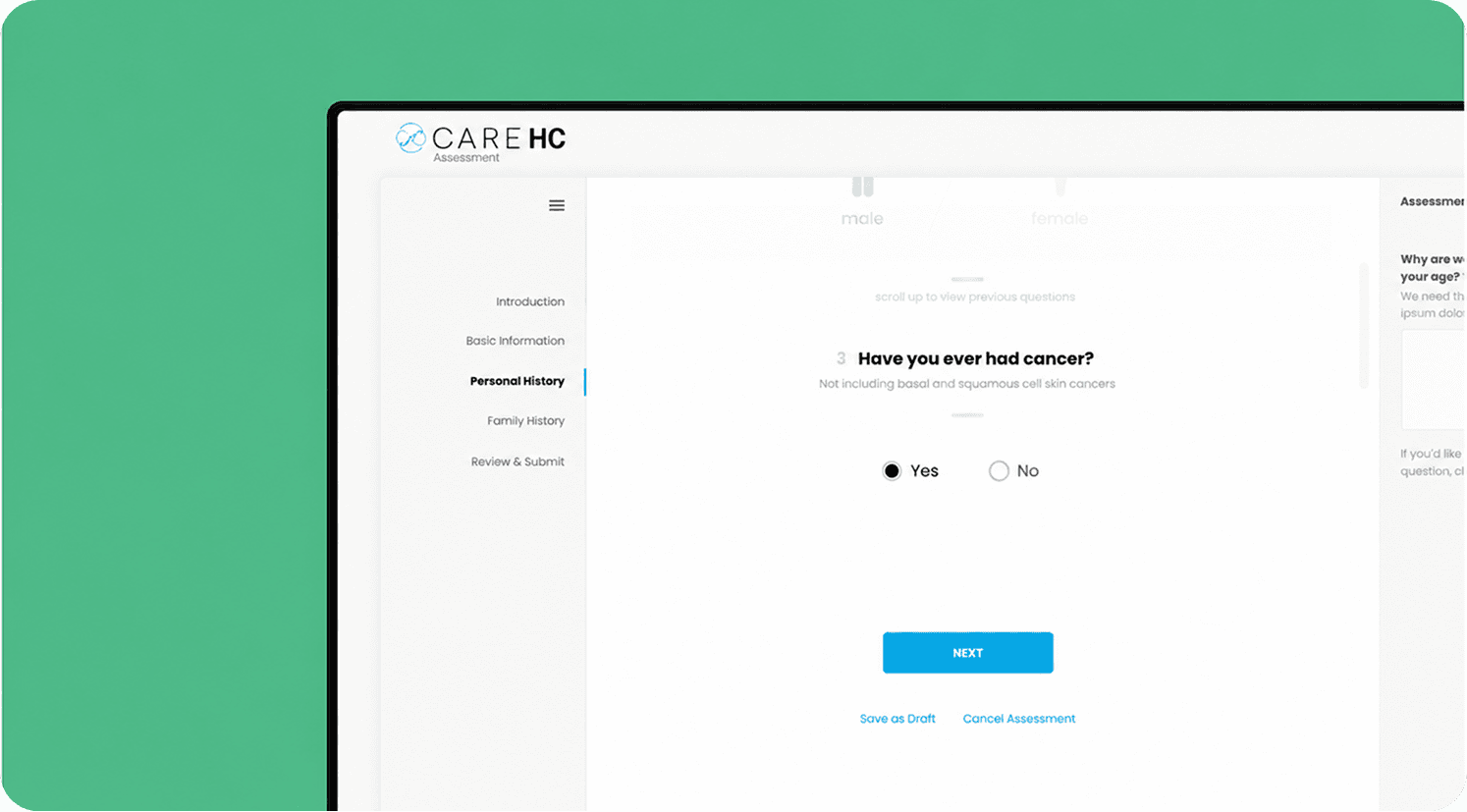
we redesigned assessment journeys to capture detailed personal and family history without making the process feel overwhelming.
the information architecture created a clearer path through complex screening requirements.
connect the entire journey
testing, appointments, billing, family tracking, results, and communication were brought into a more cohesive experience.
this reduced the need for patients to navigate between disconnected tasks and information.
design for understanding
we created interactive prototypes to validate reports, alerts, education, and next-step guidance with the experience centered around what patients needed to understand and act on.
make risk easier to understand
we redesigned assessment journeys to capture detailed personal and family history without making the process feel overwhelming.
the information architecture created a clearer path through complex screening requirements.
connect the entire journey
testing, appointments, billing, family tracking, results, and communication were brought into a more cohesive experience.
this reduced the need for patients to navigate between disconnected tasks and information.
design for understanding
we created interactive prototypes to validate reports, alerts, education, and next-step guidance with the experience centered around what patients needed to understand and act on.
the connected experience
our client partnered with clarient to turn a complex hereditary cancer screening journey into a mobile experience patients could navigate with greater confidence. together, we connected risk assessments, testing, family tracking, appointments, billing, reports, education, and alerts into one cohesive experience.
clearer workflows made it easier to complete risk assessments, understand results, and know what to do next. family tracking also helped extend the experience beyond the individual, supporting referrals and broader hereditary risk awareness.

the impact went beyond usability: 30% higher patient engagement, 40% more completed risk assessments, 25% more family member referrals, and 15% higher patient retention.
for healthcare organizations navigating complex patient journeys, clarient brings research, product thinking, ux, and technology together to turn complexity into experiences that are easier to understand, easier to use, and built around real outcomes.
complex healthcare journeys become clearer when technology works around patients.